
Nissan Murano: Three-point type seat belt with retractor / Unfastening the seat belts. Checking seat belt operation
Unfastening the seat belts
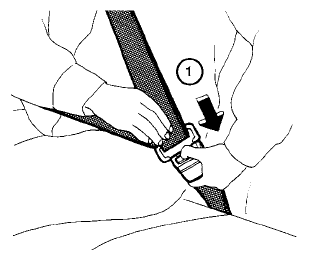
To unfasten the seat belt, press the button
on the buckle  . The seat belt
automatically
retracts.
. The seat belt
automatically
retracts.
Checking seat belt operation
Seat belt retractors are designed to lock seat belt movement by two separate methods:
- When the seat belt is pulled quickly from the retractor
- When the vehicle slows down rapidly
To increase your confidence in the seat belts, check the operation as follows:
- Grasp the shoulder belt and pull forward quickly. The retractor should lock and restrict further belt movement.
If the retractor does not lock during this check, get the system checked. It is recommended that you visit a NISSAN dealer for this service, or to learn more about seat belt operation.
 Fastening the seat belts
Adjust the seat. For additional information,
refer to “Seats” in this section.
Power front seat (if so equipped)
Slowly pull the seat belt out of the retractor
and insert the tongue into the
buckle until you hear and feel
the
latch engage...
 Rear center seat belt
The rear center seat belt has a connector
tongue and a seat belt tongue
. Both
the connector tongue and the seat belt
tongue must be securely latched for
proper seat belt operation...
Other information:
Nissan Murano (Z52) 2015-2024 Service Manual: Engine Control System Symptoms
Symptom Table SYSTEM — BASIC ENGINE CONTROL SYSTEM SYMPTOM Reference page HARD/NO START/RESTART (EXCP. HA) ENGINE STALL HESITATION/SURGING/FLAT SPOT SPARK KNOCK/DETONATION LACK OF POWER/POOR ACCELERATION HIGH IDLE/LOW IDLE ROUGH IDLE/HUNTING IDLING VIBRATION SLOW/NO RETURN TO IDLE OVERHEATS/WATER TEMPERATURE HIGH EXCESSIVE FUEL CONSUMPTION EXCESSIVE OIL CONSUMPTION BATTERY DEAD (UNDER CHARGE) Warranty symptom code AA AB AC AD AE AF AG AH AJ AK AL AM HA Fuel Fuel pump circuit 1 1 2 3 2 2 2 3 2 Diagnosis Procedure Fuel pressure regulator system 3 3 4 4 4 4 4 4 4 4 Work Procedure Fuel injector circuit 1 1 2 3 2 2 2 2 Component Function Check Evaporative emission system 3 3 4 4 4 4 4 4 4 4 System Description Air Positive crankcase ventilation system 3 3 4 4 4 4 4 4 4 4 1 Positive Crankcase Ventilation (PCV) Incorrect idle speed adjustment 1 1 1 1 1 Work Procedure Electric throttle control actuator 1 1 2 3 3 2 2 2 2 2 2 DTC Description, DTC Description Ignition Incorrect ignition timing adjustment 3 3 1 1 1 1 1 1 Work Procedure Ignition circuit 1 1 2 2 2 2 2 2 Component Function Check Power supply and ground circuit 2 2 3 3 3 3 3 2 3 Diagnosis Procedure Mass air flow sensor circuit 1 1 2 2 2 2 2 2 DTC Description, DTC Description Engine coolant temperature sensor circuit 3 3 3 DTC Description, DTC Description Air fuel ratio (A/F) sensor 1 circuit DTC Description, DTC Description, DTC Description, DTC Description, DTC Description Throttle position sensor circuit 2 2 DTC Description, DTC Description, DTC Description, DTC Description, DTC Description Accelerator pedal position sensor circuit 3 2 1 DTC Description, DTC Description, DTC Description, DTC Description Knock sensor circuit 2 3 DTC Description Engine oil temperature sensor 4 2 3 DTC Description, DTC Description Crankshaft position sensor (POS) circuit 2 2 DTC Description Camshaft position sensor (PHASE) circuit 3 2 DTC Description Nissan Murano Vehicle speed signal circuit 2 3 3 3 DTC Description ECM 2 2 3 3 3 3 3 3 3 3 3 DTC Description, DTC Description Intake valve timing control solenoid valve circuit 3 2 1 3 2 2 3 3 DTC Description Intake valve timing intermediate lock control solenoid valve circuit DTC Description Exhaust valve timing control solenoid valve 3 2 1 3 2 2 3 3 DTC Description PNP signal circuit 3 3 3 3 3 DTC Description VIAS control solenoid valve 1 circuit 1 DTC Description VIAS control solenoid valve 2 circuit 1 DTC Description Refrigerant pressure sensor circuit 2 3 3 4 Component Function Check Electrical load signal circuit 3 Component Function Check Air conditioner circuit 2 2 3 3 3 3 3 3 3 3 2 Work Flow ABS actuator and electric unit (control unit) 4 Work Flow 1 - 6: The numbers refer to the order of inspection...
Nissan Murano (Z52) 2015-2024 Service Manual: Operation Inspection
Work Procedure DESCRIPTIONThe purpose of the operational check is to check that the individual system operates normally. Check condition : Engine running at normal operating temperature. OPERATION INSPECTIONCHECK MEMORY FUNCTION Set temperature control (driver side) to 89°F or 90°F (32°C)...
Categories
- Manuals Home
- Nissan Murano Owners Manual
- Nissan Murano Service Manual
- Fuel recommendation
- Intelligent Forward Collision Warning (I-FCW)
- All-Wheel Drive (AWD) (if so equipped)
- New on site
- Most important about car
Fuel gauge
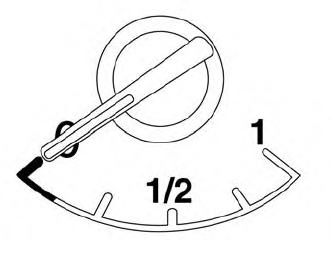
The gauge indicates the approximate fuel level in the tank.
The gauge may move slightly during braking, turning, acceleration, or going up or down hills.
The gauge needle returns to 0 (Empty) after the ignition switch is placed in the OFF position.
