
Nissan Murano: HomeLink® Universal Transceiver (if so equipped) / Reprogramming a single HomeLink® button
Nissan Murano (Z52) 2015-2024 Owners Manual / Instruments and controls / HomeLink® Universal Transceiver (if so equipped) / Reprogramming a single HomeLink® button
To reprogram a HomeLink® Universal Transceiver button, complete the following:
- Press and hold the desired HomeLink® button. DO NOT release the button.
- The indicator light will begin to flash after 20 seconds. Without releasing the HomeLink® button, proceed with “Programming HomeLink®” - Step 1.
For questions or comments, contact HomeLink® at: www.homelink.com or 1–800–355–3515 (except Mexico).
The HomeLink® Universal Transceiver button has now been reprogrammed. The new device can be activated by pressing the HomeLink® button that was just programmed. This procedure will not affect any other programmed HomeLink® buttons.
 Clearing the programmed information
The following procedure clears the programmed
information from both buttons.
Individual buttons cannot be cleared. However,
individual buttons can be reprogrammed...
 If your vehicle is stolen.
If your vehicle is stolen, you should change
the codes of any non-rolling code device
that has been programmed into
HomeLink®. Consult the Owner’s Manual of
each device or call the manufacturer or
dealer of those devices for additional information...
Other information:
Nissan Murano (Z52) 2015-2024 Service Manual: Filament
Inspection and Repair INSPECTIONWhen measuring voltage, wrap tin foil around the top of the negative probe. Then press the foil against the wire with your finger. Attach probe circuit tester (in Volt range) to middle portion of each filament. If a filament is burned out, circuit tester registers 0 or battery voltage...
Nissan Murano (Z52) 2015-2024 Service Manual: P0454 Evap Control System Pressure Sensor
DTC Description DTC DETECTION LOGICECM detects a sloshing signal from the EVAP control system pressure sensor. DTC CONSULT screen terms (Trouble diagnosis content) DTC detection condition P0454 EVAP SYS PRES SEN (Evaporative emission system pressure sensor/switch range/performance) Diagnosis condition — Signal (terminal) Voltage signal transmitted from EVAP control system pressure sensor to ECM Threshold ECM detects a sloshing signal from the EVAP control system pressure sensor Diagnosis delay time — POSSIBLE CAUSE Harness or connectors (EVAP control system pressure sensor circuit is shorted...
Categories
- Manuals Home
- Nissan Murano Owners Manual
- Nissan Murano Service Manual
- Turning the AEB system on/off
- Indicator lights
- Passenger compartment
- New on site
- Most important about car
Luggage hooks
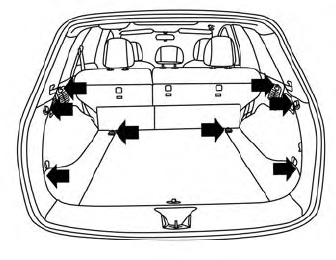
When securing items using luggage hooks located on the back of the seat or side finisher do not apply a load over more than 6.5 lbs. (29 N) to a single hook.
The luggage hooks that are located on the floor should have loads less than 110 lbs. (490 N) to a single hook.

Copyright © 2026 www.nimurano.com