
Nissan Murano: Booster seats / Precautions on booster seats
WARNING
If a booster seat and seat belt are not used properly, the risk of a child being injured or killed in a sudden stop or collision greatly increases:
- Make sure the shoulder portion of the belt is away from the child’s face and neck and the lap portion of the belt does not cross the stomach.
- Make sure the shoulder belt is not behind the child or under the child’s arm.
- A booster seat must only be installed in a seating position that has a lap/shoulder belt.
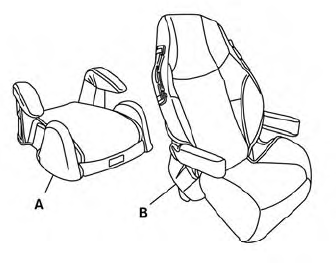
A. Low back booster seat
B. High back booster seat
Booster seats of various sizes are offered by several manufacturers. When selecting any booster seat, keep the following points in mind:
- Choose only a booster seat with a label certifying that it complies with Federal Motor Vehicle Safety Standard or Canadian Motor Vehicle Safety Standard.
- Check the booster seat in your vehicle to be sure it is compatible with the vehicle’s seat and seat belt system.
- Make sure the child’s head will be properly supported by the booster seat or vehicle seat. The seatback must be at or above the center of the child’s ears. For example, if a low back booster seat is chosen, the vehicle seatback must be at or above the center of the child’s ears. If the seatback is lower than the center of the child’s ears, a high back booster seat should be used.
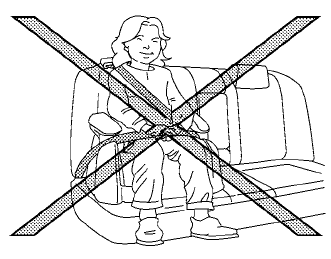
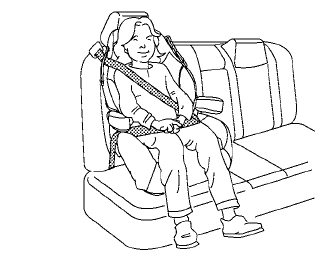
If the booster seat is compatible with your vehicle, place the child in the booster seat and check the various adjustments to be sure the booster seat is compatible with the child. Always follow all recommended procedures.
All U.S. states and Canadian provinces or territories require that infants and small children be restrained in an approved child restraint at all times while the vehicle is being operated.
The instructions in this section apply to booster seat installation in the rear seats or the front passenger seat.
 Booster seats
F..
 Booster seat installation
WARNING
To avoid injury to child, do not use the
lap/shoulder belt in the Automatic
Locking Retractor (ALR) mode when using
a booster seat with the seat belts...
Other information:
Nissan Murano (Z52) 2015-2024 Service Manual: Brake Pedal
Inspection Check the brake pedal height with the floor trim removed. Check the brake pedal height (H) between the dash lower panel (2) and the brake pedal upper surface. Brake pedal height (H) from dash lower panel (2) Refer to Brake Pedal. Clearance (A) between brake pedal bracket (1), stop lamp switch (3) and brake pedal position switch (4) contact ends Refer to Brake Pedal...
Nissan Murano (Z52) 2015-2024 Service Manual: Front Timing Chain Case
Exploded View 1. Engine assembly 2. Front timing chain case oil filter 3. Water pump cover 4. Crankshaft pulley 5. Front oil seal 6. Front timing chain case 7. O-ring A. To valve timing control cover (bank 1/bank 2). Refer to Valve Timing Control Cover (bank 1) and Valve Timing Control Cover (bank 2)...
Categories
- Manuals Home
- Nissan Murano Owners Manual
- Nissan Murano Service Manual
- Power Steering Fluid (PSF)
- How to enable/disable the LDW system
- All-Wheel Drive (AWD) (if so equipped)
- New on site
- Most important about car
Vehicle security system
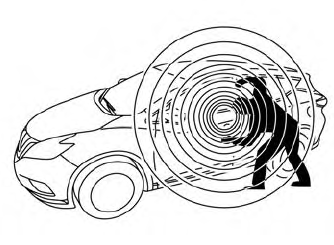
Your vehicle has two types of security systems:
Vehicle security system NISSAN Vehicle Immobilizer SystemThe vehicle security system provides visual and audible alarm signals if someone opens the doors, liftgate or the hood when the system is armed. It is not, however, a motion detection type system that activates when a vehicle is moved or when a vibration occurs.
