
Nissan Murano: Booster seats / Booster seat installation
WARNING
To avoid injury to child, do not use the lap/shoulder belt in the Automatic Locking Retractor (ALR) mode when using a booster seat with the seat belts.
For additional information, refer to allWarnings and Cautions in the “Child safety,” “Child restraints” and “Booster seats” sections of this manual before installing a child restraint.
Follow these steps to install a booster seat in the rear bench seats or in the front passenger seat:
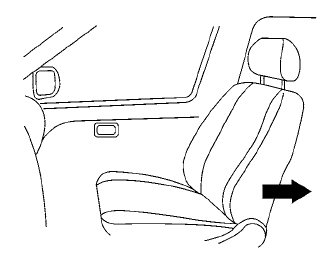
- If you must install a booster seat in
the front seat, move the seat to the
rearmost position.
- Position the booster seat on the seat. Only place it in a front-facing direction. Always follow the booster seat manufacturer’s instructions.
- The booster seat should be positioned
on the vehicle seat so that it is stable.
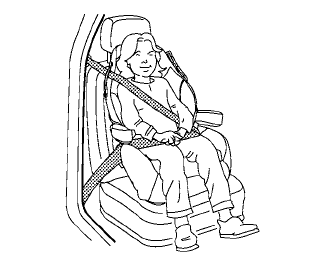
If necessary, adjust or remove the head restraint/headrest to obtain the correct booster seat fit. If the head restraint/headrest is removed, store it in a secure place. Be sure to reinstall the head restraint/headrest when the booster seat is removed. For additional information, refer to “Head restraints/headrests” in this section.
If the seating position does not have an adjustable head restraint/headrest and it is interfering with the proper booster seat fit, try another seating position or a different booster seat.
- Position the lap portion of the seat belt low and snug on the child’s hips. Be sure to follow the booster seat manufacturer’s instructions for adjusting the seat belt routing.
- Pull the shoulder belt portion of the seat belt toward the retractor to take up extra slack. Be sure the shoulder belt is positioned across the top, middle portion of the child’s shoulder. Be sure to follow the booster seat manufacturer’s instructions for adjusting the seat belt routing.
- Follow the warnings, cautions and instructions for properly fastening a seat belt shown in “Three-point type seat belt with retractor” in this section.
- If the booster seat is installed in the
front passenger seat, place the ignition
switch in the ON position.The front passenger
air bag status light
 may or
may not illuminate, depending on the
size of the child and the type of booster
seat being used. For additional information,
refer to “Front passenger air
bag and status light” in this section.
may or
may not illuminate, depending on the
size of the child and the type of booster
seat being used. For additional information,
refer to “Front passenger air
bag and status light” in this section.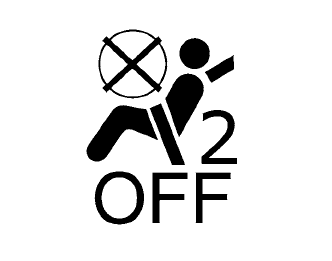
 Precautions on booster seats
WARNING
If a booster seat and seat belt are not
used properly, the risk of a child being
injured or killed in a sudden stop or collision
greatly increases:
Make sure the shoulder portion of
the belt is away from the child’s
face and neck and the lap portion
of the belt does not cross the
stomach...

Other information:
Nissan Murano (Z52) 2015-2024 Service Manual: Moonroof Unit Assembly
Inspection WIND DEFLECTOROpen glass lid fully. Visually check for proper installation, damaged/deteriorated components, or foreign objects within mechanism. Correct as required for smooth operation. Check for grease at the wind deflector arm (1) and pivot areas...
Nissan Murano (Z52) 2015-2024 Service Manual: Front Wheel Sensor
Exploded View 1. Front wheel sensor A. Color line (slant line) B. Harness connector C. Refer to Removal and Installation. Front Removal and Installation CAUTION: Do not damage the front wheel sensor or sensor rotor...
Categories
- Manuals Home
- Nissan Murano Owners Manual
- Nissan Murano Service Manual
- GAS STATION INFORMATION
- Turning the AEB system on/off
- Power Steering Fluid (PSF)
- New on site
- Most important about car
