
Nissan Murano: Towing safety / Weight distribution hitch
This type of hitch is also called a “loadleveling” or “equalizing” hitch. A set of bars attach to the ball mount and to the trailer to distribute the tongue weight (hitch weight) of your trailer. Many vehicles can’t carry the full tongue weight of a given trailer, and need some of the tongue weight transferred through the frame and pushing down on the front wheels. This gives stability to the tow vehicle.
A weight-distributing hitch system (Class IV) is recommended if you plan to tow trailers with amaximum weight over 5,000 lbs. (2,268 kg). Check with the trailer and towing equipment manufacturers to determine if they recommend the use of a weightdistributing hitch system.
NOTE:
A weight-distributing hitch system may affect the operation of trailer surge brakes. If you are considering use of a weight-distributing hitch system with a surge brake-equipped trailer, check with the surge brake, hitch or trailer manufacturer to determine if and how this can be done.
Follow the instructions provided by the manufacturer for installing and using the weight-distributing hitch system.
General set-up instructions are as follows:
- Park unloaded vehicle on a level surface. With the ignition on and the doors closed, allow the vehicle to stand for several minutes so that it can level.
- Measure the height of a reference point on the front and rear bumpers at the center of the vehicle.
- Attach the trailer to the vehicle and adjust the hitch equalizers so that the front bumper height is within 0 - .5 inches (0 – 13 mm) of the reference height measured in step 2. The rear bumper should be no higher than the reference height measured in step 2.
WARNING
Properly adjust the weight distributing hitch so the rear of the bumper is no higher than the measured reference height when the trailer is attached. If the rearbumperis higher than themeasured reference height when loaded, the vehicle may handle unpredictably which could cause a loss of vehicle controlandcause serious personal injury or property damage.
 Weight carrying hitches
A weight carrying or “dead weight” ball
mount is one that is designed to carry the
whole amount of tongue weight and gross
weight directly on the ball mount and on
the receiver...
 Sway control device
Sudden maneuvers, wind gusts, and buffeting
caused by other vehicles can affect
trailer handling. Sway control devices may
be used to help control these affects...
Other information:
Nissan Murano (Z52) 2015-2024 Owners Manual: Types of tires
WARNING When changing or replacing tires, be sure all four tires are of the same type (i.e., Summer, All Season or Snow) and construction. A NISSAN dealer may be able to help you with information about tire type, size, speed rating and availability...
Nissan Murano (Z52) 2015-2024 Service Manual: C1b55-00 Radar Blockage
DTC Description DTC DETECTION LOGIC DTC No. CONSULT screen terms (Trouble diagnosis content) DTC detection condition C1B55-00 RADAR BLOCKAGE (Radar blockage) Diagnosis condition When ignition switch is ON. Signal (terminal) – Threshold Side radar is blocked Diagnosis delay time – NOTE: DTC “C1B55-00” may be detected under the following conditions except for possible cause...
Categories
- Manuals Home
- Nissan Murano Owners Manual
- Nissan Murano Service Manual
- Power Steering Fluid (PSF)
- Rear bench seat adjustment
- Passenger compartment
- New on site
- Most important about car
Luggage hooks
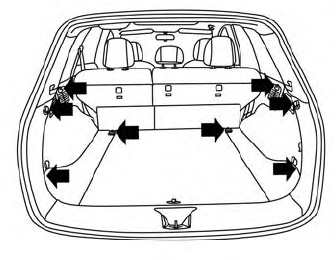
When securing items using luggage hooks located on the back of the seat or side finisher do not apply a load over more than 6.5 lbs. (29 N) to a single hook.
The luggage hooks that are located on the floor should have loads less than 110 lbs. (490 N) to a single hook.
