
Nissan Murano: System Description / System. Awd System
SYSTEM DIAGRAM

INPUT SIGNAL AND OUTPUT SIGNAL
It transmits/receives each signal from the following AWD control unit via CAN communication line:
| Component parts | Function |
|---|---|
| ABS actuator and electric unit (control unit) |
Transmits the following signals via CAN communication to AWD control unit:
|
| ECM |
Transmits the following signals via CAN communication to AWD control unit:
|
| TCM |
Transmits the following signals via CAN communication to AWD control unit:
|
| Combination meter | Transmits conditions of parking brake switch signal via CAN communication to AWD control unit. |
|
Receives the following signal via CAN communication from AWD control unit:
|
|
| Steering angle sensor | Transmits conditions of steering angle sensor signal via CAN communication to AWD control unit. |
DESCRIPTION
-
AWD controls distribution of drive power between front-wheel drive (100:0) and 4-wheel drive (50:50) conditions according to signals from sensors.
-
By receiving the steering angle sensor signal, yaw rate sensor signal, side G sensor signal and decel G sensor signal, Nissan Murano vehicle with VDC corrects a torque distribution for front and rear wheels according to a driving operation and a behavior of the Nissan Murano vehicle during cornering and improves drivability and safety on a slippery road surface.
-
Electronic control allows optimal distribution of torque to front/rear wheels to match road conditions.
-
AWD mode makes possible stable driving possible with no wheel spin, on snowy roads or other slippery surfaces.
-
On roads which do not require 4-wheel drive, it contributes to improved fuel economy by driving in conditions close to front-wheel drive.
-
Sensor inputs determine the Nissan Murano vehicle's turning condition, and tight cornering/braking are controlled by distributing optimum torque to rear wheels.
 NOTE:
NOTE:
Light tight-corner braking symptom may occur depending on driving condition. This is not malfunction.
 Structure and Operation
Sectional View
Transfer cover
Transfer case
Ring gear bearing (transfer case side)
Ring gear shaft
Pinion bearing
Drive pinion
Companion flange
Ring gear
Ring gear bearing (transfer cover side)
Operation Description
POWER TRANSFER DIAGRAMELECTRIC CONTROLLED COUPLING
The AWD control unit supplies command current to electric controlled coupling (AWD solenoid)...
 Diagnosis System (awd Control Unit)
CONSULT Function
CAUTION:
After disconnecting the CONSULT vehicle interface (VI) from the data link connector, the ignition must be cycled OFF → ON (for at least 5 seconds) → OFF...
Other information:
Nissan Murano (Z52) 2015-2024 Owners Manual: Push-button ignition switch
WARNING Do not operate the push-button ignition switch while driving the vehicle except in an emergency. (The engine will stop when the ignition switch is pushed three consecutive times in less than 1.5 seconds or the ignition switch is pushed and held for more than 2 seconds...
Nissan Murano (Z52) 2015-2024 Service Manual: Front Wheel Hub
Exploded View 1. Cotter pin 2. Nut retainer 3. Disc brake rotor 4. Wheel hub and bearing 5. Wheel stud 6. Splash guard 7. Steering knuckle Front Removal and Installation REMOVALRemove disc brake rotor. Refer to Removal and Installation...
Categories
- Manuals Home
- Nissan Murano Owners Manual
- Nissan Murano Service Manual
- GAS STATION INFORMATION
- Checking engine oil level
- Tire rotation
- New on site
- Most important about car
Fuel gauge
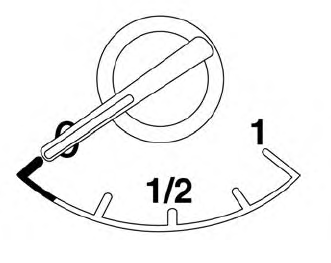
The gauge indicates the approximate fuel level in the tank.
The gauge may move slightly during braking, turning, acceleration, or going up or down hills.
The gauge needle returns to 0 (Empty) after the ignition switch is placed in the OFF position.
