
Nissan Murano: System Description / Structure and Operation

This system returns blow-by gas to the intake manifold.
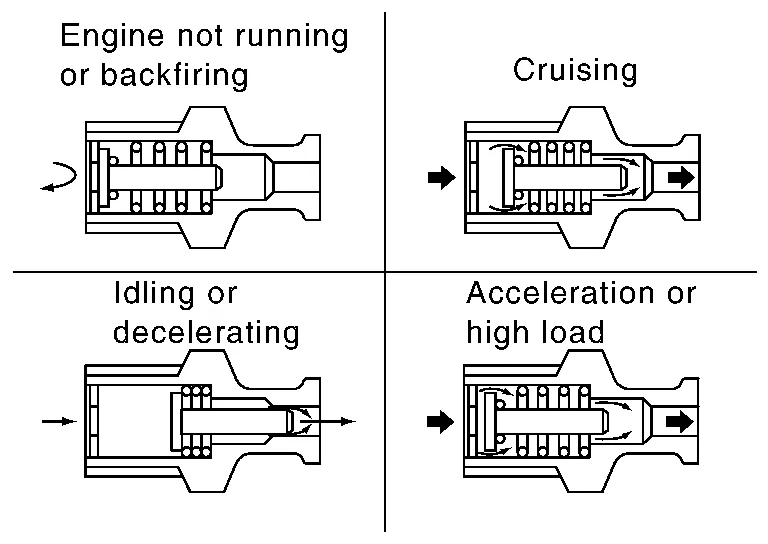
The positive crankcase ventilation (PCV) valve is provided to conduct crankcase blow-by gas to the intake manifold.
During partial throttle operation of the engine, the intake manifold sucks the blow-by gas through the PCV valve.
Normally, the capacity of the valve is sufficient to handle any blow-by and a small amount of ventilating air.
The ventilating air is drawn from the air inlet tubes into the crankcase. In this process the air passes through the hose connecting air inlet tubes to rocker cover.
Under full-throttle condition, the manifold vacuum is insufficient to draw the blow-by flow through the valve. The flow goes through the hose connection in the reverse direction.
On vehicles with an excessively high blow-by, the valve does not meet the requirement. This is because some of the flow will go through the hose connection to the air inlet tubes under all conditions.
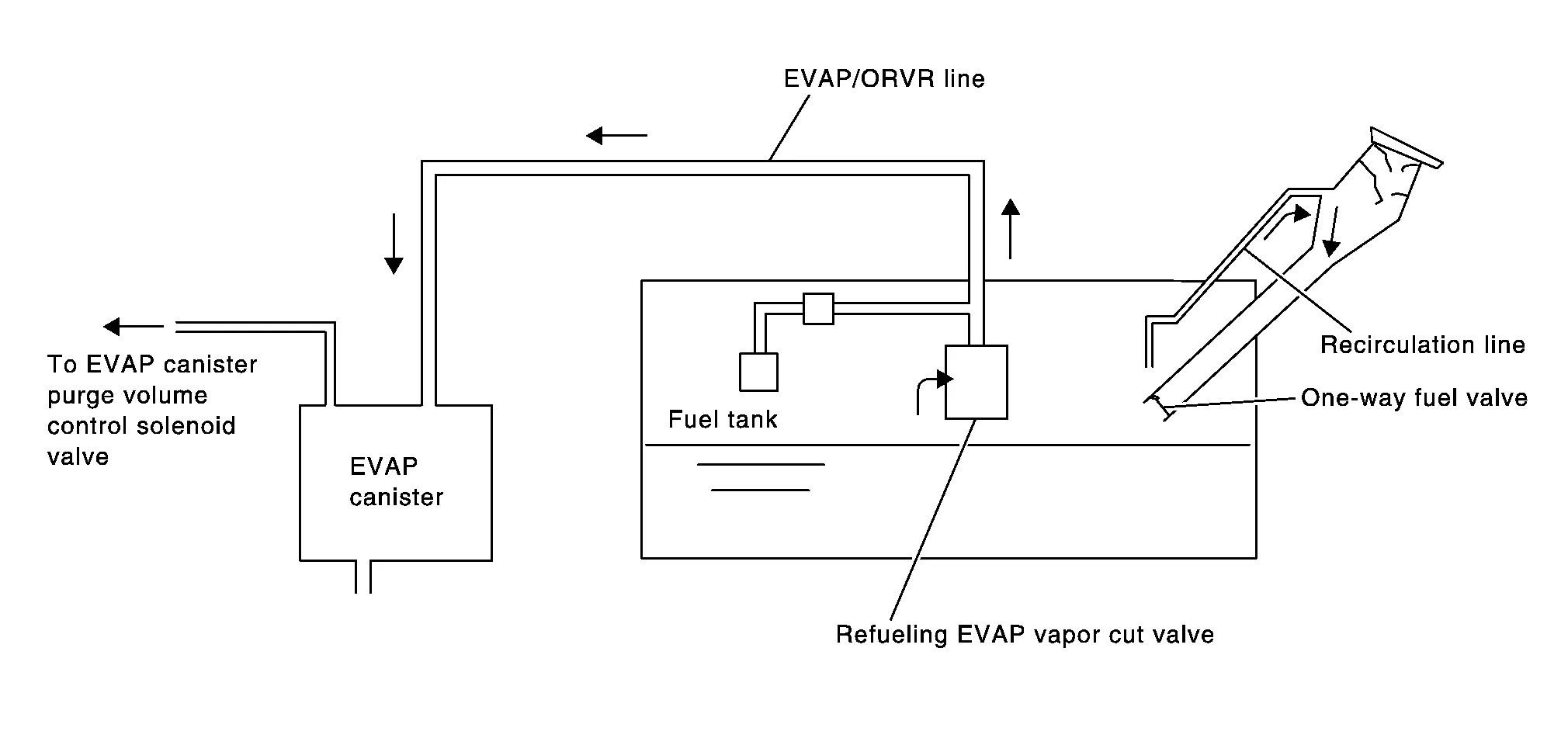
From the beginning of refueling, the air and vapor inside the fuel tank go through refueling EVAP vapor cut valve and EVAP/ORVR line to the EVAP canister. The vapor is absorbed by the EVAP canister and the air is released to the atmosphere.
When the refueling has reached the full level of the fuel tank, the refueling EVAP vapor cut valve is closed and refueling is stopped because of auto shut-off. The vapor which was absorbed by the EVAP canister is purged during driving.
WARNING:
When conducting inspections below, be sure to observe the following:
-
Put a “CAUTION: FLAMMABLE” sign in workshop.
-
Never smoke while servicing fuel system. Keep open flames and sparks away from work area.
-
Always to furnish the workshop with a CO2 fire extinguisher.
CAUTION:
-
Before removing fuel line parts, carry out the following procedures:
-
Put drained fuel in an explosion-proof container and put lid on securely.
-
Release fuel pressure from fuel line. Refer to Work Procedure.
-
Disconnect battery ground cable.
-
-
Always replace O-ring when the fuel gauge retainer is removed.
-
Never kink or twist hose and tube when they are installed.
-
Never tighten hose and clamps excessively to avoid damaging hoses.
-
After installation, run engine and check for fuel leakage at connections.
-
Never attempt to top off the fuel tank after the fuel pump nozzle shuts off automatically.
Continued refueling may cause fuel overflow, resulting in fuel spray and possibly a fire.
 Component Parts. Engine Control System
Component Parts Location
ENGINE ROOM No. Component Function
IPDM E/R
IPDM E/R activates the internal control circuit to perform the relay ON-OFF control according to the input signals from various sensors and the request signals received from control units via CAN communication...
 System
..
Other information:
Nissan Murano (Z52) 2015-2024 Service Manual: Diagnosis and Repair Work Flow
Work Flow NOTE: “DTC” includes DTC at the 1st trip. OBTAIN INFORMATION ABOUT SYMPTOM Refer to Diagnostic Work Sheet and interview the customer to obtain the malfunction information (conditions and environment when the malfunction occurred) as much as possible when the customer brings in the Nissan Murano vehicle...
Nissan Murano (Z52) 2015-2024 Service Manual: System
System Description SYSTEM DIAGRAMINPUT/OUTPUT SIGNAL CHART Item Input signal to main power window and door lock/unlock switch Main power window and door lock/unlock switch function Actuator Encoder Encoder pulse signal Power window control Front power window motor Main power window and door lock/unlock switch Front power window motor LH UP/DOWN signal Power window and door lock/unlock switch RH Front power window motor RH UP/DOWN signal BCM RAP signal Rear power window switch Rear power window motor UP/DOWN signal Rear power window motor POWER WINDOW OPERATION Power window system is activated by the power window switches when ignition switch ON position or during the retained power operation after ignition switch OFF...
Categories
- Manuals Home
- Nissan Murano Owners Manual
- Nissan Murano Service Manual
- All-Wheel Drive (AWD) (if so equipped)
- Checking engine oil level
- Vehicle Dynamic Control (VDC) OFF switch
- New on site
- Most important about car
Autolight system
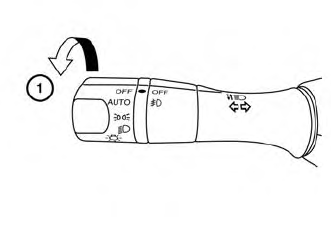
The autolight system allows the headlights to turn on and off automatically. The autolight system can:
Turn on the headlights, front parking, tail, license plate and instrument panel lights automatically when it is dark. Turn off all the lights (except daylight running lights) when it is light. Keep all the lights on for a period of time after you place the ignition switch in the OFF position and all doors are closed.