
Nissan Murano: Hood Lock / Secondary Latch
REMOVAL
Remove front grille. Refer to Removal and Installation.
Disconnect secondary latch cable from hood lock assembly.
Remove bolts and secondary latch.
INSTALLATION
Installation is in the reverse order of removal.
CAUTION:
-
Tighten bolts to specified torque. Refer to Exploded View.
-
Check that secondary latch cable is properly engaged with hood lock.
 Hood Lock
Exploded View
1.
Hood lock
2.
Secondary latch
3.
Hood lock release cable
4.
Hood lock release handle
Clip
Removal and Installation
REMOVALRemove core support cover...
 Hood Lock Release Cable
Removal and Installation
REMOVALRemove fender protector (LH). Refer to Removal and Installation.
Remove front grille. Refer to Removal and Installation...
Other information:
Nissan Murano (Z52) 2015-2024 Service Manual: C1a16 Radar Blocked or Stained
DTC Description DTC DETECTION LOGIC DTC No. CONSULT screen terms DTC detection condition C1A16–97 RADAR BLOCKED Diagnosis condition When ignition switch is ON. Signal (terminal) — Threshold If any stain occurs to distance sensor body window...
Nissan Murano (Z52) 2015-2024 Service Manual: Wheel Side
Removal and Installation REMOVALRemove disc brake rotor. Refer to Removal and Installation. Remove wheel sensor bolt (A) and position wheel sensor aside. Refer to Exploded View. CAUTION: Failure to separate front wheel sensor from steering knuckle may result in damage to front wheel sensor...
Categories
- Manuals Home
- Nissan Murano Owners Manual
- Nissan Murano Service Manual
- Tire rotation
- Warning lights
- How to enable/disable the LDW system
- New on site
- Most important about car
LATCH (Lower Anchors and Tethers for CHildren) system
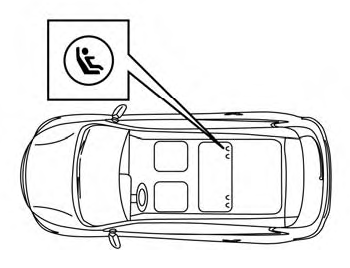
LATCH system lower anchor locations - bench seat
Your vehicle is equipped with special anchor points that are used with LATCH system compatible child restraints. This system may also be referred to as the ISOFIX or ISOFIX compatible system. With this system, you do not have to use a vehicle seat belt to secure the child restraint unless the combined weight of the child and child restraint exceeds 65 lbs. (29.5 kg). If the combined weight of the child and child restraint is greater than 65 lbs. (29.5 kg), use the vehicle’s seat belt (not the lower anchors) to install the child restraint. Be sure to follow the child restraint manufacturer’s instructions for installation.
