
Nissan Murano: Sheet Metal Work / Paintless Dent Repair
Paintless dent repair is one type of panel repair technique. This technique is used to repair irregularities on painted outer panels without damaging the painted surface.
It is not possible to correct all convex/concave portions in paintless dent repair.
Whether or not the parts need to be removed/installed, and tools that can be inserted must be checked for each repair location.
When checking the convex/concave location, determine whether or not the paintless dent repair is possible. It is also important to determine the most suitable repair method.

| Example of circular convex/concave | Example of oval convex/concave |
|---|---|
|
|
|


Over the years the light system has evolved from a single neon to multi lines and then to the reflector type light.

| Small Light (1) | Large Light (2) | ||
| Advantage | Disadvantage | Advantage | Disadvantage |
|
|
|
|
Most professionals use a large light because of its many advantages.
Light Position: 3 Points
There are several aspects to consider in setting up the light. This is the main problem area for beginners. It looks easy but it is not. We are looking at three aspects in the setting up, which are crucial to the success of a proper repair.
-
Distance (Angle)
Beginners often place the light too close.
There is no precise distance for the positioning. In a repair the light should always be positioned in two distances. First close, to see the tool a little better and also to be able to see into the dent. Although if the dent is to deep or big the center of the damage can’t be seen in the light reflection.
-
Normal distance: First position

1 :Light source 2 :Light 3 :Surface -
Finishing distance: Second position for the finish
In the finishing stages of the repair the light should be moved to the distance, as this will show the minor imperfections and the general area much better.

1 :Light source 2 :Light 3 :Surface 
1 :Normal or start position 2 :Finishing position
-
-
Light Position Parallel
Always make sure the light (1) is parallel to the surface (2) which you are repairing.
-
Top or flat surface

-
Side or curved surface

1 :Light source on a curved surface 2 :Light source on a side surface 3 :Surface
It is ideal if the light system being used is easily adjustable to be able to match the contour of the car body.
Consider which way the metal is bent.
If the panel or area is flat it doesn’t matter from which direction the dent is repaired.

But if the panel (1) or area is bent it is important to work perpendicular to the bend. The reason for this is that from the front, the dent (2) can’t be seen well with its full size.

3 :Light source -
-
Light Position Crisscross
It is always important to work the dent (1) from two angles (A and B). This is mainly the case for top panels like the hood, roof and trunk. The reason for this is that the dent can’t be seen completely from one side. Therefore you first work from one side. This is normally done with a light position with a normal angle (A) and you fix the dent up to 80%. Then you change to angle (B), ideally 90°, and finish the dent from the other side keeping the light at a distance.

Tools for paintless dent repair are hammers, spoons, dollies and punches. Some popular hand tools for paintless dent repair and application examples are described below.

Choose suitable tools to repair the panel.
There are three basic tools being used. Levers, Glue System and Hotbox. The choice of tools will depend on the access to the damage and experience level of the technician.
| Levers (Paintless dent repair) | Glue system | Hotbox | |
| Access | 95% (Roof rail) | 30% | 10% |
| Experience | 6 months | 2 days | ½ day |
| Training/Practice | 2 days (6 months practice) | ½ day | ½ day |
Difficult Areas to Repair Dents on

| Index | Explanation |
| 1 | This area is difficult to repair due to access. Often the glue or Hotbox has to be used and with sharp dents it is limited |
| 2 | This area is difficult due to braces. It can be done with PDR but often the brace is in the way. |
| 3 | This area is also difficult to repair due to the double brace in the rail. Most of the time this area is done with the glue system |
-
Levers
Levers (1) are used in the open areas like on hoods, roofs and also on side panels without any braces.
Standard levers

Next to that there are tools which are mixed like the hook tools.

Then there are also special lever tools with different tips.

-
Wire tools
Wire tools (1) are used in areas which you can’t reach with lever tools. This is the case mostly behind braces or on tight places.
Standard Wires

-
Long wires

-
Tips of wire tools
Most tips on the wire tools are very similar due to the construction. The contact area is about 1mm. In order to make it soft, often tape is used.

Another important point is the shaving along the tool (1) shaft. It makes the access into the braces (2) much easier.

(1) CORRECTION OF CONCAVE PANEL WITH SPOONS
Convex panels can be repaired with a hammer and punch. Concave panels can be repaired with a spoon if the following conditions are satisfied:
-
The spoon must be able to be inserted behind the concave panel. A closed construction portion or mating panel cannot be repaired.

-
Use of lever action should be allowed.

If the surrounding portion of panel can be used to support a spoon as a lever, the concave area can be repaired. Otherwise, corrective force cannot be transmitted to the desired portion.
-
The concave portion should be visible from outside.

This work is performed visually, and dents in concealed areas cannot be repaired.
(2) KEY POINTS IN PAINTLESS DENT REPAIR WORK
-
Repairing Larger Damages:
Especially on large dents or on dents over metal which has a bent form, the damage created a crown.
Meaning the metal was pushed to the side and deformed. First, push out some of the center (50%). Look for the crown and knock it in. Then push out the damage again. Depending on the damage, this has to be done several times, between pushing and knocking down.

1 :Original damage 2 :Finish pulling distance 3 :Tool 
1 :Knock down the crown 2 :Original damage 3 :Finish pulling distance 
1 :Finish pulling distance 2 :Tool -
Repairing Dents over Edges:
-
Start position (A).

-
Position outside in the open

1 :Original damage 2 :Finish pulling distance 3 :Tool -
Move to the edge
-
Move slowly along the edge, back and forth.
-
The edge has to come up first.
-
Knock down the crowns (1)

2 :Original damage 3 :Finish pulling distance -
Push up the rest

1 :Finish pulling distance 2 :Tool
-
-
Repairing half moon dents or dents away from the edges:

-
Position on the outside
-
Move to the edge
-
Go to the center
-
Push out from the edge and the center to the outside
-
-
Repairing a smoothly rounded concave section:

Raise the concave portion little by little, beginning with the outside.
-
Repairing a concave section bent sharply at the center:

First, raise the concave portion 60% - 70%, beginning with the outside. Next, raise the sharply bent portion slightly higher than the surrounding panel surface.
Then flatten the high point by tapping with a hammer.
-
Do not attempt to correct panel deformation all at once.
Use the step-by-step repair method, such as roughing → smoothing → finishing.
-
After repairing, visually check the repaired portion from all directions.
(1) POLISH-FINISHING OF CORRECTED SURFACE
If the painted surface is scratched during repair, polish with compound to remove scratches.
(2) ANTI-CORROSIVE TREATMENT OF BACK OF PANEL
The spoons may cause scratches. Apply anti-corrosive wax to the back of panel.

Use 3M 8852 Cavity Wax + 3M 8851 Applicator Wand Kit, or equivilent.
Irregularities in the panel must be examined carefully to see whether or not they can be repaired, and also to determine the most suitable repair method.
Refer to "Examination of Panel Damage".
Work Direction on a Vehicle

| 1 | Area mainly accessed from the back to the front |
| 2 | Area mainly accessed from the front the back |
| 3 | Area mainly accessed from the bottom |
For each panel and each general part of a panel it is important to consider the light position, direction of the light position and the work direction.
Glue systems allow pulling when an area is not easily accessible like roof rail or beneath braces. It is also one of the easiest systems to learn. But it is mainly limited to soft dents.
A couple of things that affect the glue pulling:
-
Temperature

The diameter and the size of the pull knob

-
Application
Place the knob correctly.

-
Cooling time
The cooling time depends on the surface temperature as well as on the type of glue being used. The glue is coming out of the glue gun from 120 deg. to 140 deg. depending on the glue gun. Then the glue needs some time to cool off. There are several methods as to when to pull also depending on the type of glue.

Index Explanation 1 After 15 seconds: In this range, a pull can be done if a high pulling force is not required, for example, with small dents. 2 After 25 seconds: In this range, the warmth of the glue can still be in the metal, and thus facilitate the pull. This can only be done with sharper dents. With some glues, this can be the ideal cooling off time. 3 After 60 seconds: This is the standard range if you want consistent results. -
Pulling type
There are two basic pulling methods. One is with a hand puller and the other is with the sliding hammer.
In general the hand puller (1) is easier for beginners and also for deeper damage. The sliding hammer (2) is a little faster in the application. It depends more on what you are used to.

-
Area of application
The glue system can be used on all areas. It is ideal on soft and medium dents. Although in some areas where access with the PDR tools is difficult it is used frequently.

Plastic welding can be used as a repair method only on thermoplastics.
Work preparation
Repairs must always be carried out from the inner to the outer side of the component, which means that in most cases, it is necessary to disassemble the damaged body component.
The repair area must always be thoroughly cleaned prior to any repair.
To ensure that there is a good bond between the plastic and the filler material, the edges of the break must be sanded into a wedge or "V" shape on the inner and outer sides. in addition, the paint must be removed from the damage area. A low-speed sanding tool with P120 grit abrasive can be used here, as the plastic could otherwise overheat and smear.
Procedure Overview

| 1 | :Plastic welder |
| 2 | :Filler rod |
| 3 | :Damaged surface |
A one-sided repair will not be able to totally seal the damage, and would lead to the damage recurring shortly after the repair. This is why both sides of the plastic part must always be welded.
The repair always begins on the inside of the component. The plastic part and the filler material are fused and welded together with a jet of hot air. Several layers of the filler material can be overlapped and welded to each other in the process. A single weld seam is normally sufficient on the outer side.
Any protruding filler material on the outer side of the plastic part is sanded off. The part is then prepared for refinishing.
-
Protect the surrounding area:
Protect the surrounding area next to the damage with masking and/or duct tape.
-
Prepping the area:
Sand the paint off of the surrounding area, on both sides. It is important not to get too much temperature into the area, as this can bring out plastic oil residue. Best is to hand sand at the end as to remove and dirt residue from the surface. You can use either a scraper or sandpaper (80/120 grit).
Repair Steps for Plastic Fusion
For a proper fusion to occur both materials have to be in the melting state. Meaning the welding rod and the material to be welded, each plastic has a different melting temperature as well as its own MFI (Melding flow index). Which means in the production process the melding temperature as well as the pressure gives the material its property. With the Plastic Fusion we are using a high welding temperature and a low air volume. This has the advantage to get a controlled welding bath without deforming the surrounding area. There are three points to consider during the fusion process.
-
Welding bath
-
Welding rod angle
-
Pressure on the rod
The plastic fusion is using a one set temperature of 480 degrease on all plastics no matter what its melting temperature is. The different types of plastics will start to melt at different points and this can be seen in the melting bath. The melting bath can be seen with a small rolled plastic in front of the rod.
During welding, the angle of the filler rod in relation to the repair part should be at less than 90° (acute angle). Slight downward pressure on the filler rod is also important as this will create the right pressure in the weld pool. Without the correct rod angle and pressure, the weld pool will not be created successfully.
-
Welding Rod & Weld

1 :Filler rod 2 :Weld pool A :Filler rod angle less than 90°
The right selection of plastic is required. We are using a standard rod which is ideal for the following materials. These are the main plastics used in today’s outer skins of a Nissan Murano vehicle. There are always exceptions as well as the adhesions to the plastics because of the minor add-on in the materials.
-
PP+E/P
-
PP
-
PP/EPDM
-
P/E
-
TPO
-
TSOP
-
PC
Other rods are needed for the following materials:
-
ABS
-
HDPE
-
PA
-
Xenoy/PC /PTB
-
LDPE
-
PVC
-
Xenoy/PC /PTB
Repairing a Crack or a Cut
-
Grind paint off slowly from both sides. Make sure that the area is clean of any dirt or any other material. Make a slight groove in the damaged area.
 NOTE:
NOTE:
It is important that the outer disc speed is reduced so no melding of the material occurs.

1 :Crack or cut 
1 :Grinder 2 :Crack or cut -
Tack (2) the end of the damaged area (1) in the rear, as this will prevent the damaged area to deform during the fusion process. Try to tack as close to the edge as possible.

-
Start the fusion process in the rear fist. Always start 1cm behind the actual damage.

1 :Crack or cut 2 :Filler rod 3 :Plastic welder 
1 :Crack or cut 2 :Filler rod 3 :Plastic welder -
Repeat the process on the front.
NOTE:
Let the part cool off before you do the finish grinding. As stated before, it is important to grind of the material very slowly. As the high speed will cause the material to meld.

1 :Crack or cut 2 :Plastic welder 3 :Filler rod 
1 :Crack or cut 2 :Grinder 
Repairing a broken tab
-
Grind off the paint on both sides. Make a slight groove on the broken edges.
-
Start the fusion process on one side. Make sure that on that side the material is well bonded. Once one side is bonded, let the material cool off and make a bridge. Then first heat the back of the welding strip quickly to be able to bend it. Then weld the other side making sure you get a good bond.

1 :Plastic welder 2 :Filler rod 3 :Broken tab 
1 :Filler rod 2 :Plastic welder 3 :Broken tab NOTE:
Once the bridge is bonded use the flat vice grip (1) to smoothen out the area, while it is still warm. Repeat the process on the bottom side.

2 :Broken tab 
-
Grind off the non-necessary material slowly as not to melt the material.
Repairing or filling plastic gap
-
Using P120 grit paper, sand down the edges of the break to form a "V" or wedge shape.

1 :Original damaged plastic 2 :Damaged plastic prepped for repair -
Weld strip on one end.
NOTE:
Clamp tab while still warm.

1 :Filler material 2 :Original damaged plastic 3 :Plastic welder -
Lay strip over the gap and continue welding on other side.
NOTE:
Clamp tab while still warm.

1 :Filler material 2 :Original damaged plastic 3 :Plastic welder -
Weld new strip on underside.
NOTE:
Clamp tab while still warm.

1 :Filler material 2 :Plastic welder 3 :Original damaged plastic -
Change angle of plastic welder (2) and weld both filler materials together.

1 :Filler material 3 :Original damaged plastic -
Change angle of plastic welder (2) and finish welding on other side.
NOTE:
Clamp tab while still warm.

1 :Filler material 3 :Original damaged plastic
 Correcting a Deformed Exterior Body Panel
Determining Panel Damage
CAUTION:
This repair method should not be used on rails and reinforcements.
Panel damage must be examined carefully to select the most suitable repair method...

Other information:
Nissan Murano (Z52) 2015-2024 Service Manual: Ecu Diagnosis Information. Tcu
Values on the Diagnosis Tool NOTE: The following table includes information (items) inapplicable to this Nissan Murano vehicle. For information (items) applicable to this vehicle, refer to CONSULT display items. Monitor Item Condition Value/Status HF TYPE Ignition switch ON BT AUDIO UNIT TYPE NAVI CALL SWITCH TYPE SOS SPEAKER TYPE INDRCT ZONE USA CHANNEL NISSAN CAN COMM GEN...
Nissan Murano (Z52) 2015-2024 Service Manual: Inspection and Adjustment. Additional Service When Removing Battery Negative Terminal
Special Repair Requirement Required Procedure After Battery Disconnection System Item Reference Engine Control System Idle Air Volume Learning Description Door & Lock Automatic Back Door Initialization Description Power Window Control System Power Window System Initialization Description Roof Moonroof Memory Reset/Initialization Sunshade Memory Reset/Initialization Special Repair Requirement Automatic Drive Positioner Automatic Drive Positioner System Initialization Refer to Owner's Manual...
Categories
- Manuals Home
- Nissan Murano Owners Manual
- Nissan Murano Service Manual
- Power Steering Fluid (PSF)
- All-Wheel Drive (AWD) (if so equipped)
- System malfunction
- New on site
- Most important about car
Luggage hooks
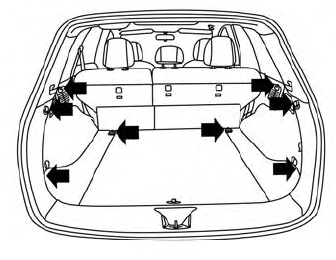
When securing items using luggage hooks located on the back of the seat or side finisher do not apply a load over more than 6.5 lbs. (29 N) to a single hook.
The luggage hooks that are located on the floor should have loads less than 110 lbs. (490 N) to a single hook.
