Nissan Murano: Engine / Fuel System :: Precaution. Precautions
The Supplemental Restraint System such as “AIR BAG” and “SEAT BELT PRE-TENSIONER”, used along with a front seat belt, helps to reduce the risk or severity of injury to the driver and front passenger for certain types of collisions.
Information necessary to service the system safely is included in the “SRS AIR BAG” and “SEAT BELT” sections of this Service Manual.
WARNING:
Always observe the following items for preventing accidental activation:
-
To avoid rendering the SRS inoperative, which could increase the risk of personal injury or death in the event of a collision that would result in air bag inflation, it is recommended that all maintenance and repair be performed by an authorized NISSAN/INFINITI dealer.
-
Improper repair, including incorrect removal and installation of the SRS, can lead to personal injury caused by unintentional activation of the system. For removal of Spiral Cable and Air Bag Module, see “SRS AIR BAG”.
-
Never use electrical test equipment on any circuit related to the SRS unless instructed to in this Service Manual. SRS wiring harnesses can be identified by yellow and/or orange harnesses or harness connectors.
PRECAUTIONS WHEN USING POWER TOOLS (AIR OR ELECTRIC) AND HAMMERS
WARNING:
Always observe the following items for preventing accidental activation:
-
When working near the Air Bag Diagnosis Sensor Unit or other Air Bag System sensors with the ignition/power switch ON or engine running, never use air or electric power tools or strike near the sensor(s) with a hammer. Heavy vibration could activate the sensor(s) and deploy the air bag(s), possibly causing serious injury.
-
When using air or electric power tools or hammers, always switch the ignition/power switch OFF, disconnect the 12V battery or batteries, and wait at least 3 minutes before performing any service.
WARNING:
When replacing fuel line parts, be sure to observe the following:
-
Put a “CAUTION: FLAMMABLE” sign in the workshop.
-
Be sure to work in a well ventilated area and furnish workshop with a CO2 fire extinguisher.
-
Do not smoke while servicing fuel system. Keep open flames and sparks away from the work area.
CAUTION:
-
Use gasoline required by the regulations for octane number. Refer to Fuel.
-
Before removing fuel line parts, perform the following procedures:
-
Put drained fuel in an explosion-proof container and put the lid on securely. Keep the container in safe area.
-
Release fuel pressure from the fuel lines. Refer to Work Procedure.
-
Disconnect the battery cable from the negative terminal.
-
-
Always replace O-ringS and clamps with new ones.
-
Do not kink or twist tubes when they are being installed.
-
Do not tighten hose clamps excessively to avoid damaging hoses.
-
After installing tubes, check that there are no fuel leaks at connections in the following steps.
-
Apply fuel pressure to fuel lines by turning ignition switch “ON” (with engine stopped). Then check for fuel leaks at connections.
-
Start engine and rev it up and check for fuel leaks at connections.
-
-
Use only a genuine NISSAN fuel filler cap as a replacement. If an incorrect fuel filler cap is used, the “MIL” may come on.
 Service Data and Specifications (sds). Service Data and Specifications (sds)
Idle Speed
Condition Specification
No load* (in P or N position)
625 ± 50 rpm
*: Under the following conditions
A/C switch: OFF
Electric load: OFF (Lights, heater fan & rear window defogger)
Steering wheel: Kept in straight-ahead position
Ignition Timing
Condition Specification
No load* (in P or N position)
12 ± 2° BTDC
*: Under the following conditions
A/C switch: OFF
Electric load: OFF (Lights, heater fan & rear window defogger)
Steering wheel: Kept in straight-ahead position
Calculated Load Value
Condition Specification (Using CONSULT or GST)
At idle
10 – 35 %
At 2,500 rpm
10 – 35 %
Mass Air Flow Sensor
Supply voltage
Approx...

Other information:
Nissan Murano (Z52) 2015-2024 Service Manual: System
System Description When the vehicle has reached a speed of 25 MPH (40 km/h) or greater, the BCM receives a signal transmitted from the tire pressure sensors/transmitters installed in each wheel. If the BCM detects low inflation pressure or a system malfunction, it sends a signal to the combination meter via CAN communication to illuminate the low tire pressure warning lamp...
Nissan Murano (Z52) 2015-2024 Service Manual: C1b52-17 Blind Spot Warning Indicator Open Circuit
DTC Description DTC DETECTION LOGIC DTC No. CONSULT screen terms (Trouble diagnosis content) DTC detection condition C1B52-17 BSW/BSI IND OPEN CIR (Blind Spot Warning indicator open circuit) Diagnosis condition When ignition switch is ON. Signal (terminal) – Threshold Open circuit in Blind Spot Warning indicator circuit is detected Diagnosis delay time – POSSIBLE CAUSE Blind Spot Warning indicator RH circuit Blind Spot Warning indicator RH Side radar RH FAIL-SAFEThe following systems are canceled: Blind Spot Warning (BSW) Rear Cross Traffic Alert (RCTA) DTC Confirmation Procedure PERFORM DTC CONFIRMATION PROCEDURE CONSULT Start the engine...
Categories
- Manuals Home
- Nissan Murano Owners Manual
- Nissan Murano Service Manual
- Rear bench seat adjustment
- Indicator lights
- GAS STATION INFORMATION
- New on site
- Most important about car
Luggage hooks
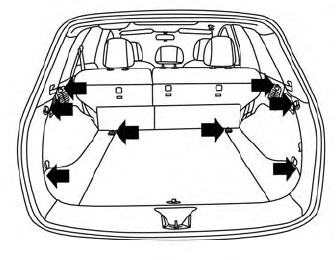
When securing items using luggage hooks located on the back of the seat or side finisher do not apply a load over more than 6.5 lbs. (29 N) to a single hook.
The luggage hooks that are located on the floor should have loads less than 110 lbs. (490 N) to a single hook.
