
Nissan Murano: Rear Door / Door Striker
REMOVAL
Remove bolts and rear door striker.
INSTALLATION
Installation is in the reverse order of removal.
CAUTION:
-
Do not reuse rear door striker bolts.
-
Tighten bolts to specification. Refer to Exploded View.
-
After installation, check rear door open/close operation. If necessary, adjust door striker. Refer to Adjustment.
DOOR STRIKER ADJUSTMENT
Loosen door striker bolts.
Adjust door striker so that it becomes parallel with front door lock insertion direction.
CAUTION:
Tighten bolts to specification. Refer to Exploded View.

 Door Assembly
Exploded View
1.
Rear door sash
2.
Rear door outside rear tape
3.
Rear door sash rear tape
4.
Rear door striker
5.
Rear door weather strip
6...
 Door Hinge
Removal and Installation
REMOVALRemove rear door assembly. Refer to Removal and Installation.
Remove center pillar lower finisher (rear door lower hinge only)...
Other information:
Nissan Murano (Z52) 2015-2024 Service Manual: Fuel Pump Control Module
Exploded View 1. Fuel pump control module (FPCM) 2. FPCM bracket Front Removal and Installation REMOVALLift luggage floor rear finisher and locate fuel pump control module (FPCM) behind luggage mask. Remove bolts (A) from the bracket. Disconnect the harness connector (B) from the fuel pump control module (1) and then remove fuel pump control module...
Nissan Murano (Z52) 2015-2024 Service Manual: Main Line Between 4wd and M&a Circuit
Diagnosis Procedure CHECK CONNECTOR Turn the ignition switch OFF. Disconnect the battery cable from the negative terminal. Check the following terminals and connectors for damage, bend and loose connection (connector side and harness side). Harness connector B101 Harness connector M84 Is the inspection result normal? YES>> GO TO 2...
Categories
- Manuals Home
- Nissan Murano Owners Manual
- Nissan Murano Service Manual
- Tire rotation
- Rear bench seat adjustment
- Checking engine oil level
- New on site
- Most important about car
LATCH (Lower Anchors and Tethers for CHildren) system
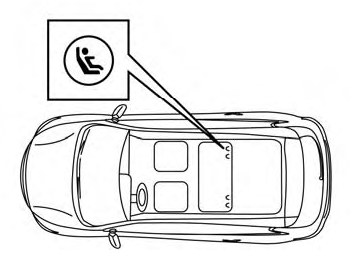
LATCH system lower anchor locations - bench seat
Your vehicle is equipped with special anchor points that are used with LATCH system compatible child restraints. This system may also be referred to as the ISOFIX or ISOFIX compatible system. With this system, you do not have to use a vehicle seat belt to secure the child restraint unless the combined weight of the child and child restraint exceeds 65 lbs. (29.5 kg). If the combined weight of the child and child restraint is greater than 65 lbs. (29.5 kg), use the vehicle’s seat belt (not the lower anchors) to install the child restraint. Be sure to follow the child restraint manufacturer’s instructions for installation.
