
Nissan Murano: Symptom Diagnosis / Audio System
RELATED TO AUDIO
| Symptoms | Check items | Probable malfunction location |
|---|---|---|
| The disk cannot be removed. | Audio unit |
Malfunction in audio unit. Refer to On Board Diagnosis Function. |
| No sound comes out or the level of the sound is low. | No sound from all speakers. |
|
| Only a certain speaker (instrument panel tweeter LH, instrument panel tweeter RH, front door speaker LH, front door speaker RH, rear door speaker LH, rear door speaker RH) does not output sound. |
|
|
| Noise is mixed with audio. | Noise comes out from all speakers. |
Malfunction in audio unit. Refer to On Board Diagnosis Function. |
| Noise comes out only from a certain speaker (instrument panel tweeter LH, instrument panel tweeter RH, front door speaker LH, front door speaker RH, rear door speaker LH, rear door speaker RH). |
|
|
| Noise is mixed with radio only (when the Nissan Murano vehicle hits a bump or while driving over bad roads) |
Poor connector connection of antenna or antenna feeder. Refer to Antenna and Antenna Feeder. |
|
| No radio reception or poor reception. |
|
|
| No satellite radio reception. |
There is malfunction in the CONSULT self diagnosis result. Refer to CONSULT Function. |
|
|
There is no malfunction in the CONSULT self diagnosis result. Refer to CONSULT Function. |
|
|
| Buzz/rattle sound from speaker | The majority of buzz/rattle sounds are not indicative of an issue with the speaker, usually something nearby the speaker is causing the buzz/rattle. | Refer to "SQUEAK AND RATTLE TROUBLE DIAGNOSIS" in the appropriate interior trim section. |
RELATED TO HANDS-FREE PHONE
-
Before performing diagnosis, confirm that the cellular phone being used by the customer is compatible with the Nissan Murano vehicle.
-
It is possible that a malfunction is occurring due to a version change of the phone even though the phone is a compatible type. This can be confirmed by changing the cellular phone to another compatible type, and check that it operates normally. It is important to determine whether the cause of the malfunction is the Nissan Murano vehicle or the cellular phone.
Check Compatibility
-
Make sure the customer’s Bluetooth® related concern is understood.
-
Verify the customer’s concern.
 NOTE:
NOTE:
The customer’s phone may be required, depending upon their concern.
-
Write down the customer’s phone brand, model and service provider.
NOTE:
It is necessary to know the service provider. On occasion, a given phone may be on the approved list with one provider, but may not be on the approved list with other providers.
-
Go to “www.nissanusa.com/bluetooth/”.
-
Using the website’s search engine, find out if the customer’s phone is on the approved list.
-
If the customer’s phone is NOT on the approved list:
Stop diagnosis here. The customer needs to obtain a Bluetooth® phone that is on the approved list before any further action.
-
If the feature related to the customer’s concern shows as “N” (not compatible):
Stop diagnosis here. If the customer still wants the feature to function, they will need to get an approved phone showing the feature as “Y” (compatible) in the “Basic Features”.
-
If the feature related to the customer’s concern shows as “Y” (compatible):
Perform diagnosis as per the following table.
-
| Symptoms | Check items | Probable malfunction location |
|---|---|---|
| Does not recognize cellular phone connection (no connection is displayed on the display screen). |
|
|
| Hands-free phone cannot be established. |
|
Malfunction in audio unit. Replace audio unit. Refer to Removal and Installation. |
| The other party’s voice cannot be heard by hands-free phone. | Check the “microphone speaker” in Inspection & Adjustment Mode if sound is heard. | |
| Originating sound is not heard by the other party with hands-free phone communication. | Sound operation function is normal. | |
| Sound operation function does not work. |
Microphone signal circuit malfunction. Refer to DTC Diagnosis Procedure. |
|
| The system cannot be operated. |
|
Steering switch malfunction. Replace steering switch. Refer to Removal and Installation. |
Steering switches  , ,   , ,  , and , and  do not work. do not work. |
Steering switch signal circuit malfunction. Refer to Diagnosis Procedure. |
|
| All steering switches do not work. |
Steering switch ground circuit malfunction. Refer to Diagnosis Procedure. |
RELATED TO USB
| Symptoms | Check items | Probable malfunction location |
|---|---|---|
| iPod or USB memory cannot be recognized. | Use Enhanced Multi-Media Interface Tester (EMMIT) J-51922 to test USB functionality. Refer to the EMMIT user guide for additional information. |
|
RELATED TO AUX JACK
| Symptoms | Check items | Probable malfunction location |
|---|---|---|
| No voice sound is heard when AUX mode is selected. | Use Enhanced Multi-Media Interface Tester (EMMIT) J-51922 to test AUX jack functionality. Refer to the EMMIT user guide for additional information. |
|

 Normal Operating Condition
Description
RELATED TO NOISEThe majority of the audio concerns are the result of outside causes (bad CD, electromagnetic interference, etc.).The following noise results from variations in field strength, such as fading noise and multi-path noise, or external noise from trains and other sources...
Other information:
Nissan Murano (Z52) 2015-2024 Owners Manual: Replacing
Replace the wiper blades if they are worn. To replace the windshield wiper blades, follow the procedure below: Lift the wiper arm away from the windshield. Lift the release tab . Move the wiper blade down and remove. Insert the new wiper blade onto the wiper arm...
Nissan Murano (Z52) 2015-2024 Service Manual: Frequently Cannot Detect the Vehicle Ahead / Detection Zone Is Short
Diagnosis Procedure The detection function may become unstable in the following cases. When distance sensor (ICC sensor) reflections from the vehicle ahead are interrupted. When driving on a road with extremely sharp corners. When the sensor cannot detect a Nissan Murano vehicle ahead while the vehicle ahead passes a hill or valley...
Categories
- Manuals Home
- Nissan Murano Owners Manual
- Nissan Murano Service Manual
- Tire rotation
- Fuel recommendation
- Rear bench seat adjustment
- New on site
- Most important about car
LATCH (Lower Anchors and Tethers for CHildren) system
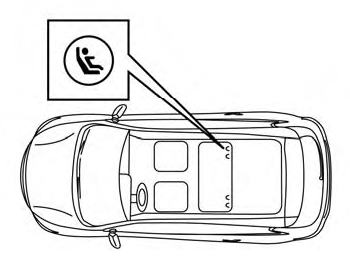
LATCH system lower anchor locations - bench seat
Your vehicle is equipped with special anchor points that are used with LATCH system compatible child restraints. This system may also be referred to as the ISOFIX or ISOFIX compatible system. With this system, you do not have to use a vehicle seat belt to secure the child restraint unless the combined weight of the child and child restraint exceeds 65 lbs. (29.5 kg). If the combined weight of the child and child restraint is greater than 65 lbs. (29.5 kg), use the vehicle’s seat belt (not the lower anchors) to install the child restraint. Be sure to follow the child restraint manufacturer’s instructions for installation.
