
Nissan Murano: Road Wheels & Tires :: System Description / System
When the vehicle has reached a speed of 25 MPH (40 km/h) or greater, the BCM receives a signal transmitted from the tire pressure sensors/transmitters installed in each wheel. If the BCM detects low inflation pressure or a system malfunction, it sends a signal to the combination meter via CAN communication to illuminate the low tire pressure warning lamp. In addition, a warning message will be displayed in the Nissan Murano vehicle information display. Refer to the Owner’s Manual for additional information.
The tire pressure monitoring system (TPMS) has a Easy fill tire alert function to aid in tire inflation. Refer to Easy Fill Tire Alert Function.
SYSTEM DIAGRAM
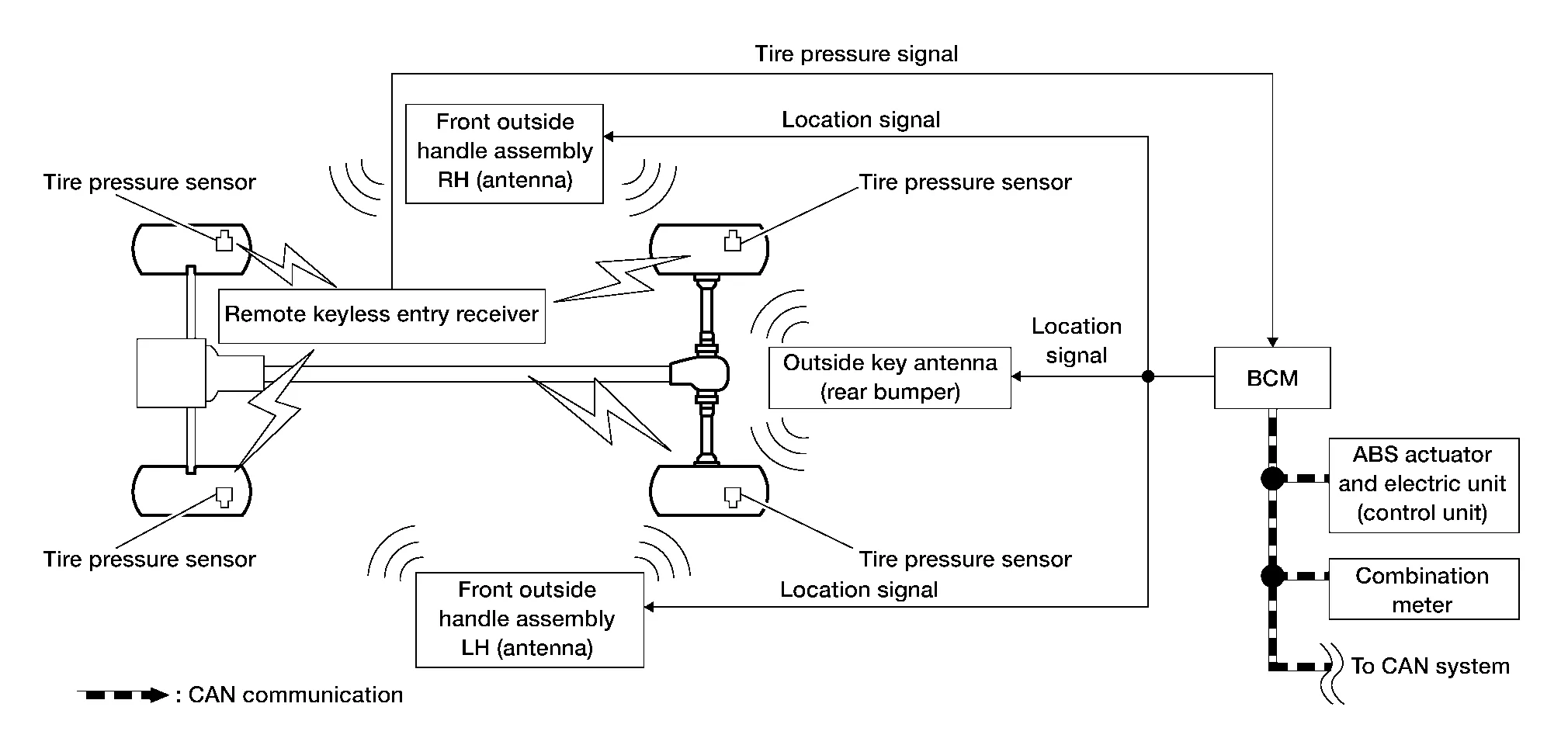
INPUT SIGNAL AND OUTPUT SIGNAL
Major signal transmission between each unit via communication lines is shown in the following table:
| Component | Signal description |
|---|---|
| Combination meter |
Mainly receives the following signals from BCM via CAN communication:
|
| ABS actuator and electric unit (control unit) | Transmits the Nissan Murano vehicle speed signal via CAN communication for combination meter. |
| BCM |
Mainly transmits the following signals to the combination meter via CAN communication:
|
LOW TIRE PRESSURE WARNING LAMP AND INFORMATION DISPLAY INDICATIONS
Uses CAN communication from the BCM to illuminate the low tire pressure warning lamp on the combination meter.
| Name | Design | Layout |
|---|---|---|
| Low tire pressure warning lamp |  |
Refer to Design. |
| Condition | Low tire pressure warning lamp | Information display |
|---|---|---|
| Ignition switch OFF | OFF | OFF |
|
Ignition switch ON (system normal) |
ON for 1 second then turns off | No TPMS message |
| Low tire pressure | ON |
|
| Configuration not performed in tire pressure monitoring system | Blinks for 1 minute then stays ON | No TPMS message |
| Tire pressure sensor ID not registered in BCM | ||
| TPMS malfunction |
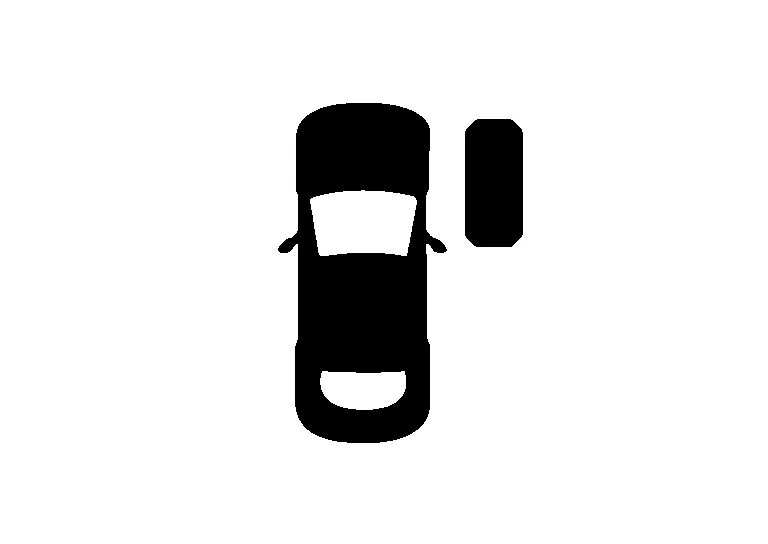
LOW TIRE PRESSURE LOCATION INDICATOR
The low tire pressure location indicator is displayed in the vehicle information display of the combination meter with the low tire pressure warning lamp and warning message under the following conditions:
-
Tire pressure is low.
-
TPMS detected a system malfunction.
-
Tire pressure is extremely low (flat tire).
| Symbol | Warning Message |
|---|---|
|
|
|
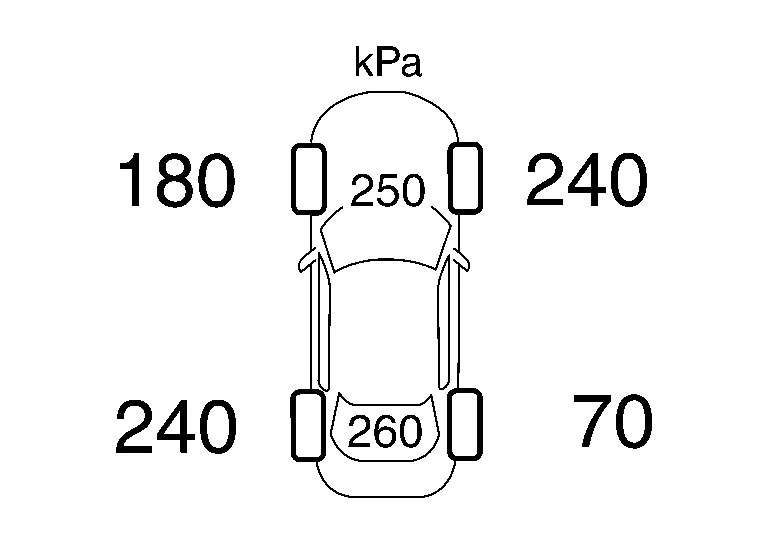
TIRE PRESSURE DISPLAY
The adoption of this function allows tire pressure indication on the information display installed to the combination meter.
| Design | Description |
|---|---|
|
|
|
HAZARD WARNING LAMP INDICATION CONDITION
The hazard warning lamp blinks when ID registration is completed. Refer to Work Procedure.
BUZZER CONTROL CONDITION
BCM transmits a buzzer request signal to combination meter. Based on the signal, BCM sends a command to the combination meter to sound the buzzer.
The buzzer sounds under the following conditions:
-
When wake-up of registered wheel has been completed. Refer to Work Procedure.
-
When tire goes flat.
 NOTE:
NOTE:
When beginning tire inflation, it takes a few seconds for the Easy fill tire alert to function. If there is no response for approximately 15 seconds or more, cancel the Easy fill tire alert function and move the Nissan Murano vehicle approximately 3.2 ft (1 m) backward or forward to try again.
-
The Easy fill tire alert function operates only when the select lever position is in P-range with the ignition switch ON.
-
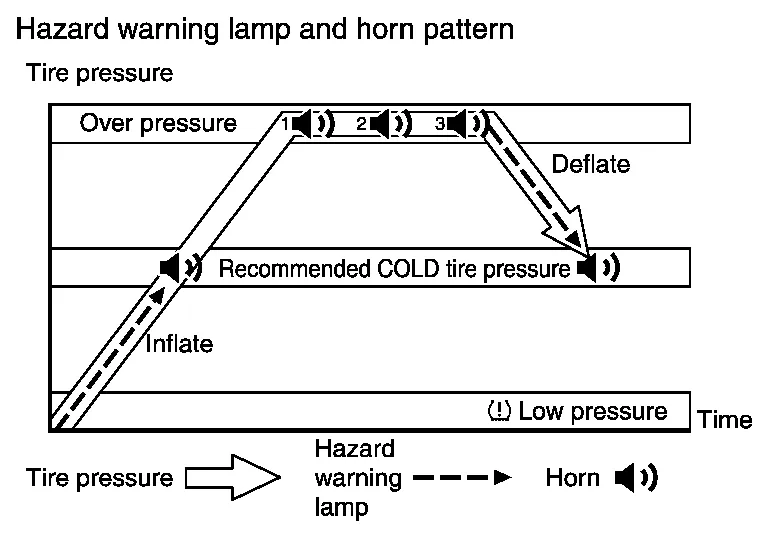
This function informs the driver with a visual and audible indication that the recommended COLD tire pressure has been reached.
-
The hazard warning lamps blink when the recommended COLD tire pressure has been reached. After the recommended COLD tire pressure has been reached, the horn sounds once and the hazard warning lamps stop blinking.
-
If the tire pressure value is equal to or greater than 4 psi (30 kPa, 0.31 kg/cm2) more than the recommended COLD tire pressure, the hazard warning lamps flash and horn sounds three times.
-
To return the tire to the recommended COLD tire pressure, deflate the tire until the horn sounds once and the hazard warning lamps stop blinking.
 Component Parts. Tire Pressure Monitoring System
Component Parts Location
A.
LH side of instrument panel
(view with instrument panel removed)
B.
Combination meter
(view with combination meter removed)
C...

Other information:
Nissan Murano (Z52) 2015-2024 Service Manual: P1614 Chain of Immu-Key
DTC Description DTC DETECTION LOGIC DTC No. CONSULT screen terms (Trouble diagnosis content) DTC Detection Condition P1614 CHAIN OF IMMU-KEY (Chain of immobilizer-key) Diagnosis condition When ignition switch ON. Signal (terminal) — Threshold Inactive communication between NATS antenna amp...
Nissan Murano (Z52) 2015-2024 Service Manual: P062f Ecm
DTC Description DTC DETECTION LOGIC ECM back up system does not function properly. EEPROM (built-in microcomputer) system internal ECM does not function properly. DTC CONSULT screen terms (Trouble diagnosis content) DTC detection condition P0603 ECM BACK UP/CIRCUIT [Internal Control Module Keep Alive Memory (KAM) Error] Diagnosis condition Ignition switch ON Signal (terminal) — Threshold ECM back up system does not function properly Diagnosis delay time — P062F CONTROL MODULE (Internal control module EEPROM error) Diagnosis condition Start engine and let it idle Signal (terminal) — Threshold EEPROM (built-in microcomputer) system internal ECM does not function properly Diagnosis delay time — POSSIBLE CAUSEDTC P0603 Harness or connectors [ECM power supply circuit is open or shorted...
Categories
- Manuals Home
- Nissan Murano Owners Manual
- Nissan Murano Service Manual
- Intelligent Forward Collision Warning (I-FCW)
- Checking engine oil level
- Vehicle Dynamic Control (VDC) OFF switch
- New on site
- Most important about car
Luggage hooks
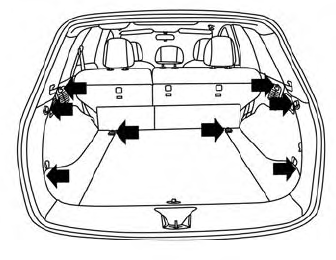
When securing items using luggage hooks located on the back of the seat or side finisher do not apply a load over more than 6.5 lbs. (29 N) to a single hook.
The luggage hooks that are located on the floor should have loads less than 110 lbs. (490 N) to a single hook.
