
Nissan Murano: Steering / Steering System :: Periodic Maintenance. Power Steering Fluid
DRAINING
Disconnect the hydraulic lines from the steering gear. Refer to Exploded View.
Drain power steering fluid into a suitable container.
REFILLING
Connect the hydraulic lines to the steering gear. Refer to Exploded View.
Fill power steering reservoir while checking power steering fluid level.
Bleed air from power steering hydraulic system. Refer to Air Bleeding Hydraulic System.
Check for power steering fluid leaks.
If air bleeding is not complete, excessive noise in the power steering oil pump will be present.
Make sure the engine is off.
Remove cover. Refer to Exploded View.
Turn the steering wheel from the full right stop position and then to full left stop position several times. Repeat until bubbles are no longer being generated in the reservoir.
When the power steering fluid level lowers, refill the reservoir.

CAUTION:
Do not allow the power steering fluid level to drop below the hatching area on the power steering reservoir cap indicator.
Repeat steps three and four until the power steering fluid level stabilizes.
Start the engine and run at idle.
Turn the steering wheel from the full right stop position and then to full left stop position several times. Repeat until bubbles or fluid discoloration are no longer being generated in the reservoir.
When the power steering fluid level lowers, refill the reservoir.
Stop the engine.
Verify proper power steering fluid level. Power steering fluid level should be in the hatching area on the power steering reservoir cap indicator.


Other information:
Nissan Murano (Z52) 2015-2024 Service Manual: Warning Function
System Description OPERATION DESCRIPTIONThe warning functions are as per the following items and are given to the user as warning information and warnings using combinations of Intelligent Key warning buzzer, combination meter buzzer, KEY warning lamp and information display in combination meter: Intelligent Key system malfunction OFF position warning P position warning Take away warning Door lock operation warning Engine start information Intelligent Key low battery warning Key ID warning Key ID verification information OPERATION CONDITIONOnce the following condition from below is established, alert or warning is executed: Warning/Information functions Operation procedure Intelligent Key system malfunction When a malfunction is detected on BCM, “KEY” warning lamp illuminates...
Nissan Murano (Z52) 2015-2024 Service Manual: Entry Assist Function
System Description SYSTEM DIAGRAMSIGNAL TRANSMISSION FUNCTION LISTSeveral types of signals are transmitted from the following units to the driver seat control unit via CAN communication. Component Signal BCM Ignition switch signal Key ID signal TCM Shift position signal DESCRIPTIONThe seat is in the exiting position when either following condition is satisfied; the seat returns from exiting position to the previous driving position...
Categories
- Manuals Home
- Nissan Murano Owners Manual
- Nissan Murano Service Manual
- Warning lights
- Shift lock release
- Turning the AEB system on/off
- New on site
- Most important about car
LATCH (Lower Anchors and Tethers for CHildren) system
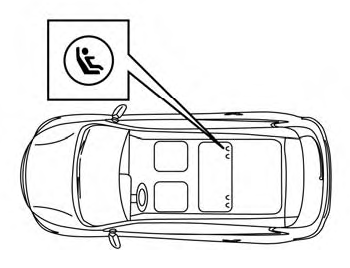
LATCH system lower anchor locations - bench seat
Your vehicle is equipped with special anchor points that are used with LATCH system compatible child restraints. This system may also be referred to as the ISOFIX or ISOFIX compatible system. With this system, you do not have to use a vehicle seat belt to secure the child restraint unless the combined weight of the child and child restraint exceeds 65 lbs. (29.5 kg). If the combined weight of the child and child restraint is greater than 65 lbs. (29.5 kg), use the vehicle’s seat belt (not the lower anchors) to install the child restraint. Be sure to follow the child restraint manufacturer’s instructions for installation.
