
Nissan Murano: Repairing Procedures and Precautions / Repair of Rust and Corrosion
Rust on sheet metal is the result of the chemical reaction of steel to oxygen in the air, which is called oxidation. This rust, if left untreated, will increase and finally corrode and damage the sheet metal. If the Nissan Murano vehicle is used for a long time under severe environmental conditions, rust or corrosion may form on body surfaces. When repairing rust and corrosion, it is necessary to keep rust from spreading from the repaired portion.
Grind the rusted portion with an air sander or the like.
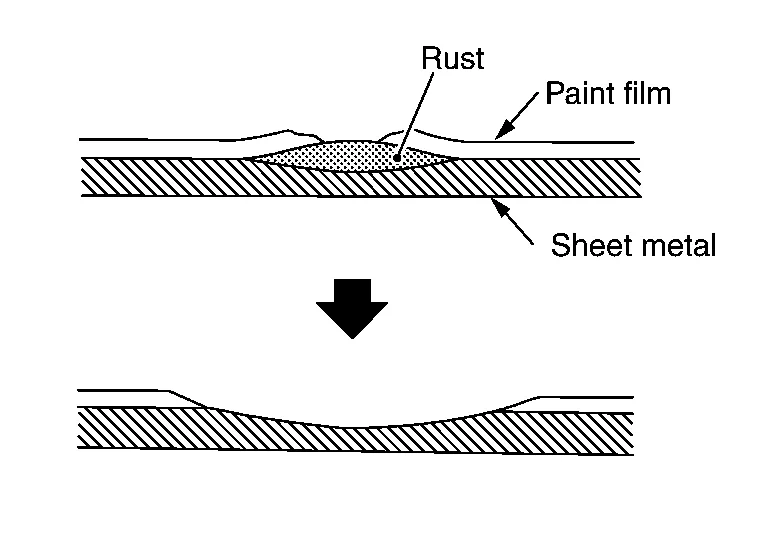
Rust may be more extensive than it appears from the outside. Therefore, it is necessary to grind the area around rusted portion. Repair the ground out portion using body filler.
(1) FILLING WITH FIBERGLASS
(a) Grind off the corroded portion of the panel with an air sander. If corrosion is severe, cut off the affected portion with a chisel or tinman's shears. Remove the paint from the surrounding areas.

(b) Hollow the area surrounding the repair hole by tapping with a hammer and bending the panel.

(c) Cut a piece of fiberglass cloth. The cloth should be large enough to overlap the repair hole.

Apply fiberglass putty to the cloth using a spatula until the mesh is filled. Prepare the fiberglass putty by mixing 100 parts of base with 2 to 3 parts of hardener.
(d) Apply a thin coat of fiberglass putty to the panel where the piece of fiberglass cloth is to be attached.

Apply putty also to the edge and back of the repair hole.
(e) Apply the piece of fiberglass cloth to the surrounding portion and the back of the repair hole.

This is necessary to prevent rust.
(f) Apply the piece of fiberglass cloth prepared in step (c) above to the repair hole. Press the periphery of the cloth to the panel for better adhesion. If the repair hole is large and the cloth sags in the center, support the cloth with tape applied behind the panel.

(g) Apply the fiberglass putty to the piece of fiberglass cloth. The fiberglass putty surface should be below the surrounding panel surface. If the area to be repaired is deep, use two or more piece of fiberglass cloth. In such a case, avoid thick application of fiberglass putty. Thick fiberglass putty will crack after drying.

(h) Dry the fiberglass putty, and grind the surface with an air sander. Then trim the entire panel using body filler.

When force drying fiberglass putty, allow the putty to sit for approximately 20 minutes. Then heat at a temperature below 60°C (140°F). Rapid heating which causes the putty to change color must be avoided, as it will lead to cracked putty. Fiberglass putty forms blowholes easily. Body filler must be used to finish the surface of fiberglass putty.
(2) PATCHING
(a) Remove the corroded portion of the panel.

Remove paint from the panel around the repair hole.
Make a flange by bending the surrounding panel with pliers and hammer, then apply anti-corrosive treatment (Metallic solution).
(b) Using tinman's shears, cut a patch large enough to overlap the repair hole. Apply the anti-corrosive treatment to the portion to be welded. Use of stainless steel is recommended to avoid rusting. If the repair hole is large, use a panel having the same thickness as the original panel to retain the original strength.

(c) Weld the patch to the repair hole. If stainless steel is used, use the MAG welding or spot welding method.

 NOTE:
NOTE:
When welding the patch by MAG welding, use the plug welding method.

(d) Apply the body filler to the repaired portion of the panel.

(e) Apply the anti-corrosive treatment to the back of the panel. If accessible from behind, apply a sealer to the panel-to-patch mating section.

(f) If inaccessible from behind, apply an anti-corrosive wax from an inner panel opening or the like. It is also important to apply the anti-corrosive treatment to other portions in addition to the repaired portion.

 Use of Body Filler (putty) and Grinding
Use of Body Filler (Putty) and Grinding
Panel irregularities may be corrected with a hammer and dolly. However, exact restoration of the original shape with these tools takes a long time...

Other information:
Nissan Murano (Z52) 2015-2024 Service Manual: B00d5 Passenger Air Bag Off Indicator
DTC Description DTC DETECTION LOGIC DTC No. CONSULT screen items (Trouble diagnosis content) DTC detecting condition B00D5-04 PASS A/B INDCTR CKT [UNIT MALFUNC] Diagnosis condition When ignition switch is ON. Signal (terminal) Front passenger air bag OFF indicator (terminal 54) Threshold — Diagnosis delay time — B00D5-15 PASS A/B INDCTR CKT [PWR-SHORT/OPEN] Diagnosis condition When ignition switch is ON...
Nissan Murano (Z52) 2015-2024 Owners Manual: Engine coolant temperature gauge
The gauge indicates the engine coolant temperature.The engine coolant temperature is within the normal range when the gauge needle points within the zone shown in the illustration. The engine coolant temperature varies with the outside air temperature and driving conditions...
Categories
- Manuals Home
- Nissan Murano Owners Manual
- Nissan Murano Service Manual
- Power Steering Fluid (PSF)
- High Beam Assist (if so equipped)
- Shift lock release
- New on site
- Most important about car
Luggage hooks
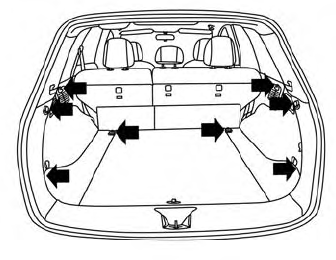
When securing items using luggage hooks located on the back of the seat or side finisher do not apply a load over more than 6.5 lbs. (29 N) to a single hook.
The luggage hooks that are located on the floor should have loads less than 110 lbs. (490 N) to a single hook.
