
Nissan Murano: Precautions when starting and driving / Rapid air pressure loss
Rapid air pressure loss or a “blow-out” can occur if the tire is punctured or is damaged due to hitting a curb or pothole. Rapid air pressure loss can also be caused by driving on under-inflated tires.
Rapid air pressure loss can affect the handling and stability of the vehicle, especially at highway speeds.
Help prevent rapid air pressure loss by maintaining the correct air pressure and visually inspecting the tires for wear and damage. For additional information, refer to “Wheels and tires” in the “Do-it-yourself” section of this manual. If a tire rapidly loses air pressure or “blows-out” while driving, maintain control of the vehicle by following the procedure below. Please note that this procedure is only a general guide. The vehicle must be driven as appropriate based on the conditions of the vehicle, road and traffic.
WARNING
If there is a sudden loss of tire air pressure, the vehicle will generally move or pull in the direction of the flat tire. In this situation, losing control of the vehicle may cause a collision and result in personal injury.
- To help avoid loss of control:
- Do not rapidly apply the brakes.
- Do not rapidly release the accelerator pedal.
- Donot rapidly turn the steering wheel.
- Remain calm and do not overreact.
- Maintain a firm grip on the steering wheel with both hands and try to hold a straight course.
- When appropriate, slowly release the accelerator pedal to gradually slow the vehicle.
- Gradually steer the vehicle to a safe location off the road and away from traffic if possible.
- Lightly apply the brake pedal to gradually stop the vehicle.
- Turn on the hazard warning flashers and contact a roadside emergency service to change the tire. For additional information, refer to “Changing a flat tire” in the “In case of emergency” section of this manual.
 Off-road recovery
While driving, the right side or left side
wheels may unintentionally leave the road
surface. If this occurs, maintain control of
the vehicle by following the procedure below...
 Drinking alcohol/drugs and driving
WARNING
Never drive under the influence of alcohol
or drugs. Alcohol in the bloodstream
reduces coordination, delays reaction
time and impairs judgement...
Other information:
Nissan Murano (Z52) 2015-2024 Service Manual: U1010 Control Unit(can)
DTC Description DTC DETECTION LOGIC DTC No. CONSULT screen terms (Trouble diagnosis content) DTC Detection Condition U1010 CONTROL UNIT(CAN) [Control unit (CAN)] Diagnosis condition When ignition switch ON. Signal (terminal) — Threshold — Diagnosis delay time 2 seconds or more POSSIBLE CAUSEBCMFAIL-SAFE— DTC Diagnosis Procedure Replace BCM When DTC U1010 is detected, replace BCM...
Nissan Murano (Z52) 2015-2024 Service Manual: Engine Does Not Start When Intelligent Key Is Inside of Vehicle (one Key)
Diagnosis Procedure Engine does not start when ignition switch is pressed. (One Intelligent Key has the symptom, other keys operate normally.)SYMPTOM TABLE (ONE INTELLIGENT KEY HAS THE SYMPTOM, OTHER KEYS OPERATE NORMALLY) Door lock operation (remote keyless entry) Door lock operation (request switch) or back door open operation (opener switch of back door panel) Engine started with push-button ignition switch operation (Intelligent Key is within the detection area of inside key antenna) Engine started with push-button ignition switch operation (registered Intelligent Key placed next to push-button ignition switch) OK OK No crank, No start No crank, No start DIAGNOSIS PROCEDURERefer to Diagnosis Procedure...
Categories
- Manuals Home
- Nissan Murano Owners Manual
- Nissan Murano Service Manual
- Vehicle Dynamic Control (VDC) OFF switch
- Warning lights
- Tire rotation
- New on site
- Most important about car
Seatback pockets
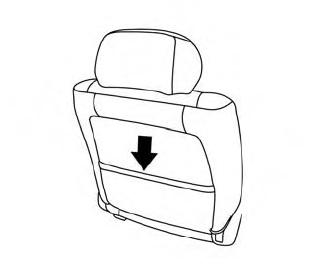
Theremaybe one or two seatback pockets located on the back of the driver and passenger seats. The pockets can be used to store maps.
WARNING
