
Nissan Murano: Driver Assistance System :: Driver Assistance System / Precaution. Precautions
The Supplemental Restraint System such as “AIR BAG” and “SEAT BELT PRE-TENSIONER”, used along with a front seat belt, helps to reduce the risk or severity of injury to the driver and front passenger for certain types of collisions.
Information necessary to service the system safely is included in the “SRS AIR BAG” and “SEAT BELT” sections of this Service Manual.
WARNING:
Always observe the following items for preventing accidental activation:
-
To avoid rendering the SRS inoperative, which could increase the risk of personal injury or death in the event of a collision that would result in air bag inflation, it is recommended that all maintenance and repair be performed by an authorized NISSAN/INFINITI dealer.
-
Improper repair, including incorrect removal and installation of the SRS, can lead to personal injury caused by unintentional activation of the system. For removal of Spiral Cable and Air Bag Module, see “SRS AIR BAG”.
-
Never use electrical test equipment on any circuit related to the SRS unless instructed to in this Service Manual. SRS wiring harnesses can be identified by yellow and/or orange harnesses or harness connectors.
PRECAUTIONS WHEN USING POWER TOOLS (AIR OR ELECTRIC) AND HAMMERS
WARNING:
Always observe the following items for preventing accidental activation:
-
When working near the Air Bag Diagnosis Sensor Unit or other Air Bag System sensors with the ignition/power switch ON or engine running, never use air or electric power tools or strike near the sensor(s) with a hammer. Heavy vibration could activate the sensor(s) and deploy the air bag(s), possibly causing serious injury.
-
When using air or electric power tools or hammers, always switch the ignition/power switch OFF, disconnect the 12V battery or batteries, and wait at least 3 minutes before performing any service.
ITS communication uses a twisted pair line. Be careful when repairing it.
-
Solder the repaired area and wrap tape around the soldered area.

 NOTE:
NOTE:
A fray of twisted lines must be within 110 mm (4.33 in).
-
Bypass connection is never allowed at the repaired area.
 NOTE:
NOTE:
Bypass connection may cause ITS communication error. The spliced wire becomes separated and the characteristics of twisted line are lost.
CAUTION:
-
Turn the MAIN switch OFF in conditions similar to driving, such as free rollers or a chassis dynamometer.
-
Never use the distance sensor removed from Nissan Murano vehicle. Never disassemble or remodel.
-
Erase DTC when replacing parts of ICC system, then check the operation of ICC system after adjusting radar alignment if necessary.
CAUTION:
-
Turn the I-FCW/AEB system OFF in conditions similar to driving, such as free rollers or a chassis dynamometer.
-
Do not use the distance sensor removed from Nissan Murano vehicle. Never disassemble or remodel.
-
Erase DTC when replacing parts of ICC system, then check the operation of ICC system after radar alignment if necessary.
-
Do not change I-FCW/AEB initial state ON⇒OFF without consent of the customer.
CAUTION:
-
Do not use the Blind Spot Warning/ Rear Cross Traffic Alert (RCTA) system when driving with free rollers or a chassis dynamometer.
-
Do not perform the active test while driving.
TO KEEP THE BLIND SPOT WARNING/Rear Cross Traffic Alert (RCTA) SYSTEM OPERATING PROPERLY, BE SURE TO OBSERVE THE FOLLOWING ITEMS:
System Maintenance
The side radars for the Blind Spot Warning and Rear Cross Traffic Alert (RCTA) system are located near the rear bumper.
-
Be sure to keep the area near the side radars clean.
-
Do not attach stickers (including transparent material), install accessories or apply additional paint near the side radars.
-
Do not strike or damage the area around the side radars.
WARNING:
Be careful of traffic conditions and safety around the vehicle when performing road test.
WARNING:
Be careful of traffic conditions and safety around the vehicle when performing road test.
CAUTION:
-
Do not use the I-LI system when driving with free rollers or a chassis dynamometer.
-
Do not perform the active test while driving.
-
Do not disassemble the lane camera unit.
-
Do not use the lane camera unit that is removed from the Nissan Murano vehicle.
-
Do not change I-LI initial state ON ⇒ OFF without the consent of the customer.
WARNING:
Be careful of traffic conditions and safety around the vehicle when performing road test.
CAUTION:
-
Do not use the Blind Spot Intervention system when driving with free rollers or a chassis dynamometer.
-
Do not perform the active test while driving.
-
Do not disassemble the lane camera unit.
-
Do not use the lane camera unit that is removed from the Nissan Murano vehicle.
-
Do not change BSW initial state ON ⇒ OFF without the consent of the customer.
TO KEEP THE BLIND SPOT WARNING/BLIND SPOT INTERVENTION SYSTEM OPERATING PROPERLY, BE SURE TO OBSERVE THE FOLLOWING ITEMS:
Lane Camera Unit Maintenance
The lane camera unit for the LDW/LDP system is located above the inside mirror. To keep the proper operation of the LDW/LDP systems and prevent a system malfunction, be sure to observe the following:
-
Always keep the windshield clean.
-
Do not attach a sticker (including transparent material) or install an accessory near the camera unit.
-
Do not place reflective materials, such as white paper or a mirror, on the instrument panel. The reflection of sunlight may adversely affect the camera unit capability of detecting the lane markers.
-
Do not strike or damage the areas around the camera unit.
-
Do not touch the camera lens or remove the screw located on the camera unit.
System Maintenance
The two side radar for the Blind Spot Warning and Blind Spot Intervention systems are located near the rear bumper.
-
Always keep the area near the side radar clean.
-
Do not attach stickers (including transparent material), install accessories or apply additional paint near the side radar.
-
Do not strike or damage the area around the side radar.
-
When removing or disassembling each component, be careful not to damage or deform it. If a component may be subject to interference, be sure to protect it with a shop cloth.
-
When removing (disengaging) components with a screwdriver or similar tool, be sure to wrap the component with a shop cloth or vinyl tape to protect it.
-
Protect the removed parts with a shop cloth and prevent them from being dropped.
-
Replace a deformed or damaged clip.
-
If a part is specified as a non-reusable part, always replace it with a new one.
-
Be sure to tighten bolts and nuts securely to the specified torque.
-
After installation is complete, be sure to check that each part works properly.
-
Follow the steps below to clean components:
-
Water soluble dirt:
-
Dip a soft cloth into lukewarm water, wring the water out of the cloth and wipe the dirty area.
-
Then rub with a soft, dry cloth.
-
-
Oily dirt:
-
Dip a soft cloth into lukewarm water with mild detergent (concentration: within 2 to 3%) and wipe the dirty area.
-
Then dip a cloth into fresh water, wring the water out of the cloth and wipe the detergent off.
-
Then rub with a soft, dry cloth.
-
-
Do not use organic solvent such as thinner, benzene, alcohol or gasoline.
-
For genuine leather seats, use a genuine leather seat cleaner.
-


Other information:
Nissan Murano (Z52) 2015-2024 Owners Manual: I-LI system limitations
WARNING Listed below are the system limitations for the I-LI system. Failure to follow the warnings and instructions for proper use of the I-LI system could result in serious injury or death. The I-LI system may activate if you change lanes without first activating your turn signal or, for example, if a construction zone directs traffic to cross an existing lane marker...
Nissan Murano (Z52) 2015-2024 Service Manual: Its Can Communication Circuit
Diagnosis Procedure CHECK CAN DIAGNOSIS Check the CAN diagnosis results from CONSULT to see that the Nissan Murano vehicle CAN communication circuit has no malfunction. Are the vehicle CAN communication circuits normal? YES>> GO TO 2. NO>> Check and repair Nissan Murano vehicle CAN communication circuit...
Categories
- Manuals Home
- Nissan Murano Owners Manual
- Nissan Murano Service Manual
- Power Steering Fluid (PSF)
- Jacking up vehicle and removing the damaged tire
- How to enable/disable the LDW system
- New on site
- Most important about car
LATCH (Lower Anchors and Tethers for CHildren) system
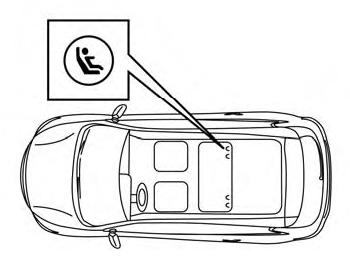
LATCH system lower anchor locations - bench seat
Your vehicle is equipped with special anchor points that are used with LATCH system compatible child restraints. This system may also be referred to as the ISOFIX or ISOFIX compatible system. With this system, you do not have to use a vehicle seat belt to secure the child restraint unless the combined weight of the child and child restraint exceeds 65 lbs. (29.5 kg). If the combined weight of the child and child restraint is greater than 65 lbs. (29.5 kg), use the vehicle’s seat belt (not the lower anchors) to install the child restraint. Be sure to follow the child restraint manufacturer’s instructions for installation.
