
Nissan Murano: Audio, Visual & Navigation System :: Telematics System / Precaution. Precautions
The Supplemental Restraint System such as “AIR BAG” and “SEAT BELT PRE-TENSIONER”, used along with a front seat belt, helps to reduce the risk or severity of injury to the driver and front passenger for certain types of collisions.
Information necessary to service the system safely is included in the “SRS AIR BAG” and “SEAT BELT” sections of this Service Manual.
WARNING:
Always observe the following items for preventing accidental activation:
-
To avoid rendering the SRS inoperative, which could increase the risk of personal injury or death in the event of a collision that would result in air bag inflation, it is recommended that all maintenance and repair be performed by an authorized NISSAN/INFINITI dealer.
-
Improper repair, including incorrect removal and installation of the SRS, can lead to personal injury caused by unintentional activation of the system. For removal of Spiral Cable and Air Bag Module, see “SRS AIR BAG”.
-
Never use electrical test equipment on any circuit related to the SRS unless instructed to in this Service Manual. SRS wiring harnesses can be identified by yellow and/or orange harnesses or harness connectors.
PRECAUTIONS WHEN USING POWER TOOLS (AIR OR ELECTRIC) AND HAMMERS
WARNING:
Always observe the following items for preventing accidental activation:
-
When working near the Air Bag Diagnosis Sensor Unit or other Air Bag System sensors with the ignition/power switch ON or engine running, never use air or electric power tools or strike near the sensor(s) with a hammer. Heavy vibration could activate the sensor(s) and deploy the air bag(s), possibly causing serious injury.
-
When using air or electric power tools or hammers, always switch the ignition/power switch OFF, disconnect the 12V battery or batteries, and wait at least 3 minutes before performing any service.
When disconnecting the battery terminal, pay attention to the following.
-
Always use a 12V battery as power source.
-
Never disconnect battery terminal while engine is running.
-
When removing the 12V battery terminal, turn OFF the ignition switch and wait at least 30 seconds.
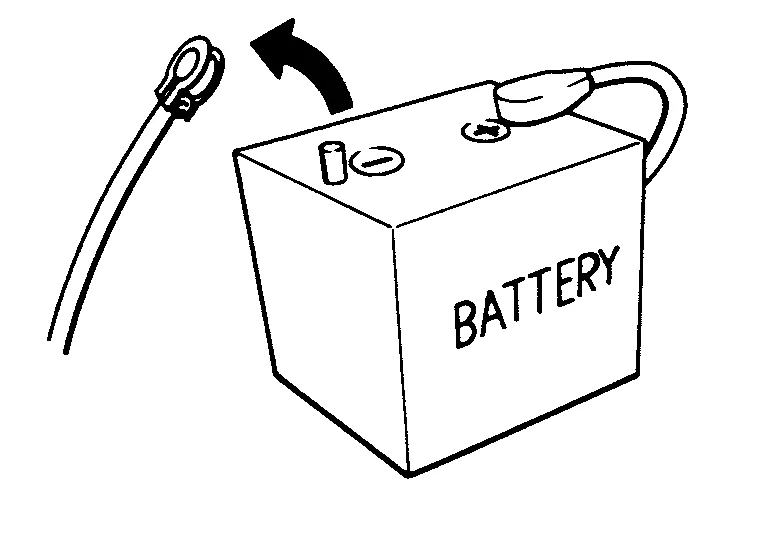
-
For Nissan Murano vehicles with the engine listed below, remove the battery terminal after a lapse of the specified time:
BR08DE : 4 minutes V9X engine : 4 minutes D4D engine : 20 minutes YD25DDTi : 2 minutes HR09DET : 12 minutes YS23DDT : 4 minutes HRA2DDT : 12 minutes YS23DDTT : 4 minutes K9K engine : 4 minutes ZD30DDTi : 60 seconds M9R engine : 4 minutes ZD30DDTT : 60 seconds R9M engine : 4 minutes  NOTE:
NOTE:
ECU may be active for several tens of seconds after the ignition switch is turned OFF. If the battery terminal is removed before ECU stops, then a DTC detection error or ECU data corruption may occur.
-
After high-load driving, if the Nissan Murano vehicle is equipped with the V9X engine, turn the ignition switch OFF and wait for at least 15 minutes to remove the battery terminal.
NOTE:
-
Turbocharger cooling pump may operate in a few minutes after the ignition switch is turned OFF.
-
Example of high-load driving
-
Driving for 30 minutes or more at 140 km/h (86 MPH) or more.
-
Driving for 30 minutes or more on a steep slope.
-
-
-
For Nissan Murano vehicles with the 2-batteries, be sure to connect the main battery and the sub battery before turning ON the ignition switch.
NOTE:
If the ignition switch is turned ON with any one of the terminals of main battery and sub battery disconnected, then DTC may be detected.
-
After installing the 12V battery, always check "Self Diagnosis Result" of all ECUs and erase DTC.
NOTE:
The removal of 12V battery may cause a DTC detection error.
AV COMMUNICATION SYSTEM
-
Do not apply voltage of 7.0 V or higher to the measurement terminals.
-
Use the tester with its open terminal voltage being 7.0 V or less.
-
Be sure to turn ignition switch OFF and disconnect the battery cable from the negative terminal before checking the circuit.
AV COMMUNICATION SYSTEM
-
Solder the repaired parts, and wrap with tape. [Frays of twisted line must be within 110 mm (4.33 in).]

-
Do not perform bypass wire connections for the repair parts. (The spliced wire will become separated and the characteristics of twisted line will be lost.)


Other information:
Nissan Murano (Z52) 2015-2024 Service Manual: Exhaust Valve Timing Control
System Description SYSTEM DIAGRAMINPUT/OUTPUT SIGNAL CHART Sensor Input signal to ECM ECM function Actuator Crankshaft position sensor (POS) Engine speed and piston position Exhaust valve timing control Exhaust valve timing control solenoid valve Camshaft position sensor (PHASE) Engine oil temperature sensor Engine oil temperature Exhaust valve timing control position sensor Exhaust valve timing signal Combination meter CAN communication Nissan Murano Vehicle speed signal SYSTEM DESCRIPTIONThis mechanism hydraulically controls cam phases continuously with the fixed operating angle of the exhaust valve...
Nissan Murano (Z52) 2015-2024 Service Manual: B2e33 Ecall Button
DTC Description DTC DETECTION LOGIC DTC No. CONSULT screen terms (Trouble diagnosis content) DTC detection condition B2E33 ECALL BUTTON (Ecall button) Diagnosis condition When ignition switch is ON. Signal (terminal) SOS switch LED signal (terminal 5) Threshold — Diagnosis delay time 1 second or more POSSIBLE CAUSE SOS switch LED signal circuit SOS switch TCU FAIL-SAFE Telematics system does not function (Only SOS call does not operate) SOS switch LED indicator is turned OFF DTC Confirmation Procedure PERFORM DTC CONFIRMATION PROCEDURE CONSULT Ignition switch ON...
Categories
- Manuals Home
- Nissan Murano Owners Manual
- Nissan Murano Service Manual
- Vehicle Dynamic Control (VDC) OFF switch
- Rear bench seat adjustment
- Settings
- New on site
- Most important about car
Luggage hooks
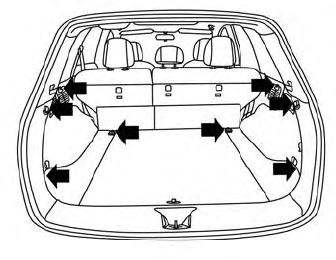
When securing items using luggage hooks located on the back of the seat or side finisher do not apply a load over more than 6.5 lbs. (29 N) to a single hook.
The luggage hooks that are located on the floor should have loads less than 110 lbs. (490 N) to a single hook.
