
Nissan Murano: System / Power Consumption Control System
SYSTEM DIAGRAM
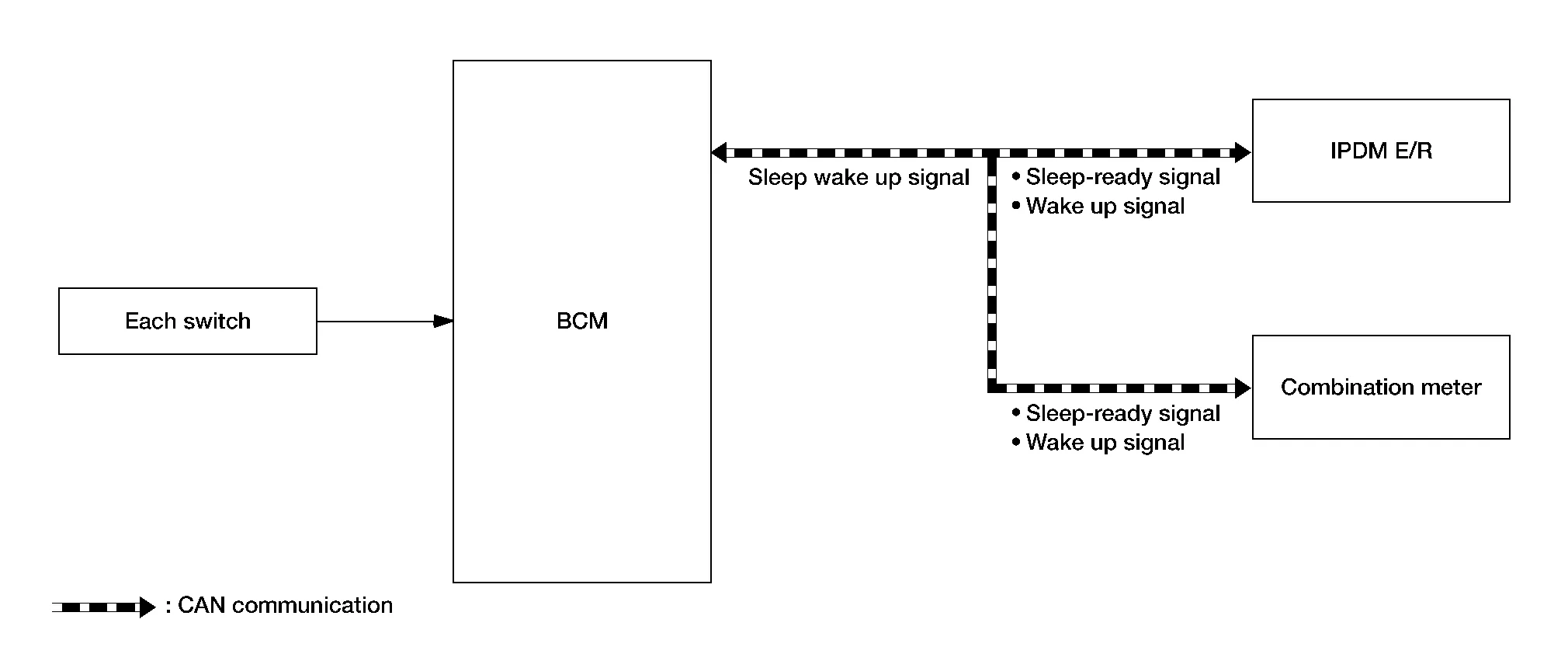
INPUT SIGNAL AND OUTPUT SIGNAL
Major signal transmission between each unit via communication lines is shown in the following table:
| Component parts | Signal description |
|---|---|
| IPDM E/R |
|
| Combination meter | |
| BCM |
|
DESCRIPTION
-
IPDM E/R incorporates a power consumption control function that reduces the power consumption according to the Nissan Murano vehicle status.
-
IPDM E/R changes its status (control mode) with the sleep wake up signal received from BCM via CAN communication.
Normal mode (wake-up)
-
CAN communication is normally performed with other control units.
-
Individual unit control by IPDM E/R is normally performed.
Low power consumption mode (sleep)
-
Low power consumption control is active.
-
CAN transmission is stopped.
-
SLEEP MODE ACTIVATION
-
IPDM E/R judges that the sleep-ready conditions are fulfilled when the ignition switch is OFF and none of the conditions below are present. Then it transmits a sleep-ready signal (ready) to BCM via CAN communication.
-
Front wiper fail-safe operation
-
Outputting signals to actuators
-
Switches or relays operating
-
Auto active test is starting
-
Emergency OFF
-
Output requests are being received from control units via CAN communication.
-
-
IPDM E/R stops CAN communication and enters the low power consumption mode when it receives a sleep wake up signal (sleep) from BCM and the sleep-ready conditions are fulfilled.
WAKE-UP OPERATION
-
IPDM E/R changes from the low power consumption mode to the normal mode when it receives a sleep wake-up signal (wake up) from BCM or any of the following conditions is fulfilled. In addition, it transmits a sleep-ready signal (not-ready) to BCM via CAN communication to report the CAN communication start.
-
Ignition switch ON
-
An output request is received from a control unit via CAN communication.
-
IGNITION BATTERY SAVER LOGIC
If ignition switch ON for a period of time with the engine OFF, the IPDM E/R and BCM turn OFF to save the battery.
 Relay Control System
System Description
SYSTEM DIAGRAMSystem DescriptionIPDM E/R activates the internal control circuit to perform the relay ON-OFF control according to the input signals from various sensors and the request signals received from control units via CAN communication...
 Diagnosis System (ipdm E/r)
Diagnosis Description
AUTO ACTIVE TESTDescriptionIn auto active test mode, the IPDM E/R sends a drive signal to the following systems to check their operation:
Front wiper (LO, HI)
Front fog lamps
Parking lamps
Side marker lamps
Tail lamps
License plate lamps
Headlamps (LO, HI)
A/C compressor
Cooling fans (LO, HI)
Operation ProcedureCAUTION:
Do not start the engine...
Other information:
Nissan Murano (Z52) 2015-2024 Owners Manual: Turning the I-FCW system on/off
Perform the following steps to turn the I-FCW system on or off. Press the button until “Settings” displays in the vehicle information display and then press the OK button. Use the button to select “Driver Assistance.” Then press the OK button...
Nissan Murano (Z52) 2015-2024 Service Manual: Electric Resistance Spot Welding
Principles of Spot Welding Resistance spot welding is a kind of electric resistance welding. It is classified as pressure welding. Two or three sheets of metal are overlapped and pressed, and current is passed through the mating surfaces. As the current flows, the metals melt due to Joule heat at the mating surfaces and are joined by the pressure...
Categories
- Manuals Home
- Nissan Murano Owners Manual
- Nissan Murano Service Manual
- Vehicle Dynamic Control (VDC) OFF switch
- High Beam Assist (if so equipped)
- Shift lock release
- New on site
- Most important about car
Luggage hooks
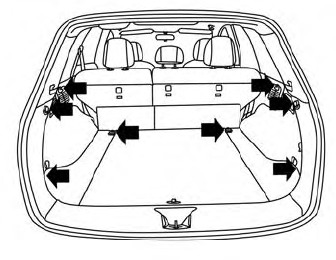
When securing items using luggage hooks located on the back of the seat or side finisher do not apply a load over more than 6.5 lbs. (29 N) to a single hook.
The luggage hooks that are located on the floor should have loads less than 110 lbs. (490 N) to a single hook.
