
Nissan Murano: Dtc/circuit Diagnosis / P0130 A/f Sensor 1
DTC DETECTION LOGIC
To judge malfunctions, the diagnosis checks that the A/F signal computed by ECM from the A/F sensor 1 signal fluctuates according to fuel feedback control.
-
The A/F signal computed by ECM from the A/F sensor 1 signal is constantly in a range other than approx. 2.2 V.
-
The A/F signal computed by ECM from the A/F sensor 1 signal is constantly approx. 2.2 V.
| DTC |
CONSULT screen terms (Trouble diagnosis content) |
DTC detection condition | ||
| P0130 |
A/F SENSOR1 (B1) (O2 sensor circuit bank 1 sensor 1) |
1 | Diagnosis condition | — |
| Signal (terminal) | The A/F signal computed by ECM | |||
| Threshold | The A/F signal computed by ECM from the A/F sensor 1 signal is constantly in a range other than approx. 2.2 V | |||
| Diagnosis delay time | — | |||
| 2 | Diagnosis condition | — | ||
| Signal (terminal) | The A/F signal computed by ECM | |||
| Threshold | The A/F signal computed by ECM from the A/F sensor 1 signal is constantly approx. 2.2 V | |||
| Diagnosis delay time | — | |||
POSSIBLE CAUSE
P0130 - 1
-
Harness or connectors (The A/F sensor 1 circuit is open or shorted.)
-
A/F sensor 1
P0130 - 2
-
Harness or connectors (The A/F sensor 1 circuit is open or shorted.)
-
A/F sensor 1
FAIL-SAFE
Not applicable
PRECONDITIONING
If DTC Confirmation Procedure has been previously conducted, always perform the following before conducting the next test.
-
Turn ignition switch OFF and wait at least 10 seconds.
-
Turn ignition switch ON.
-
Turn ignition switch OFF and wait at least 10 seconds.
TESTING CONDITION:
Before performing the following procedure, confirm that battery voltage is more than 11 V at idle.
>>
GO TO 2.
PERFORM DTC CONFIRMATION PROCEDURE FOR MALFUNCTION 1
-
Start engine and warm it up to normal operating temperature.
-
Let engine idle for 2 minutes.
-
Check 1st trip DTC.
Is 1st trip DTC detected?
YES>>Proceed to Diagnosis Procedure.
NO>>With CONSULT: GO TO 3.
NO>>With GST: GO TO 7.
CHECK AIR FUEL RATIO (A/F) SENSOR 1 FUNCTION
-
Start engine and warm it up to normal operating temperature.
-
Select “A/F SEN1 (B1)” in “DATA MONITOR” mode with CONSULT.
-
Check “A/F SEN1 (B1)” indication.
Does the indication fluctuate around 2.2 V?
YES>>GO TO 4.
NO>>Proceed to Diagnosis Procedure.
PERFORM DTC CONFIRMATION PROCEDURE FOR MALFUNCTION 2-I
-
Select “A/F SEN1 (B1) P1276” (for DTC P0130) of “A/F SEN1” in “DTC WORK SUPPORT” mode with CONSULT.
-
Touch “START”.
-
When the following conditions are met, “TESTING” will be displayed on the CONSULT screen.
ENG SPEED 1,000 - 3,200 rpm VHCL SPEED SE More than 64 km/h (40 mph) B/FUEL SCHDL 1.0 - 10.0 msec Selector lever D position If “TESTING” is not displayed after 20 seconds, retry from step 2.
CAUTION:
Always drive Nissan Murano vehicle at a safe speed.
Is “TESTING” displayed on CONSULT screen?
YES>>GO TO 5.
NO>>Check A/F sensor 1 function again. GO TO 3.
PERFORM DTC CONFIRMATION PROCEDURE FOR MALFUNCTION 2-II
Release accelerator pedal fully.
 NOTE:
NOTE:
Never apply brake when releasing the accelerator pedal.
Which does “TESTING” change to?
COMPLETED>>GO TO 6.
OUT OF CONDITION>>Retry DTC CONFIRMATION PROCEDURE. GO TO 4.
PERFORM DTC CONFIRMATION PROCEDURE FOR MALFUNCTION 2-III
Touch “SELF-DIAG RESULT”.
Which is displayed on CONSULT screen?
OK-1>>To check malfunction symptom before repair: Refer to Intermittent Incident.
OK-2>>Confirmation after repair: INSPECTION END
NG>>Proceed to Diagnosis Procedure.
PERFORM COMPONENT FUNCTION CHECK
 With GST
-
Start engine and warm it up to normal operating temperature.
-
Drive the Nissan Murano vehicle at a speed of 80 km/h (50 MPH) for a few minutes in the suitable gear position.
-
Shift the selector lever to the D position, then release the accelerator pedal fully until the Nissan Murano vehicle speed decreases to 50 km/h (31 MPH).
CAUTION:
Always drive vehicle at a safe speed.
NOTE:
Never apply brake when releasing the accelerator pedal.
-
Repeat steps 2 and 3 for 5 times.
-
Stop the Nissan Murano vehicle and turn ignition switch OFF.
-
Wait at least 10 seconds and restart engine.
-
Repeat steps 2 and 3 for 5 times.
-
Stop the Nissan Murano vehicle.
-
Check 1st trip DTC.
Is 1st trip DTC detected?
YES>>Proceed to Diagnosis Procedure.
NO>>To check malfunction symptom before repair: Refer to Intermittent Incident.
NO>>Confirmation after repair: INSPECTION END
CHECK AIR FUEL RATIO (A/F) SENSOR 1 POWER SUPPLY
-
Disconnect A/F sensor 1 harness connector.
-
Turn ignition switch ON.
-
Check the voltage between A/F sensor 1 harness connector and ground.
A/F sensor 1 Ground Voltage Bank Connector Terminal 1 F12 1 Ground Battery voltage
Is the inspection result normal?
YES>>GO TO 3.
NO>>GO TO 2.
CHECK AIR FUEL RATIO (A/F) SENSOR 1 POWER SUPPLY CIRCUIT
-
Turn ignition switch OFF.
-
Disconnect IPDM E/R harness connector.
-
Check the continuity between A/F sensor 1 harness connector and IPDM E/R harness connector.
| A/F sensor 1 | IPDM E/R | Continuity | |||
|---|---|---|---|---|---|
| Bank | Connector | Terminal | Connector | Terminal | |
| 1 | F12 | 1 | F19 | 52 | Existed |
Is the inspection result normal?
YES>>Perform the trouble diagnosis for power supply circuit.
NO>>Repair or replace error-detected parts.
CHECK A/F SENSOR 1 INPUT SIGNAL CIRCUIT
-
Turn ignition switch OFF.
-
Disconnect ECM harness connector.
-
Check the continuity between A/F sensor 1 harness connector and ECM harness connector .
A/F sensor 1 ECM Continuity Bank Connector Terminal Connector Terminal 1 F12 3 F79 66 Existed 4 67 -
Check the continuity between A/F sensor 1 harness connector and ground, or ECM harness connector and ground.
A/F sensor 1 Ground Continuity Bank Connector Terminal 1 F12 3 Ground Not existed 4 ECM Ground Continuity Connector Terminal F79 66 Ground Not existed 67 -
Also check harness for short to power.
Is the inspection result normal?
YES>>INSPECTION END
NO>>Repair open circuit, short to ground or short to power in harness or connectors.
 P0128 Thermostat Function
DTC Description
DTC DETECTION LOGICEngine coolant temperature has not risen enough to open the thermostat even though the engine has run long enough.This is due to a leak in the seal or the thermostat being stuck open...
 P0131 A/f Sensor 1
DTC Description
DTC DETECTION LOGICTo judge the malfunction, the diagnosis checks that the A/F signal computed by ECM from the A/F sensor 1 signal is not inordinately low...
Other information:
Nissan Murano (Z52) 2015-2024 Service Manual: Air Breather Hose
Exploded View 1. Air cleaner case 2. Air breather hose 3. Transaxle assembly 4. Heater pipe 5. Clip Front Removal and Installation REMOVALRemove the front air duct, air cleaner cases (upper and lower) with mass air flow sensor and air duct assembly...
Nissan Murano (Z52) 2015-2024 Service Manual: P2122 App Sensor
DTC Description DTC DETECTION LOGIC An excessively low voltage from the APP sensor 1 is sent to ECM. An excessively high voltage from the APP sensor 1 is sent to ECM. DTC CONSULT screen terms (Trouble diagnosis content) DTC detection condition P2122 APP SEN 1/CIRC (Throttle/Pedal position sensor/switch “D” circuit low) Diagnosis condition Start engine and let it idle Signal (terminal) Voltage signal transmitted from APP sensor 1 to ECM Threshold An excessively low voltage is sent to ECM Diagnosis delay time — P2123 APP SEN 1/CIRC (Throttle/Pedal position sensor/switch “D” circuit high) Diagnosis condition Start engine and let it idle Signal (terminal) Voltage signal transmitted from APP sensor 1 to ECM Threshold An excessively high voltage is sent to ECM Diagnosis delay time — POSSIBLE CAUSEDTC P2122 Harness or connectors (APP sensor 1 circuit is open or shorted...
Categories
- Manuals Home
- Nissan Murano Owners Manual
- Nissan Murano Service Manual
- Intelligent Forward Collision Warning (I-FCW)
- Fuel recommendation
- How to enable/disable the LDW system
- New on site
- Most important about car
LATCH (Lower Anchors and Tethers for CHildren) system
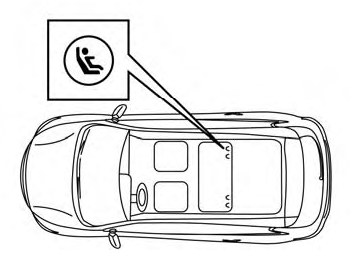
LATCH system lower anchor locations - bench seat
Your vehicle is equipped with special anchor points that are used with LATCH system compatible child restraints. This system may also be referred to as the ISOFIX or ISOFIX compatible system. With this system, you do not have to use a vehicle seat belt to secure the child restraint unless the combined weight of the child and child restraint exceeds 65 lbs. (29.5 kg). If the combined weight of the child and child restraint is greater than 65 lbs. (29.5 kg), use the vehicle’s seat belt (not the lower anchors) to install the child restraint. Be sure to follow the child restraint manufacturer’s instructions for installation.
