Nissan Murano: Cooler Pipe and Hose / Low-Pressure Flexible Hose
REMOVAL
Discharge the refrigerant. Refer to Recycle Refrigerant.
Remove the front under cover. Refer to Exploded View.
Remove the low-pressure flexible hose bolt from the internal heat exchanger.
CAUTION:
Cap or wrap the joint of the pipe with suitable material such as vinyl tape to avoid the entry of air.
Remove the low-pressure flexible hose bolt from the compressor.
CAUTION:
Cap or wrap the joint of the pipe with suitable material such as vinyl tape to avoid the entry of air.
Remove the low-pressure flexible hose.
INSTALLATION
Installation is in the reverse order of removal.
CAUTION:
-
Do not reuse O-rings.
-
Apply A/C oil to the O-rings of the low-pressure flexible hose for installation.
-
After charging refrigerant, check for leaks. Refer to Leak Test.
 High-Pressure Pipe
Removal and Installation
REMOVALDischarge the refrigerant. Refer to Recycle Refrigerant.
Remove the power steering oil pump assembly. Refer to Removal and Installation...
 Internal Heat Exchanger
Removal and Installation
REMOVALDischarge the refrigerant. Refer to Recycle Refrigerant.
Remove the engine room cover. Refer to Removal and Installation...
Other information:
Nissan Murano (Z52) 2015-2024 Service Manual: Warning Function
System Description OPERATION DESCRIPTIONThe warning functions are as per the following items and are given to the user as warning information and warnings using combinations of Intelligent Key warning buzzer, combination meter buzzer, KEY warning lamp and information display in combination meter: Intelligent Key system malfunction OFF position warning P position warning Take away warning Door lock operation warning Engine start information Intelligent Key low battery warning Key ID warning Key ID verification information OPERATION CONDITIONOnce the following condition from below is established, alert or warning is executed: Warning/Information functions Operation procedure Intelligent Key system malfunction When a malfunction is detected on BCM, “KEY” warning lamp illuminates...
Nissan Murano (Z52) 2015-2024 Service Manual: Squeak and Rattle Trouble Diagnoses
Work Flow CUSTOMER INTERVIEWInterview the customer if possible, to determine the conditions that exist when the noise occurs. Use the Diagnostic Worksheet during the interview to document the facts and conditions when the noise occurs and any customer's comments; refer to Diagnostic Worksheet...
Categories
- Manuals Home
- Nissan Murano Owners Manual
- Nissan Murano Service Manual
- How to enable/disable the LDW system
- Warning lights
- Jacking up vehicle and removing the damaged tire
- New on site
- Most important about car
Unfastening the seat belts. Checking seat belt operation
Unfastening the seat belts
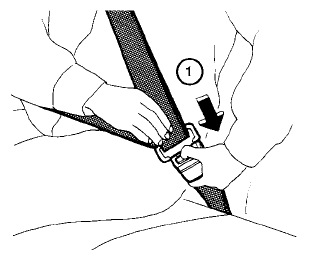
To unfasten the seat belt, press the button
on the buckle  . The seat belt
automatically
retracts.
