
Nissan Murano: Intelligent Forward Collision Warning (I-FCW) / I-FCW system limitations
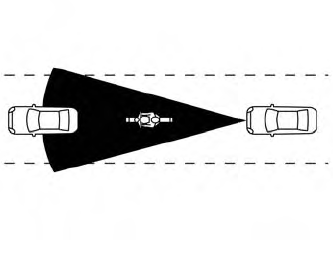
Illustration A
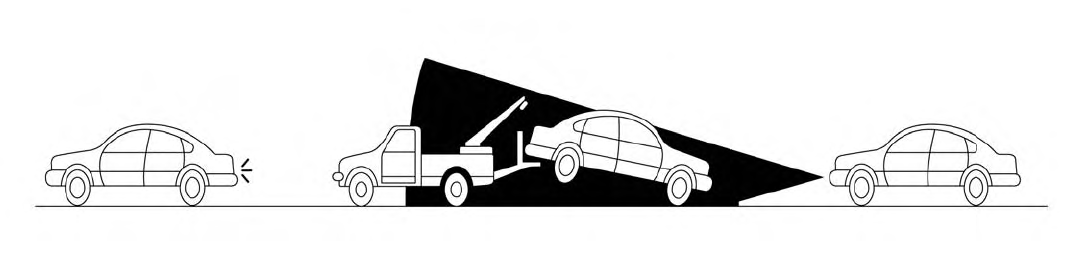
Illustration B
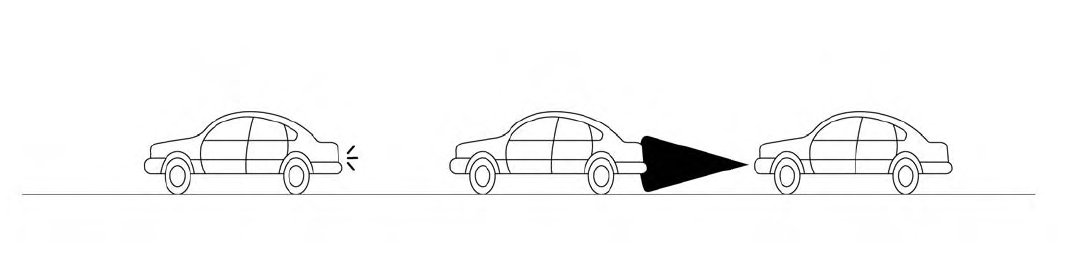
Illustration C
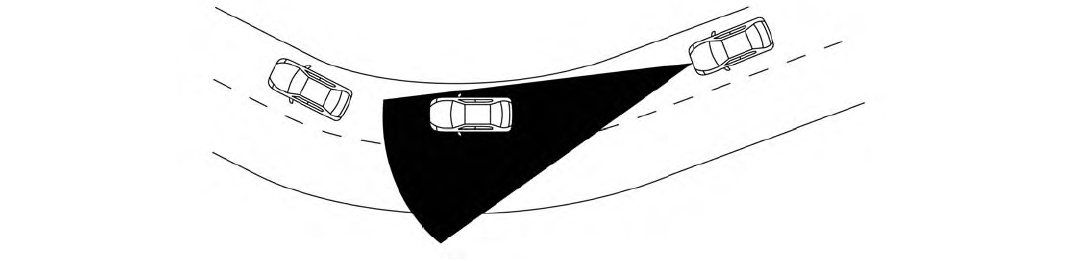
Illustration D
WARNING
Listed below are the system limitations for the I-FCW system. Failure to operate the vehicle in accordance with these system limitations could result in serious injury or death.
- The I-FCW system cannot detect all vehicles under all conditions.
- The radar sensor does not detect the
following objects:
- Pedestrians, animals or obstacles in the roadway
- Oncoming vehicles
- Crossing vehicles
- (Illustration A) The I-FCW system does not function when a vehicle ahead is a narrow vehicle, such as a motorcycle.
- The radar sensor may not detect a vehicle
ahead in the following
conditions:
- Snow or heavy rain
- Dirt, ice, snow or other material covering the radar sensor.
- Interference by other radar sources.
- Snow or road spray from traveling vehicles.
- Driving in a tunnel
- (Illustration B) When the vehicle ahead is being towed.
- (Illustration C) When the distance to the vehicle ahead is too close, the beam of the radar sensor is obstructed.
- (Illustration D) When driving on a steep downhill slope or roads with sharp curves.
- The system is designed to automatically check the sensor’s functionality, within certain limitations. The system may not detect some forms of obstruction of the sensor area such as ice, snow, stickers, etc. In these cases, the system may not be able to warn the driver properly. Be sure that you check, clean and clear the sensor area regularly.
- Excessive noise will interfere with the warning chime sound, and the chime may not be heard.
 Turning the I-FCW system on/off
Perform the following steps to turn the
I-FCW system on or off.
Press the button until
“Settings”
displays in the vehicle information display
and then press the OK button...
 System temporarily unavailable
Condition A
When the radar sensor picks up interference
from another radar source, making it
impossible to detect a vehicle ahead, the
I-FCW system is automatically turned off...
Other information:
Nissan Murano (Z52) 2015-2024 Service Manual: System. Power Distribution System
System Description SYSTEM DIAGRAMSignal transmission function list Signal name Input Output Description Push-button ignition switch signal Push-button ignition switch BCM Transmits the push-button ignition switch signal to the BCM. ACC/ON indicator lamp signal BCM Push-button ignition switch Activates/deactivates push-button ignition switch illumination using the ACC/ON indicator lamp signal...
Nissan Murano (Z52) 2015-2024 Service Manual: C1a04-97 Abs/tcs/vdc Circ
DTC Description DTC DETECTION LOGIC DTC No. CONSULT screen items (Trouble diagnosis content) DTC detection condition C1A04-97 ABS/TCS/VDC CIRC (ABS/TCS/VDC circuit) Diagnosis condition When engine is running When MAIN switch of ICC system is ON Signal (terminal) — Threshold If a malfunction occurs in the VDC/TCS/ABS system Diagnosis delay time 60 seconds or more POSSIBLE CAUSEABS actuator and electric unit (control unit)FAIL-SAFEThe following systems are canceled: Vehicle-to-vehicle distance control mode Conventional (fixed speed) cruise control mode Automatic Emergency Braking (AEB) with pedestrian detection Automatic Emergency Braking (AEB) Intelligent Forward Collision Warning (I-FCW) Lane Departure Warning (LDW) Intelligent Lane Intervention (I-LI) Blind Spot Warning (BSW) Rear Cross Traffic Alert (RCTA) Rear Automatic Braking (RAB) Confirmation Procedure CHECK DTC PRIORITY If DTC “C1A04–97” is displayed with DTC “U1000–01”, first diagnose the DTC “U1000–01”...
Categories
- Manuals Home
- Nissan Murano Owners Manual
- Nissan Murano Service Manual
- Jacking up vehicle and removing the damaged tire
- Warning lights
- Memory storage function (key-link)
- New on site
- Most important about car
LATCH (Lower Anchors and Tethers for CHildren) system
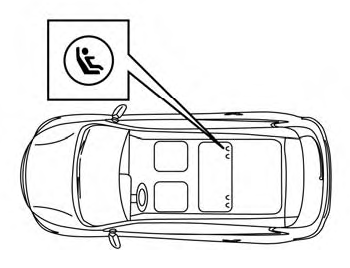
LATCH system lower anchor locations - bench seat
Your vehicle is equipped with special anchor points that are used with LATCH system compatible child restraints. This system may also be referred to as the ISOFIX or ISOFIX compatible system. With this system, you do not have to use a vehicle seat belt to secure the child restraint unless the combined weight of the child and child restraint exceeds 65 lbs. (29.5 kg). If the combined weight of the child and child restraint is greater than 65 lbs. (29.5 kg), use the vehicle’s seat belt (not the lower anchors) to install the child restraint. Be sure to follow the child restraint manufacturer’s instructions for installation.
