
Nissan Murano: System / Exit Assist Function
SYSTEM DIAGRAM
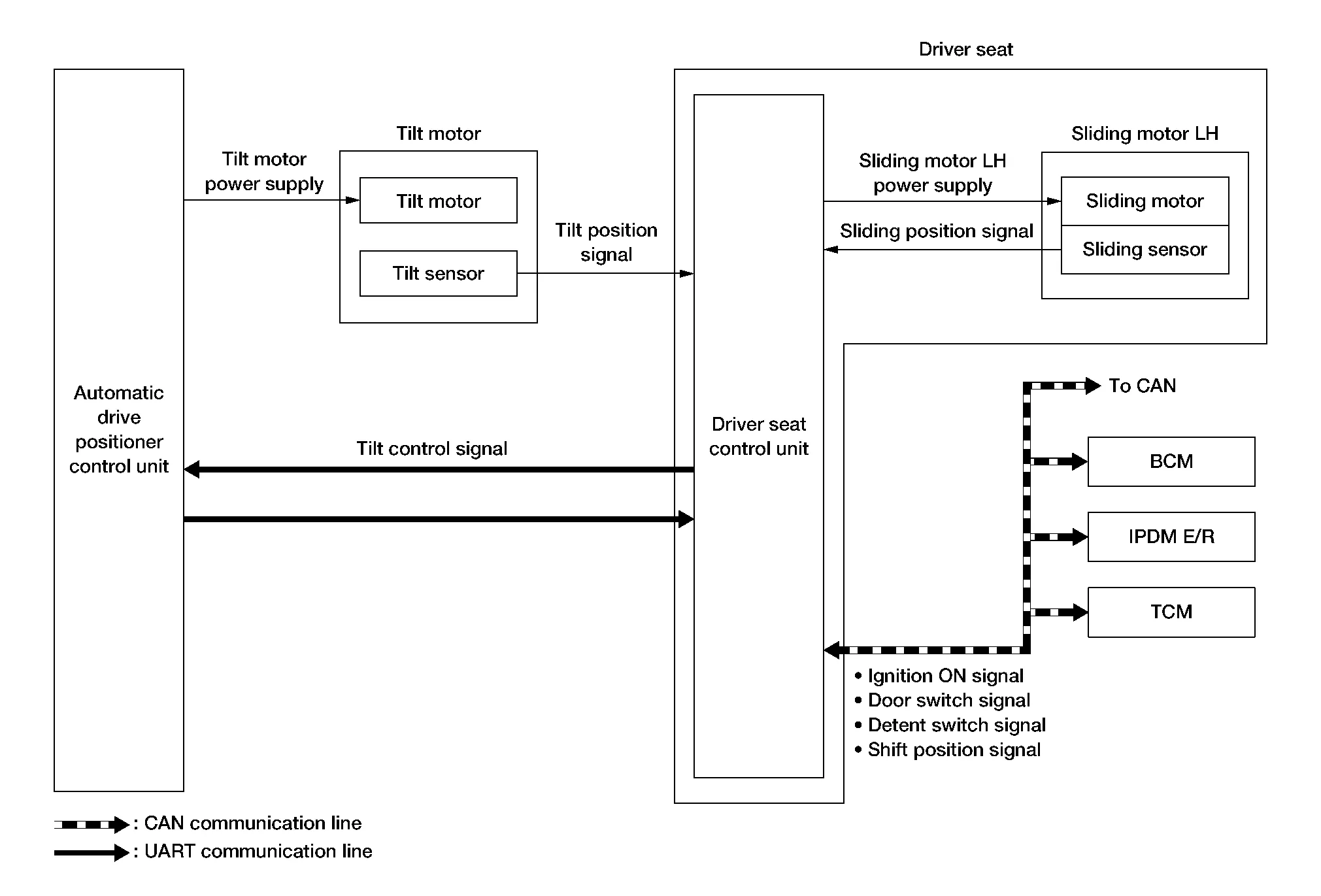
SIGNAL TRANSMISSION FUNCTION LIST
Several types of signals are transmitted from the following units to the driver seat control unit via CAN communication.
| Component | Signal |
|---|---|
| BCM |
|
| TCM | Shift position signal |
| IPDM E/R | Detention switch signal |
DESCRIPTION
When exiting, if the conditions are satisfied, the seat is moved backward from normal sitting position and the steering column is moved up.
The seat slide amount at entry/exit operation can be changed.
 NOTE:
NOTE:
-
This function is set to ON before delivery (initial setting).
-
For further information on the system setting procedure, refer to Owner’s Manual.
Operation Procedure
-
Shift position P position.
-
Open the front door LH with ignition switch OFF.
-
Front seat LH and steering column will move to the exiting position.
Operation Condition
Satisfy all of the following items. The exit assist function is not performed if these items are not satisfied.
| Item | Request status |
|---|---|
| Ignition switch | OFF |
| System setting [Entry/exit assist function] | ON |
| Initialization | Done |
|
Switch inputs
|
OFF (Not operated) |
| CVT selector lever | P position |
Detail Flow
| Order | Input | Output | Control unit condition |
|---|---|---|---|
| 1 | Front door switch LH | — | Driver seat control unit receives front door switch LH signal (open) from BCM via CAN communication. |
| 2 | — | Motors (seat sliding LH, tilt) | Driver seat control unit operates the seat sliding motor LH, which recognizes that the driver side door is opened with ignition switch OFF. Driver seat control unit then requests the operations of tilt motor to automatic drive positioner control unit via UART communication. The automatic drive positioner control unit operates each motor for a constant amount. |
 Memory Function
System Description
SYSTEM DIAGRAMSIGNAL TRANSMISSION FUNCTION LISTSeveral types of signals are transmitted from the following units to the driver seat control unit via CAN communication...
 Entry Assist Function
System Description
SYSTEM DIAGRAMSIGNAL TRANSMISSION FUNCTION LISTSeveral types of signals are transmitted from the following units to the driver seat control unit via CAN communication...
Other information:
Nissan Murano (Z52) 2015-2024 Service Manual: Center Console Assembly
Exploded View 1. Center console side finisher (RH) 2. Center console side finisher (LH) 3. Center console lower side finisher (LH) 4. Center console reinforcement bracket 5. Mood lamp [front console LH (if equipped)] 6. Mood lamp lens [front console LH (if equipped)] 7...
Nissan Murano (Z52) 2015-2024 Service Manual: P0605 Control Module Rom
DTC Description DTC DETECTION LOGIC DTC CONSULT screen terms (Trouble diagnosis content) DTC detection condition P0605 CONTROL MODULE ROM [Internal Control Module Read Only Memory (ROM) Error] Diagnosis condition When turning ON the ignition switch Signal — Threshold TCM ROM area sum parity check detects malfunction in ROM...
Categories
- Manuals Home
- Nissan Murano Owners Manual
- Nissan Murano Service Manual
- Vehicle Dynamic Control (VDC) OFF switch
- All-Wheel Drive (AWD) (if so equipped)
- Warning lights
- New on site
- Most important about car
LATCH (Lower Anchors and Tethers for CHildren) system
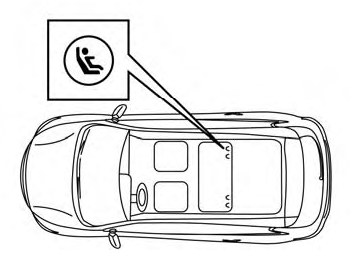
LATCH system lower anchor locations - bench seat
Your vehicle is equipped with special anchor points that are used with LATCH system compatible child restraints. This system may also be referred to as the ISOFIX or ISOFIX compatible system. With this system, you do not have to use a vehicle seat belt to secure the child restraint unless the combined weight of the child and child restraint exceeds 65 lbs. (29.5 kg). If the combined weight of the child and child restraint is greater than 65 lbs. (29.5 kg), use the vehicle’s seat belt (not the lower anchors) to install the child restraint. Be sure to follow the child restraint manufacturer’s instructions for installation.
