
Nissan Murano: Periodic Maintenance / Evap Leak Check
CAUTION:
-
Never use compressed air or a high pressure pump.
-
Never exceed 4.12 kPa (0.042 kg/cm2, 0.6 psi) of pressure in EVAP system.
 NOTE:
NOTE:
-
Do not start engine.
-
Improper installation of EVAP service port adapter (commercial service tool) to the EVAP service port may cause a leakage.
WITH CONSULT
-
To locate the EVAP leakage, install EVAP service port adapter (commercial service tool) and pressure pump to EVAP service port.

-
Turn ignition switch ON.
-
Select the “EVAP SYSTEM CLOSE” of “WORK SUPPORT MODE” with CONSULT.
-
Touch “START”. A bar graph (Pressure indicating display) will appear on the screen.
-
Apply positive pressure to the EVAP system until the pressure indicator reaches the middle of the bar graph.
-
Remove EVAP service port adapter (commercial service tool) and hose with pressure pump.
-
Locate the leakage using a leakage detector (commercial service tool). Refer to System Description.

WITHOUT CONSULT
-
To locate the EVAP leakage, install EVAP service port adapter (commercial service tool) and pressure pump to EVAP service port.
-
Apply battery voltage between the terminals of EVAP canister vent control valve to make a closed EVAP system.
-
To locate the leakage, deliver positive pressure to the EVAP system until pressure gauge points reach 1.38 to 2.76 kPa (0.014 to 0.028 kg/cm2, 0.2 to 0.4 psi).
-
Remove EVAP service port adapter (commercial service tool) and hose with pressure pump.
-
Locate the leakage using a leak detector (commercial service tool). Refer to System Description.
 Ignition Timing
Work Procedure
CHECK IGNITION TIMING
Attach timing light to loop wires as shown.
(A)
: Timing light
: Nissan Murano Vehicle front
Check ignition timing...
 Positive Crankcase Ventilation
Work Procedure
CHECK PCV VALVE
With engine running at idle, remove PCV valve from rocker cover. A properly working valve makes a hissing noise as air passes through it...
Other information:
Nissan Murano (Z52) 2015-2024 Service Manual: L Terminal Circuit (short)
Diagnosis Procedure CHECK “L” TERMINAL CIRCUIT (SHORT) Ignition switch OFF. Disconnect generator connector. Ignition switch ON. Does charge warning lamp illuminate? YES>> GO TO 2. NO>> Refer to Work Flow (With 165-DSS-5000P), or (Without 165-DSS-5000P)...
Nissan Murano (Z52) 2015-2024 Owners Manual: Doors
When the doors are locked using one of the following methods, the doors cannot be opened using the inside or outside door handles. The doors must be unlocked to open the doors. WARNING Always have the doors locked while driving. Along with the use of seat belts, this provides greater safety in the event of an accident by helping to prevent persons from being thrown from the vehicle...
Categories
- Manuals Home
- Nissan Murano Owners Manual
- Nissan Murano Service Manual
- Rear bench seat adjustment
- Jacking up vehicle and removing the damaged tire
- System malfunction
- New on site
- Most important about car
Driver and passenger supplemental knee air bag
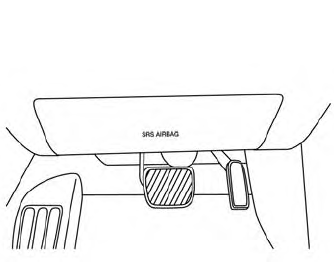
Driver’s side
The knee air bag is located in the knee bolster, on the driver’s and passenger’s side. All of the information, cautions and warnings in this manual apply and must be followed. The knee air bag is designed to inflate in higher severity frontal collisions, although it may inflate if the forces in another type of collision are similar to those of a higher severity frontal impact. It may not inflate in certain collisions.
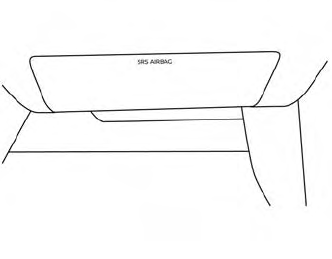
Passenger’s side
