Nissan Murano: System / Cvt Control System
SYSTEM DIAGRAM

MAIN CONTROL CONTENTS OF TCM
| Controls | Reference |
| Line pressure control | System Description |
| Shift control | System Description |
| Select control | System Description |
| Lock-up control | System Description |
| Fail-safe | Fail-safe |
| Self-diagnosis function | CONSULT Function |
| Communication function with CONSULT | CONSULT Function |
LIST OF CONTROL ITEMS AND INPUT/OUTPUT
| Control Item | Shift control | Line pressure control | Select control | Lock-up control | Fail-safe function* | |
|---|---|---|---|---|---|---|
| Input |
Engine torque signal (CAN communication) |
× | × | × | × | × |
|
Engine speed signal (CAN communication) |
× | × | × | × | × | |
|
Accelerator pedal position signal (CAN communication) |
× | × | × | × | ||
|
Closed throttle position signal (CAN communication) |
× | × | × | |||
|
Stop lamp switch signal (CAN communication) |
× | × | × | × | ||
| Primary pressure sensor | × | |||||
| Secondary pressure sensor | × | × | × | |||
| CVT fluid temperature sensor | × | × | × | × | × | |
| Primary speed sensor | × | × | × | × | × | |
| Output speed sensor | × | × | × | × | ||
| Input speed sensor | × | × | × | × | × | |
| Transmission range switch | × | × | × | × | × | |
|
Manual mode switch (CAN communication) |
× | × | × | |||
| Output | Line pressure solenoid valve | × | × | × | × | |
| Primary pressure solenoid valve | × | × | × | |||
| Torque converter clutch solenoid valve | × | × | ||||
| Secondary pressure solenoid valve | × | × | × | |||
| Select solenoid valve | × | × | × | |||
|
Shift position indicator (CAN communication) |
× | |||||
*: If these input/output signals show errors, TCM activates the fail-safe function.
TCM has a fail-safe mode. The mode functions so that operation can be continued even if the signal circuit of the main electronically controlled input/output parts is damaged.
If the vehicle shows following behaviors including “poor acceleration”, a malfunction of the applicable system is detected by TCM and the Nissan Murano vehicle may be in a fail-safe mode. At this time, check the DTC code and perform inspection and repair according to the malfunction diagnosis procedures.
Fail-safe function
| DTC | Nissan Murano Vehicle behavior | Conditions of vehicle |
|---|---|---|
| P0605 |
|
— |
| P062F | Not changed from normal driving | — |
| P0705 |
|
— |
| P0706 |
|
— |
| P0711 |
|
Engine coolant temperature when engine start: Temp. ≥ 10°C (50°F) |
|
Engine coolant temperature when engine start: −35°C (−31°F) ≤ Temp. < 10°C (50°F) |
|
|
Engine coolant temperature when engine start: Temp. <−35°C (−31°F) |
|
| P0712 |
|
Engine coolant temperature when engine start: Temp. ≥ 10°C (50°F) |
|
Engine coolant temperature when engine start: −35°C (−31°F) ≤ Temp. < 10°C (50°F) |
|
|
Engine coolant temperature when engine start: Temp. <−35°C (−31°F) |
|
| P0713 |
|
Engine coolant temperature when engine start: Temp. ≥ 10°C (50°F) |
|
Engine coolant temperature when engine start: −35°C (−31°F) ≤ Temp. < 10°C (50°F) |
|
|
Engine coolant temperature when engine start: Temp. <−35°C (−31°F) |
|
| P0715 |
|
— |
| P0716 |
|
— |
| P0717 |
|
— |
| P0718 |
|
— |
| P0740 |
|
— |
| P0741 |
|
— |
| P0742 |
|
— |
| P0743 |
|
— |
| P0746 |
|
— |
| P0776 |
|
When a malfunction occurs on the low oil pressure side |
|
When a malfunction occurs on the high oil pressure side | |
| P0778 |
|
— |
| P0779 |
|
— |
| P0791 |
|
— |
| P0792 |
|
— |
| P0793 |
|
— |
| P0794 |
|
— |
| P0826 | Manual mode is not activated | — |
| P0841 | Not changed from normal driving | — |
| P0847 | Not changed from normal driving | — |
| P0848 | Not changed from normal driving | — |
| P084C | Not changed from normal driving | — |
| P084D | Not changed from normal driving | — |
| P0863 |
|
— |
| P0890 |
|
— |
| P0894 | Not changed from normal driving | — |
| P0962 |
|
— |
| P0963 |
|
— |
| P0965 |
|
When a malfunction occurs on the low oil pressure side |
|
When a malfunction occurs on the high oil pressure side | |
| P0966 |
|
— |
| P0967 |
|
— |
| P1588 | Not changed from normal driving | — |
| P159C | Not changed from normal driving | — |
| P159D | Not changed from normal driving | — |
| P17F0 | Not changed from normal driving | — |
| P17F1 | Not changed from normal driving | — |
| P17F2 | Not changed from normal driving | — |
| P2758 |
|
— |
| P2765 |
|
— |
| P2766 |
|
— |
| P2767 |
|
— |
| P2768 |
|
— |
| P2813 |
|
When a malfunction occurs on the low oil pressure side |
| Selector shock is large | When a malfunction occurs on the high oil pressure side | |
| P2814 | Selector shock is large | — |
| P2815 | Selector shock is large | — |
| U0073 |
|
— |
| U0100 |
|
— |
| U0102 | Not changed from normal driving | — |
| U0121 | Not changed from normal driving | — |
| U0122 | Not changed from normal driving | — |
| U0140 | Not changed from normal driving | — |
| U0141 | Not changed from normal driving | — |
| U0155 | Not changed from normal driving | — |
| U0164 | Not changed from normal driving | — |
| U0300 |
|
— |
| U1000 | Not changed from normal driving | — |
| U1117 | Not changed from normal driving | — |
| U1118 | Not changed from normal driving | — |
The TCM becomes the protection control status temporarily to protect the safety when the safety of TCM and transmission is lost. It automatically returns to the normal status if the safety is secured.
The TCM has the following protection control.
CONTROL FOR WHEEL SPIN
| Control |
When a wheel spin is detected, the engine output and gear ratio are limited and the line pressure is increased. Limits engine output when a wheel spin occurs in any of right and left drive wheels. |
| Nissan Murano Vehicle behavior in control | If the accelerator is kept depressing during wheel spin, the engine revolution and Nissan Murano vehicle speed are limited to a certain degree. |
| Normal return condition | Wheel spin convergence returns the control to the normal control. |
TORQUE IS REDUCED WHEN DRIVING WITH THE REVERSE GEAR
| Control | Engine output is controlled according to a Nissan Murano vehicle speed while reversing the vehicle. |
| Vehicle behavior in control | Power performance may be lowered while reversing the Nissan Murano vehicle. |
| Normal return condition | Torque returns to normal by positioning the selector lever in a range other than “R” position. |
CONTROL WHEN FLUID TEMPERATURE IS HIGH
| Control | When the CVT fluid temperature is high, the gear shift permission maximum revolution and the maximum torque are reduced than usual to prevent increase of the oil temperature. |
| Nissan Murano Vehicle behavior in control | Power performance may be lowered, compared to normal control. |
| Normal return condition | The control returns to the normal control when CVT fluid temperature is lowered. |
REVERSE PROHIBIT CONTROL
| Control | The reverse brake is controlled to avoid becoming engaged when the selector lever is set in “R” position while driving in forward direction at more than the specified speed. |
| Nissan Murano Vehicle behavior in control | If the selector lever is put at “R” position when driving with the forward gear, the gear becomes neutral, not reverse. |
| Normal return condition | The control returns to normal control when the Nissan Murano vehicle is driven at low speeds. (The reverse brake becomes engaged.) |
 System
..
 Line Pressure Control
System Description
SYSTEM DIAGRAMDESCRIPTIONHighly accurate line pressure control and secondary pressure control reduces friction for improvement of fuel economy...
Other information:
Nissan Murano (Z52) 2015-2024 Service Manual: Outside Handle
Removal and Installation REMOVALFully close front door glass. Remove front door finisher. Refer to Removal and Installation. Remove front door vapor barrier. Remove door side grommet (1), and remove bolt from grommet hole (2). Separate door key cylinder rod (LH only) (1) from door key cylinder assembly (LH only) (2)...
Nissan Murano (Z52) 2015-2024 Service Manual: Engine Mount. Engine Mount (front)
Removal and Installation WARNING: Situate the vehicle on a flat and solid surface. Place chocks at front and back of rear wheels. CAUTION: Always work safely. Do not start work until the engine and exhaust system are cooled completely. Refer to the applicable sections for warnings, cautions, notes, and instructions if necessary procedures are not included in this section...
Categories
- Manuals Home
- Nissan Murano Owners Manual
- Nissan Murano Service Manual
- Settings
- Vehicle Dynamic Control (VDC) OFF switch
- Turning the AEB system on/off
- New on site
- Most important about car
Luggage hooks
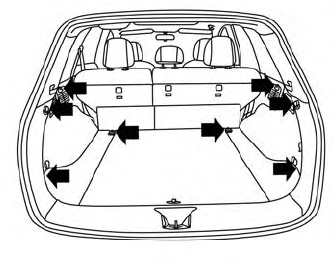
When securing items using luggage hooks located on the back of the seat or side finisher do not apply a load over more than 6.5 lbs. (29 N) to a single hook.
The luggage hooks that are located on the floor should have loads less than 110 lbs. (490 N) to a single hook.
