
Nissan Murano: Heater & Air Conditioning System :: Periodic Maintenance / Refrigerant
CONNECTION OF SERVICE TOOLS AND EQUIPMENT
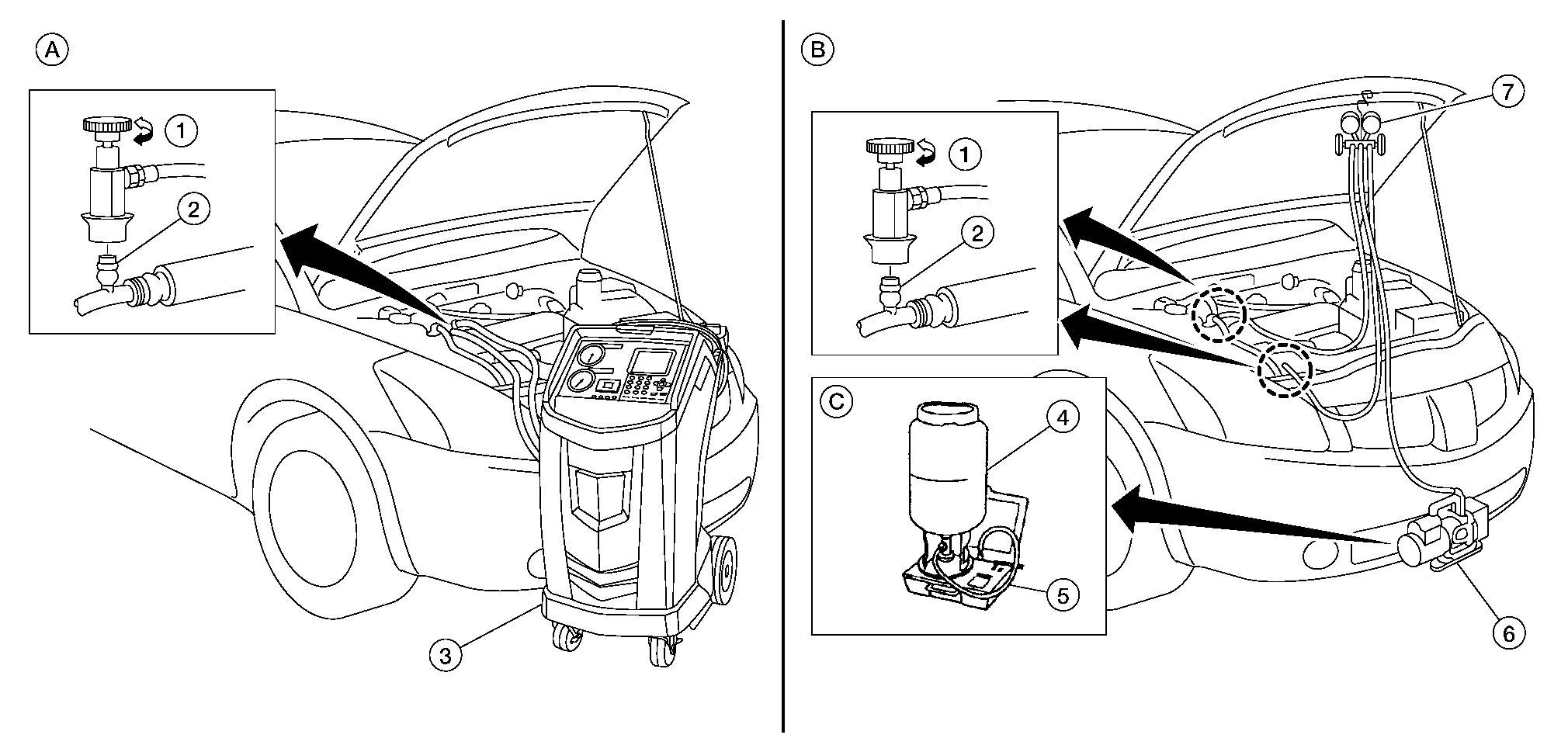
| 1. | Shut-off valve | 2. | A/C service valve | 3. | Recovery/recycling/recharging equipment |
| 4. | Refrigerant container (HFO-1234yf) | 5. | Weight scale | 6. | Vacuum pump |
| 7. | Manifold gauge set | ||||
| A. | Preferred (best) method | B. | Alternative method | C. | For charging |
CHECK REFRIGERANT LEAKS USING FLUORESCENT LEAK DETECTION DYE
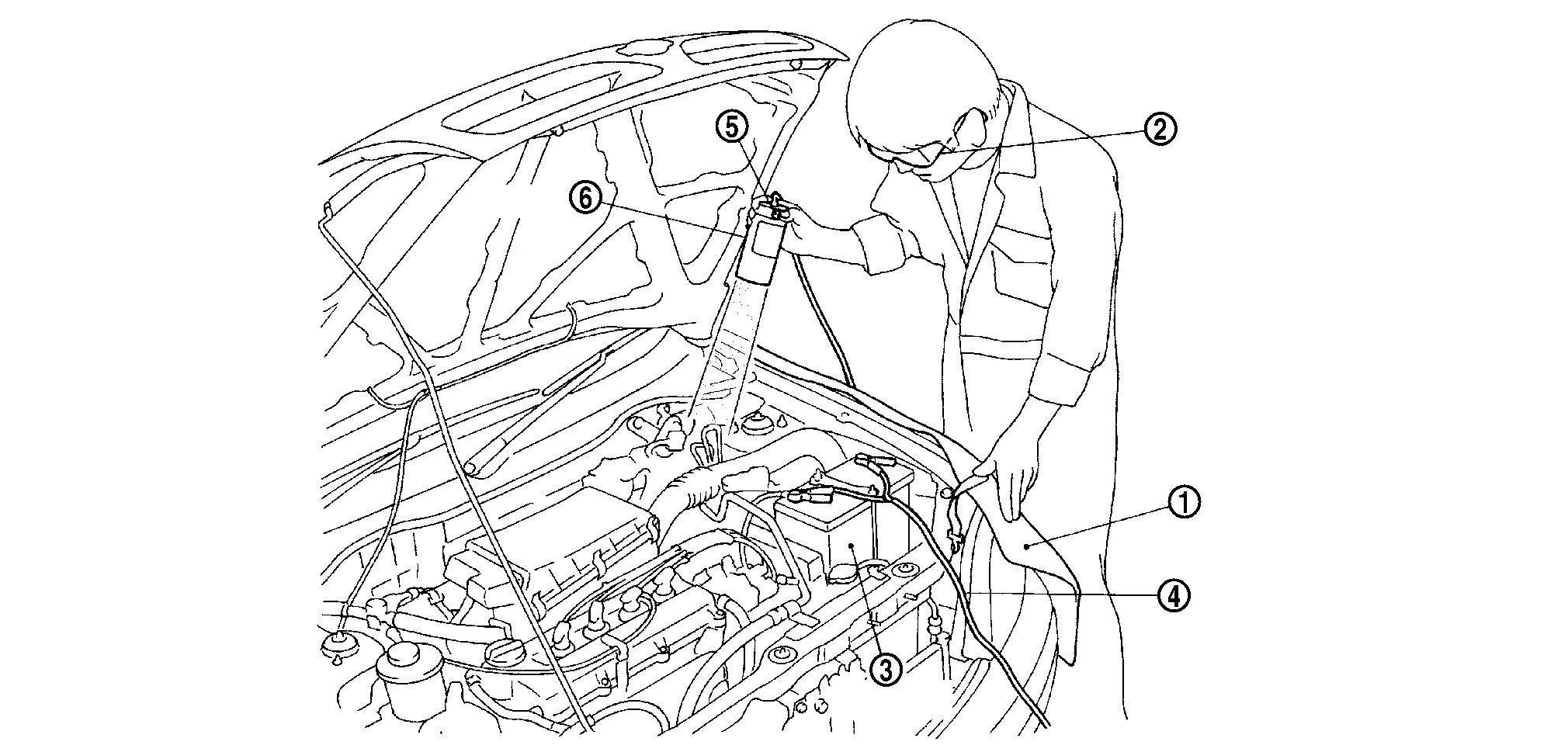
Install a fender cover (1).
Wear UV safety goggles (2) provided with refrigerant dye leak detection kit.
Connect power cable (4) of UV lamp (6) to positive and negative terminals of the battery (3).
Press UV lamp switch (5) and check A/C system for refrigerant leaks. (Where refrigerant leaks occur, fluorescent leak detection dye appears in green color.)
WARNING:
Do not look directly into UV lamp light source.
 NOTE:
NOTE:
-
For continuous operating time of UV lamp, follow the manufacturer’s operating instructions.
-
Illuminate piping joints from different angles using UV lamp and check that there are no leaks.
-
Use a mirror in areas that are difficult to see to check for refrigerant leaks.
-
Refrigerant leaks from evaporator can be detected by soaking a cotton swab or a similar materials with drain hose water and illuminating it using UV lamp.
-
Dust, dirt, and packing materials adhesive used for condenser, evaporator, and other locations may fluoresce. Be careful not to misidentify leaks.
Repair or replace parts where refrigerant leaks occur and wipe off fluorescent leak detection dye.
NOTE:
Completely wipe off fluorescent leak detection dye from gaps between parts, screw threads, and others using a cotton swab or similar materials.
Use a UV lamp to check that no fluorescent leak detection dye remains after finishing work.
WARNING:
Do not look directly into UV lamp light source.
NOTE:
-
For continuous operating time of UV lamp, follow the manufacturer’s operating instructions.
-
Dust, dirt, and packing materials adhesive used for condenser, evaporator, and other locations may fluoresce. Be careful not to misidentify leaks.
CHECK REFRIGERANT LEAKS USING ELECTRONIC LEAK DETECTOR
WARNING:
Do not check for refrigerant leaks while the engine is running.
CAUTION:
Be careful of the following items so that inaccurate checks or misidentifications are avoided.
-
Do not allow refrigerant vapor, shop chemical vapors, cigarette smoke or others around the Nissan Murano vehicle.
-
Always check for refrigerant leaks in a low air flow environment so that refrigerant may not disperse when leaks occur.
Stop the engine.
Connect recovery/recycling/recharging equipment or manifold gauge set to A/C service valve.
Check that A/C refrigerant pressure is 345 kPa (3.52 kg/cm2, 50 psi) or more when temperature is 16°C (61°F) or more. When pressure is lower than the specified value, recycle refrigerant completely and fill refrigerant to the specified level.
NOTE:
Leaks may not be detected if A/C refrigerant pressure is 345 kPa (3.52 kg/cm2, 50 psi) or less when temperature is less than 16°C (61°F).
Clean area where refrigerant leak check is performed and check for refrigerant leaks along all surfaces of pipe connections and A/C system components using electronic leak detector probe.
CAUTION:
-
Continue checking when a leak is found. Always continue and complete checking along all pipe connections and A/C system components for additional leaks.
-
When a leak is detected, clean leak area using compressed air and check again.
-
When checking for leaks inside the cooling unit, always clean inside the drain hose so that the probe surface may not be exposed to water or dirt.
NOTE:
-
Always check for leaks starting from high-pressure side and continuing to low-pressure side.
-
When checking for leaks inside the cooling unit, operate blower fan motor for 15 minutes or more at the maximum fan speed while the engine is stopped, and then insert electrical leak detector probe into drain hose and hold for 10 minutes or more.
-
When disconnecting shut-off valve that is connected to A/C service valve, always evacuate remaining refrigerant so that misidentification can be avoided.
Repair or replace parts where refrigerant leaks are detected.
Start the engine and set A/C control in the following conditions:
-
A/C switch ON
-
Air flow: VENT (ventilation)
-
Intake door position: Recirculation
-
Temperature setting: Full cold
-
Fan (blower) speed: Maximum speed set
Run the engine at approximately 1,500 rpm for 2 minutes or more.
Stop the engine. Check again for refrigerant leakage. Go to step 4.
WARNING:
Be careful not to get burned when the engine is hot.
NOTE:
-
Start refrigerant leak check immediately after the engine is stopped.
-
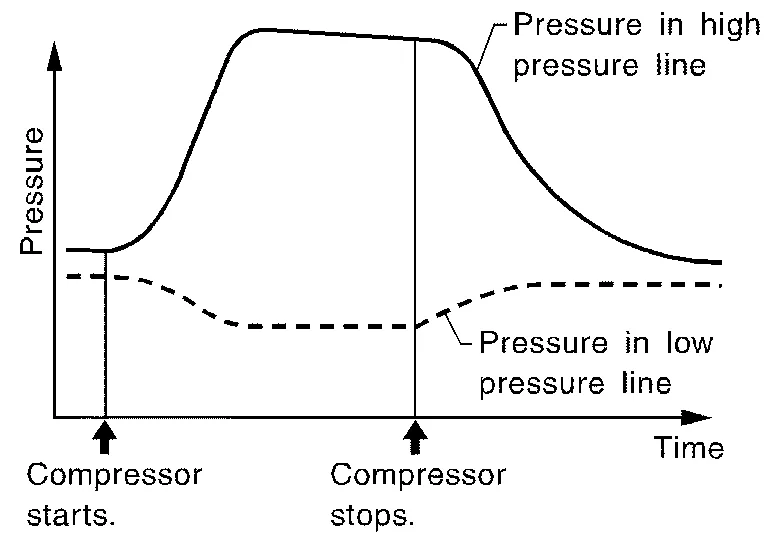
When refrigerant circulation is stopped, pressure on the low-pressure side rises gradually, and after this, pressure on the high-pressure side falls gradually.
-
The higher the pressure is, the easier it is to find the refrigerant leaks.
WARNING:
-
Always use HFO-1234yf for A/C refrigerant. If HFC-134a (R-134a) is accidentally charged, compressor is damaged due to insufficient lubrication.
-
Always observe and follow precautions described on refrigerant container. Incorrect handling may result in an explosion of refrigerant container, frostbite or the loss of eyesight.
-
Do not breathe A/C refrigerant and oil vapor or mist. Exposure may irritate eyes, nose, or throat.
-
Do not allow HFO-1234yf to be exposed to an open flame or others because it generates poisonous gas when in contact with high temperature objects. Keep workshop well ventilated.
Perform oil return operation. Refer to Perform Oil Return Operation. (If refrigerant or oil leak is detected in a large amount, omit this step, and go to step 2.)
CAUTION:
Do not perform oil return operation if a large amount of refrigerant or oil leak is detected.
Check gauge pressure readings of recovery/recycling/recharging equipment. When remaining pressure exists, recycle refrigerant from high-pressure hose and low-pressure hose.
NOTE:
Follow manufacturer instructions for the handling or maintenance of the equipment. Do not fill the equipment with non-specified refrigerant.
Remove A/C service valve cap from the Nissan Murano vehicle.
Connect recovery/recycling/recharging equipment to A/C service valve.
Operate recovery/recycling/recharging equipment, and recycle refrigerant from the Nissan Murano vehicle.
Evacuate air for 10 minutes or more to remove any remaining refrigerant integrated to compressor oil, etc.
Refrigerant recycle operation is complete.
WARNING:
-
Always use HFO-1234yf for A/C refrigerant. If HFC-134a (R-134a) is accidentally charged, compressor is damaged due to insufficient lubrication.
-
Always observe and follow precautions described on refrigerant container. Incorrect handling may result in an explosion of refrigerant container, frostbite, or the loss of eyesight.
-
Do not breathe A/C refrigerant and oil vapor or mist. Exposure my irritate eyes, nose, or throat.
-
Do not allow HFO-1234yf to be exposed to an open flame or others because it generates poisonous gas when in contact with high temperature objects. Keep workshop well ventilated.
Connect recovery/recycling/recharging equipment to the A/C service valve.
Operate recovery/recycling/recharging equipment, and evacuate air from A/C system for 25 minutes or more.
CAUTION:
Evacuate air for 15 minutes or more if the parts are replaced.
Check the airtightness of A/C system for 25 minutes or more. If pressure raises more than the specified level, charge A/C system with approximately 200g refrigerant and check that there is no refrigerant leak. Refer to Leak Test.
CAUTION:
Check the airtightness for 15 minutes or more if the parts are replaced.
If parts other than compressor are replaced, fill compressor oil according to parts that are replaced.
Charge the specified amount of refrigerant to A/C system.
Check that A/C system operates normally.
Disconnect recovery/recycling/recharging equipment. (Collect the refrigerant from the high-pressure hose and low-pressure hose of recovery/recycling/recharging equipment.)
Install A/C service valve cap.
Refrigerant charge is complete.

 Oil
Oil
Description
MAINTENANCE OF OIL LEVELThe compressor oil is circulating in the system together with the refrigerant. It is necessary to fill compressor with oil when replacing A/C system parts or when a large amount of refrigerant leaks are detected...
Other information:
Nissan Murano (Z52) 2015-2024 Service Manual: Transaxle
Cross-Sectional View Converter housing Oil pump Planetary gear Control valve Oil pan Chain belt Planetary pulley Secondary pulley Side cover Transaxle case Differential case Final gear Reduction gear Idler gear Output gear Drive sprocket Torque converter Driven sprocket Oil pump chain FWD models AWD models Transaxle Mechanism TORQUE CONVERTER (WITH LOCK-UP FUNCTION)In the same way as a conventional A/T, the torque converter is a system that increases the engine torque and transmits the torque to the transaxle...
Nissan Murano (Z52) 2015-2024 Service Manual: Precaution. Precautions
Precaution for Supplemental Restraint System (SRS) "AIR BAG" and "SEAT BELT PRE-TENSIONER" The Supplemental Restraint System such as “AIR BAG” and “SEAT BELT PRE-TENSIONER”, used along with a front seat belt, helps to reduce the risk or severity of injury to the driver and front passenger for certain types of collisions...
Categories
- Manuals Home
- Nissan Murano Owners Manual
- Nissan Murano Service Manual
- Passenger compartment
- Turning the AEB system on/off
- Power Steering Fluid (PSF)
- New on site
- Most important about car
Luggage hooks
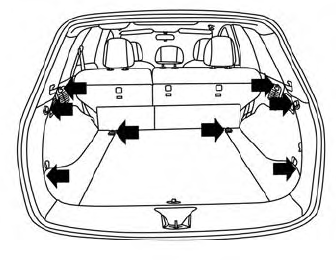
When securing items using luggage hooks located on the back of the seat or side finisher do not apply a load over more than 6.5 lbs. (29 N) to a single hook.
The luggage hooks that are located on the floor should have loads less than 110 lbs. (490 N) to a single hook.
