
Nissan Murano: Maintenance :: Periodic Maintenance / Recommended Fluids and Lubricants
The following are approximate capacities, The actual refill capacities may be slightly different.
When refilling, follow the procedures described elsewhere in this manual.
| Fluid type | Capacity (approximate) | Recommended Fluids/Lubricants | |||
|---|---|---|---|---|---|
|
Metric Measure |
US Measure |
Imperial Measure | |||
| Fuel | 71.9  |
19 gal | 15-7/8 gal |
|
|
|
Engine oil Drain and refill |
With oil filter change | 4.8 |
5-1/8 qt | 4-1/4 qt |
|
| Without oil filter change | 4.5 |
4-3/4 qt | 4 qt | ||
| Dry engine (Overhaul) | 5.2 |
5-1/2 qt | 4-5/8 qt | ||
|
Engine coolant (with reservoir at MAX level) |
8.7 |
9-1/4 qt | 7-5/8 qt |
|
|
| CVT fluid | 8.8 |
9-1/4 qt | 7-3/4 qt |
|
|
| Differential gear oil | 0.5 |
1 pt | 7/8 pt |
|
|
| Transfer fluid | 0.31 |
5/8 pt | 1/2 pt | ||
| Power steering fluid (E-PSF) | 1.0 |
1-1/8 qt | 7/8 qt |
|
|
| Brake fluid | — | — | — |
|
|
| Multi-purpose grease | — | — | — |
|
|
| Windshield washer fluid | 4.6 |
4-7/8 qt | 4 qt |
|
|
| Air conditioning system refrigerant | 0.575 ± 0.05 kg | 1.268 ± 0.1102 lb | 1.268 ± 0.1102 lb |
|
|
| Air conditioning system oil | 100 m |
3.4 fl oz | 3.5 fl oz |
|
|
NISSAN recommends the use of an energy conserving oil in order to improve fuel economy. Select only engine oils that meet the American Petroleum Institute (API) certification and International Lubricant Standardization and Approval Committee (ILSAC) certification and SAE viscosity standard. These oils have the API certification mark on the front of the container. Oils which do not have the specified quality label should not be used as they could cause engine damage.
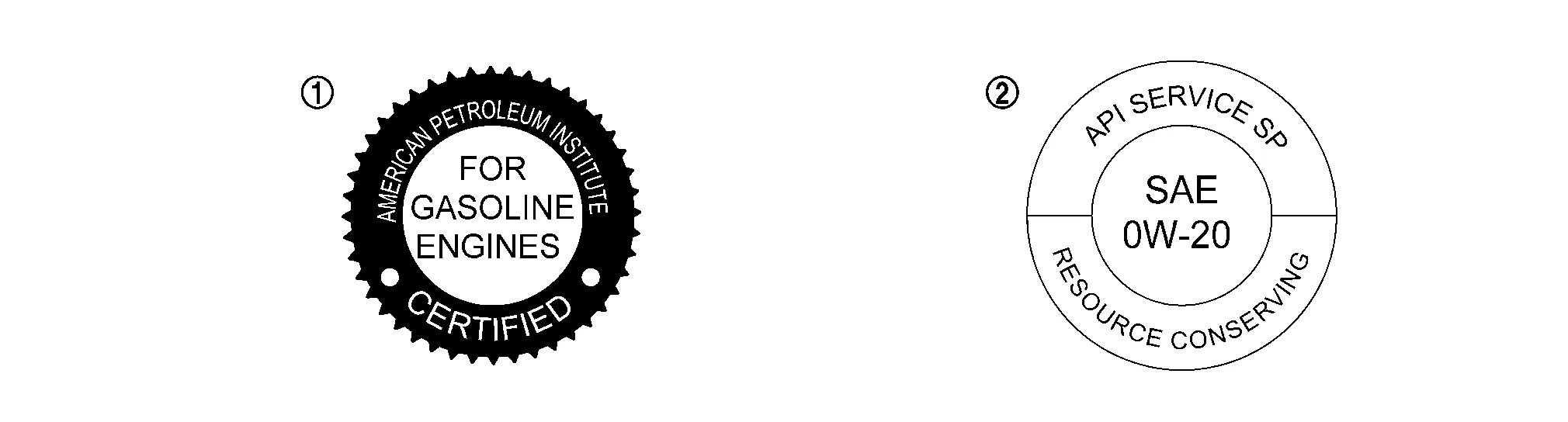
| 1. | API certification mark | 2. | API service symbol |
The engine cooling system is filled at the factory with a pre-diluted mixture of 50% Genuine NISSAN Long Life Antifreeze/Coolant (blue) and 50% water to provide year-round anti-freeze and coolant protection. The anti-freeze solution contains rust and corrosion inhibitors. Additional engine cooling system additives are not necessary.
WARNING:
Do not remove the radiator cap when the engine is hot. Serious burns could occur from high-pressure engine coolant escaping from the radiator. Wrap a thick cloth around the cap. Slowly push down and turn it a quarter turn to allow built-up pressure to escape. Carefully remove the cap by pushing it down and turning it all the way.
CAUTION:
-
When adding or replacing coolant, be sure to use only Genuine NISSAN Long Life Antifreeze/Coolant (blue) or equivalent. Genuine NISSAN Long Life Antifreeze/Coolant (blue) is pre-diluted to provide antifreeze protection to -34°F (-37°C). If additional freeze protection is needed due to weather where the Nissan Murano vehicle is operated, add Genuine NISSAN long life Antifreeze/Coolant (blue) concentrate following the directions on the container. If an equivalent coolant other than Genuine NISSAN Long Life Antifreeze/Coolant (blue) is used, follow the coolant manufacturer’s instructions to maintain minimum antifreeze protection to -34°F (-37°C). The use of other types of coolant solutions other than Genuine NISSAN Long Life Antifreeze/Coolant (blue) or equivalent may damage the engine cooling system.
-
Mixing any other type of coolant other than Genuine NISSAN Long Life Antifreeze/Coolant (blue), including Genuine NISSAN Long Life Antifreeze/Coolant (green) or the use of non-distilled water will reduce the life expectancy of the factory filled coolant.
 Periodic Maintenance
Introduction of Periodic Maintenance
The following tables show the normal maintenance schedule. Depending upon weather and atmospheric conditions, varying road surfaces, individual driving habits and Nissan Murano vehicle usage, additional or more frequent maintenance may be required...

Other information:
Nissan Murano (Z52) 2015-2024 Service Manual: U1000 Can Comm Circuit
DTC Description DESCRIPTIONCAN (Controller Area Network) is a serial communication line for real-time application. It is an on-Nissan Murano vehicle multiplex communication line with high data communication speed and excellent error detection ability...
Nissan Murano (Z52) 2015-2024 Service Manual: Rear View Camera Image Signal Circuit
Diagnosis Procedure CHECK REVERSE INPUT SIGNAL Ignition switch ON. Shift the selector lever to R (reverse). Check voltage between audio unit connector and ground. Audio unit Ground Condition Voltage (Approx.) (+) (−) Connector Terminal M121 8 — Selector lever in R (reverse) Battery Voltage Is inspection result normal? YES>> GO TO 2...
Categories
- Manuals Home
- Nissan Murano Owners Manual
- Nissan Murano Service Manual
- System malfunction
- Passenger compartment
- Shift lock release
- New on site
- Most important about car
LATCH (Lower Anchors and Tethers for CHildren) system
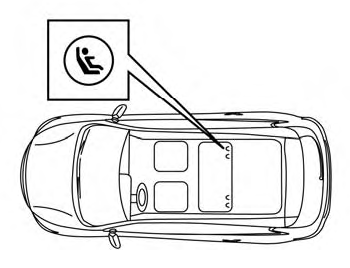
LATCH system lower anchor locations - bench seat
Your vehicle is equipped with special anchor points that are used with LATCH system compatible child restraints. This system may also be referred to as the ISOFIX or ISOFIX compatible system. With this system, you do not have to use a vehicle seat belt to secure the child restraint unless the combined weight of the child and child restraint exceeds 65 lbs. (29.5 kg). If the combined weight of the child and child restraint is greater than 65 lbs. (29.5 kg), use the vehicle’s seat belt (not the lower anchors) to install the child restraint. Be sure to follow the child restraint manufacturer’s instructions for installation.
