
Nissan Murano: Dtc/circuit Diagnosis / P0776 Pressure Control Solenoid B
DTC DETECTION LOGIC
| DTC |
CONSULT screen terms (Trouble diagnosis content) |
DTC detection condition | ||
| P0776 |
PC SOLENOID B (Pressure Control Solenoid “B” Performance/Stuck Off) |
1 | Diagnosis condition |
When all of the following conditions are satisfied:
|
| Signal | — | |||
| Threshold |
|
|||
| Diagnosis delay time | Maintained for 10 seconds or more | |||
| 2 | Diagnosis condition |
When all of the following conditions are satisfied:
|
||
| Signal | — | |||
| Threshold |
|
|||
| Diagnosis delay time | Maintained for 10 seconds or more | |||
| 3 | Diagnosis condition |
When all of the following conditions are satisfied:
|
||
| Signal | — | |||
| Threshold |
|
|||
| Diagnosis delay time | Maintained for 10 seconds or more | |||
POSSIBLE CAUSE
-
Secondary pressure solenoid valve (Control valve)
-
CVT chain
FAIL-SAFE
-
When a malfunction occurs on the low oil pressure side
-
Selector shock is large
-
Start is slow
-
Acceleration is slow
-
Lock-up is not performed
-
Nissan Murano Vehicle speed is not increased
-
-
When a malfunction occurs on the high oil pressure side
-
Selector shock is large
-
Start is slow
-
Acceleration is slow
-
Lock-up is not performed
-
CAUTION:
Always drive vehicle at a safe speed.
The MIL is ON and ONLY DTC P0776 (PC SOLENOID B - Pressure Control Solenoid “B” Performance/Stuck OFF) is stored in the TCM.
 NOTE:
NOTE:
If this issue should occur, the vehicle may hesitate and/or have a lack of power.
CHECK DTC PRIORITY
When DTC P0776 is displayed together with P17F0, diagnose first the P17F0.
Is "P17F0" detected?
YES>>Perform diagnosis of P17F0. Refer to Diagnosis Procedure.
NO>>GO TO 2.
PREPARATION BEFORE WORK
If another “DTC CONFIRMATION PROCEDURE” occurs just before, turn ignition switch OFF and wait for at least 10 seconds, then perform the next test.
>>
GO TO 3.
CHECK DTC DETECTION
-
Start the engine.
-
Drive the Nissan Murano vehicle.
-
Maintain the following condition for 20 seconds or more.
Selector lever : “D” position Nissan Murano Vehicle speed : 40 km/h (25 MPH) or more Accelerator pedal position : 1.0/8 or more -
Stop the Nissan Murano vehicle.
-
Check the first trip DTC.
Is “P0776” detected?
YES>>Go to Diagnosis Procedure.
NO-1>>To check malfunction symptom before repair: Refer to Intermittent Incident.
NO-2>>Confirmation after repair: INSPECTION END
INSPECT CVT CHAIN
Inspect the CVT chain. Refer to Component Inspection.
Is CVT chain OK?
YES>>GO TO 2.
NO>>GO TO 3.
INSTALL NEW CONTROL VALVE
Install new control valve. Refer to Removal and Installation.
>>
WORK END
REPLACE SUB-ASSEMBLY AND INSTALL NEW CONTROL VALVE
Replace sub-assembly and install new control valve. Refer to Disassembly & Assembly.
>>
WORK END
CVT CHAIN BELT INSPECTION
CAUTION:
Never allow any chemicals or fluids other than NS-3 CVT fluid or equivalent to enter the CVT assembly. Never allow any foreign debris, dust, dirt, etc. to enter the CVT assembly.
NOTE:
Before lifting the vehicle:
-
Place the transmission gear selector in Neutral.
-
Leave the driver door unlatched.
-
Remove the control valve. Refer to Removal and Installation.
-
Secure the right front tire with a suitable strap
 . This will assist in making the chain belt turn.
-
Mark the left front tire with a suitable marking. This will ensure all 360° of the chain belt is inspected.
-
Using borescope J-51951 with mirror attachment, visually inspect the entirety of the two sides of the chain belt
that come in contact with the pulleys  . Slowly and carefully turn the left front tire one full turn in the forward rotation to view all of the chain belt.

Guide rail 
: Front CAUTION:
If the tire is rotated in the rearward rotation, the camera lens may get caught between the chain belt and the pulley.
NOTE:
-
Be sure to remove the protective film from the mirror before the first use.
-
Clean the camera lens and mirror before each inspection. Use 90% isopropyl alcohol, and a lens swab from Lens Swab packet J-51963.
-
Before inspecting, make sure the camera handle’s AA batteries are fresh and the LCD monitor’s battery is charged.
-
Route the camera cable past the primary pulley and position the camera lens behind the plastic guide. See figure below.
NOTE:
For best picture, position camera lens 10mm away from chain belt.

Chain belt Camera cable Secondary pulley 
Plastic guide 
Primary pulley : Front -
First inspect the entire 360° of the driver side of the chain belt that comes in contact with the pulley. Refer to figures below for examples of normal and excessive wear patterns.

Pulley Guide rail Camera flexible tube Chain belt NOTE:
-
Insert the camera lens behind the pulley past the guide rail and between the chain belt and the CVT case.
-
Insert the lens approximately 8-9 inches, and then view the side of the chain belt that contacts the pulley.
-
Holding the borescope with one hand allows for turning the tire with the other hand.
-
-
If the inspection result is OK on all 360° of the driver side, inspect all 360° of the passenger side of the chain belt. Refer to figures below for examples of normal and excessive wear patterns.

Chain belt Pulley Camera flexible tube Guide rail
-
CHAIN BELT WEAR PATTERNS
Examples of OK (normal) wear patterns.

-
Chain contact surfaces appear smooth.


Examples of NG (abnormal) wear patterns.

-
Chain contact surfaces show visible scuffing.


 P0746 Pressure Control Solenoid a
DTC Description
DTC DETECTION LOGIC DTC
CONSULT screen terms
(Trouble diagnosis content)
DTC detection condition
P0746
PC SOLENOID A
(Pressure Control Solenoid A Performance/Stuck Off)
1
Diagnosis condition
When all of the following conditions are satisfied:
Engine speed: More than 600 rpm
Primary pulley speed: More than 450 rpm
Idle is not being detected...
 P0778 Pressure Control Solenoid B
DTC Description
DTC DETECTION LOGIC DTC
CONSULT screen terms
(Trouble diagnosis content)
DTC detection condition
P0778
PC SOLENOID B
(Pressure Control Solenoid “B” Electrical)
Diagnosis condition
TCM power supply voltage: More than 11 V
Signal
—
Threshold
TCM judges that solenoid valve circuit is shorted to ground
Diagnosis delay time
Maintained for 1 second
POSSIBLE CAUSE
Harness or connector (Secondary pressure solenoid valve circuit is shorted to ground)
Secondary pressure solenoid valve
FAIL-SAFE
Selector shock is large
Start is slow
Acceleration is slow
Lock-up is not performed
DTC Confirmation Procedure
CAUTION:
Always drive vehicle at a safe speed...
Other information:
Nissan Murano (Z52) 2015-2024 Service Manual: Parking Brake Shoe
Exploded View 1. Back plate 2. Parking brake shoe (front) 3. Adjuster 4. Adjuster spring 5. Return spring 6. Anti-rattle spring 7. Retainer 8. Anti-rattle pin 9. Toggle lever 10. Parking brake shoe (rear) Front Apply PBC (Poly Butyl Cuprysil) grease or silicone-based grease Removal and Installation REMOVALWARNING: Clean dust on the parking brake shoes with a vacuum dust collector to minimize the hazard of air borne particles or other materials...
Nissan Murano (Z52) 2015-2024 Owners Manual: I-LI system limitations
WARNING Listed below are the system limitations for the I-LI system. Failure to follow the warnings and instructions for proper use of the I-LI system could result in serious injury or death. The I-LI system may activate if you change lanes without first activating your turn signal or, for example, if a construction zone directs traffic to cross an existing lane marker...
Categories
- Manuals Home
- Nissan Murano Owners Manual
- Nissan Murano Service Manual
- GAS STATION INFORMATION
- Tire rotation
- Power Steering Fluid (PSF)
- New on site
- Most important about car
LATCH (Lower Anchors and Tethers for CHildren) system
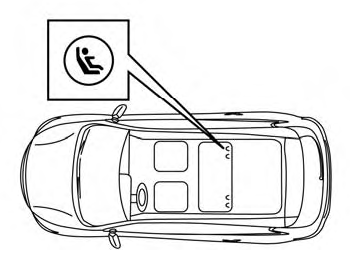
LATCH system lower anchor locations - bench seat
Your vehicle is equipped with special anchor points that are used with LATCH system compatible child restraints. This system may also be referred to as the ISOFIX or ISOFIX compatible system. With this system, you do not have to use a vehicle seat belt to secure the child restraint unless the combined weight of the child and child restraint exceeds 65 lbs. (29.5 kg). If the combined weight of the child and child restraint is greater than 65 lbs. (29.5 kg), use the vehicle’s seat belt (not the lower anchors) to install the child restraint. Be sure to follow the child restraint manufacturer’s instructions for installation.
