
Nissan Murano: Dtc/circuit Diagnosis / P0420 Three Way Catalyst Function
DTC DETECTION LOGIC
The ECM monitors the switching frequency ratio of air fuel ratio (A/F) sensor 1 and heated oxygen sensor 2.

A three way catalyst (manifold) with high oxygen storage capacity will indicate a low switching frequency of heated oxygen sensor 2. As oxygen storage capacity decreases, the heated oxygen sensor 2 switching frequency will increase.
When the frequency ratio of A/F sensor 1 and heated oxygen sensor 2 approaches a specified limit value, the three way catalyst (manifold) malfunction is diagnosed.
-
Three way catalyst (manifold) does not operate properly.
-
Three way catalyst (manifold) does not have enough oxygen storage capacity.
| DTC |
CONSULT screen terms (Trouble diagnosis content) |
DTC detection condition | ||
| P0420 |
TW CATALYST SYS-B1 (Catalyst system efficiency below threshold bank 1) |
1 | Diagnosis condition | — |
| Signal (terminal) | — | |||
| Threshold | Three way catalyst (manifold) does not operate properly | |||
| Diagnosis delay time | — | |||
| 2 | Diagnosis condition | — | ||
| Signal (terminal) | — | |||
| Threshold | Three way catalyst (manifold) does not have enough oxygen storage capacity | |||
| Diagnosis delay time | — | |||
| P0430 |
TW CATALYST SYS-B2 (Catalyst system efficiency below threshold bank 2) |
1 | Diagnosis condition | — |
| Signal (terminal) | — | |||
| Threshold | Three way catalyst (manifold) does not operate properly | |||
| Diagnosis delay time | — | |||
| 2 | Diagnosis condition | — | ||
| Signal (terminal) | — | |||
| Threshold | Three way catalyst (manifold) does not have enough oxygen storage capacity | |||
| Diagnosis delay time | — | |||
POSSIBLE CAUSE
P0420
-
Three way catalyst (manifold)
-
Exhaust tube
-
Intake air leakage
-
Fuel injector
-
Fuel injector leakage
-
Spark plug
-
Improper ignition timing
P0430
-
Three way catalyst (manifold)
-
Exhaust tube
-
Intake air leakage
-
Fuel injector
-
Fuel injector leakage
-
Spark plug
-
Improper ignition timing
-
Harness or connectors (The sensor circuit is open or shorted.)
-
Fuel tank temperature sensor
FAIL-SAFE
Not applicable
INSPECTION START
Will CONSULT be used?
Will CONSULT be used?
YES>>GO TO 2.
NO>>GO TO 7.
PRECONDITIONING
If DTC Confirmation Procedure has been previously conducted, always perform the following before conducting the next test.
-
Turn ignition switch OFF and wait at least 10 seconds.
-
Turn ignition switch ON.
-
Turn ignition switch OFF and wait at least 10 seconds.
TESTING CONDITION:
Do not maintain engine speed for more than the specified minutes below.
>>
GO TO 3.
PERFORM DTC CONFIRMATION PROCEDURE-I
 With CONSULT
-
Turn ignition switch ON and select “DATA MONITOR” mode with CONSULT.
-
Start engine and warm it up to the normal operating temperature.
-
Turn ignition switch OFF and wait at least 10 seconds.
-
Turn ignition switch ON.
-
Turn ignition switch OFF and wait at least 10 seconds.
-
Start engine and keep the engine speed between 3,500 and 4,000 rpm for at least 1 minute under no load.
-
Let engine idle for 1 minute.
-
Check that “COOLANT TEMP/S” indicates more than 70°C (158°F).
If not, warm up engine and go to next step when “COOLANT TEMP/S” indication reaches 70°C (158°F).
-
Open engine hood.
-
Select “DTC & SRT CONFIRMATION” then “SRT WORK SUPPORT” mode with CONSULT.
-
Rev engine between 2,000 and 3,000 rpm and hold it for 3 consecutive minutes then release the accelerator pedal completely.
-
Check the indication of “CATALYST”.
Which is displayed on CONSULT screen?
CMPLT>>GO TO 6.
INCMP>>GO TO 4.
PERFORM DTC CONFIRMATION PROCEDURE-II
-
Wait 5 seconds at idle.
-
Rev engine between 2,000 and 3,000 rpm and maintain it until “INCMP” of “CATALYST” changes to “CMPLT” (It will take approximately 5 minutes).
Does the indication change to “CMPLT”?
YES>>GO TO 6.
NO>>GO TO 5.
PERFORM DTC CONFIRMATION PROCEDURE AGAIN
-
Stop engine and cool it down to less than 70°C (158°F).
-
Perform DTC CONFIRMATION PROCEDURE again.
>>
GO TO 3.
PERFORM DTC CONFIRMATION PROCEDURE-III
Check 1st trip DTC.
Is 1st trip DTC detected?
YES>>Proceed to Diagnosis Procedure.
NO>>INSPECTION END
PERFORM COMPONENT FUNCTION CHECK
 Without CONSULT
-
Start engine and warm it up to the normal operating temperature.
-
Turn ignition switch OFF and wait at least 10 seconds.
-
Turn ignition switch ON.
-
Turn ignition switch OFF and wait at least 10 seconds.
-
Start engine and keep the engine speed between 3,500 and 4,000 rpm for at least 1 minute under no load.
-
Let engine idle for 1 minute.
-
Open engine hood.
-
Check the voltage between ECM harness connector terminals under the following conditions.
DTC ECM Condition Voltage (V) Connector + – Terminal Terminal P0420 F78 41 35 Keeping engine speed at 2,500 rpm constant under no load The voltage fluctuation cycle takes more than 5 seconds.
-
1 cycle: 0.6 - 1.0 → 0 - 0.3 → 0.6 - 1.0
P0430 32 -
Is the inspection result normal?
YES>>To check malfunction symptom before repair: Refer to Intermittent Incident.
YES>>Confirmation after repair: INSPECTION END
NO>>Proceed to Diagnosis Procedure.
CHECK EXHAUST SYSTEM
Visually check exhaust tubes and muffler for dents.
Is the inspection result normal?
YES>>GO TO 2.
NO>>Repair or replace malfunctioning part.
CHECK EXHAUST GAS LEAKAGE
-
Start engine and run it at idle.
-
Listen for an exhaust gas leakage before the three way catalyst (manifold).
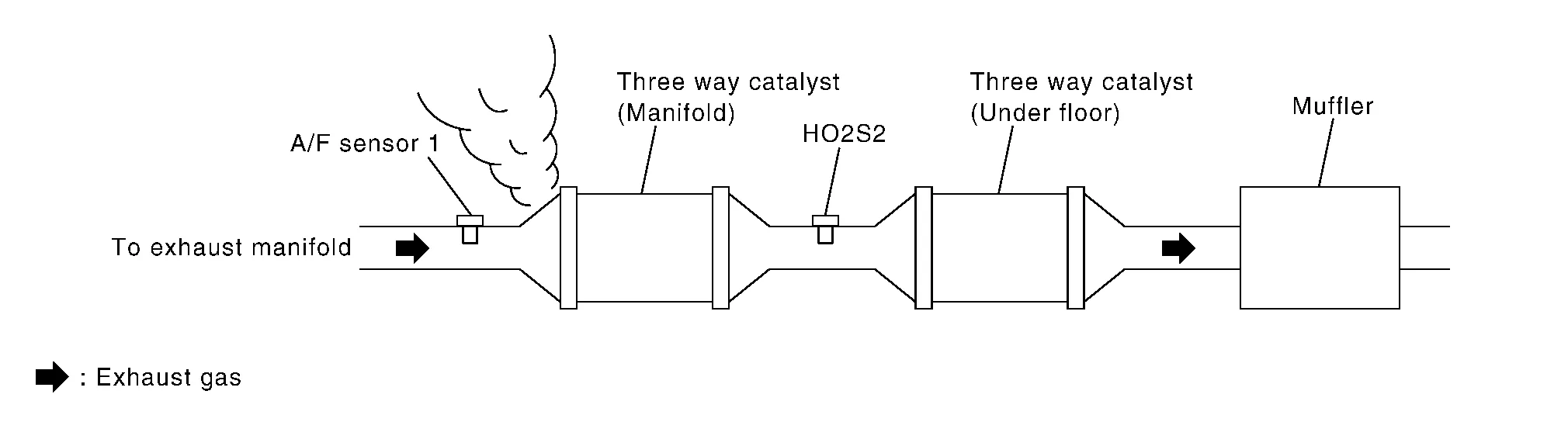
Is exhaust gas leakage detected?
YES>>Repair or replace malfunctioning part.
NO>>GO TO 3.
CHECK INTAKE AIR LEAKAGE
Listen for an intake air leakage after the mass air flow sensor.
Is intake air leakage detected?
YES>>Repair or replace malfunctioning part.
NO>>GO TO 4.
CHECK IGNITION TIMING
Check idle speed and ignition timing.
For procedure, refer to Work Procedure.
For specification, refer to Idle Speed and Ignition Timing.
Is the inspection result normal?
YES>>GO TO 5.
NO>>Follow the Work Procedure.
CHECK FUEL INJECTORS
-
Stop engine and then turn ignition switch ON.
-
Check the voltage between ECM harness connector terminals.
ECM Voltage + – Connector Terminal Connector Terminal F78 11 E32 152 Battery voltage 12 16 17 21 22
Is the inspection result normal?
YES>>GO TO 6.
NO>>Perform Diagnosis Procedure.
CHECK FUNCTION OF IGNITION COIL-I
CAUTION:
Perform the following procedure in a place with no combustible objects and good ventilation.
-
Turn ignition switch OFF.
-
Remove fuel pump fuse in IPDM E/R to release fuel pressure.
 NOTE:
NOTE:
Do not use CONSULT to release fuel pressure, or fuel pressure applies again during the following procedure.
-
Start engine.
-
After engine stalls, crank it 2 or 3 times to release all fuel pressure.
-
Turn ignition switch OFF.
-
Remove all ignition coil harness connectors to avoid the electrical discharge from the ignition coils.
-
Remove ignition coil and spark plug of the cylinder to be checked.
-
Crank engine for 5 seconds or more to remove combustion gas in the cylinder.
-
Connect spark plug and harness connector to ignition coil.
-
Fix ignition coil using a rope etc. with gap of 13 - 17 mm (0.52 - 0.66 in) between the edge of the spark plug and grounded metal portion as shown in the figure.
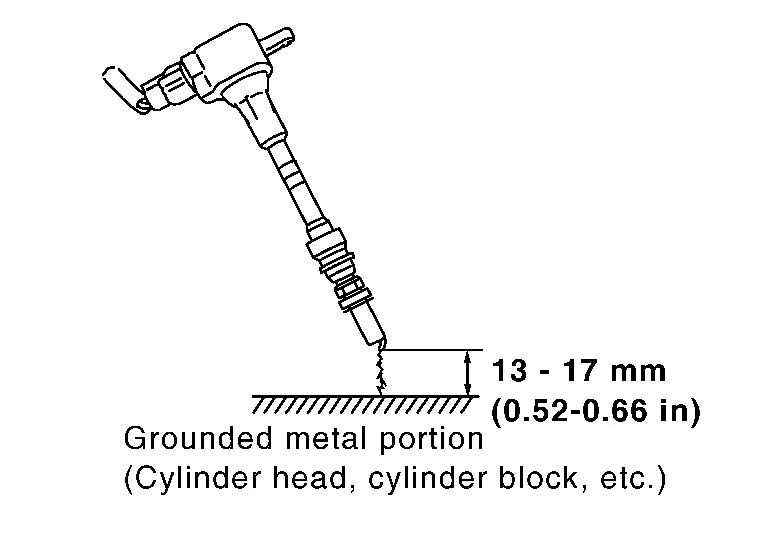
-
Crank engine for approximately 3 seconds, and check whether spark is generated between the spark plug and the grounded metal portion.
Spark should be generated. CAUTION:
-
During the operation, always stay 0.5 m (19.7 in) or more away from the spark plug and the ignition coil. Be careful not to get an electrical shock while checking, because the electrical discharge voltage becomes 20 kV or more.
-
It might cause to damage the ignition coil if the gap of more than 17 mm (0.66 in) is taken.
NOTE:
When the gap is less than 13 mm (0.52 in), the spark might be generated even if the coil is malfunctioning.
-
Is the inspection result normal?
YES>>GO TO 10.
NO>>GO TO 7.
CHECK FUNCTION OF IGNITION COIL-II
-
Turn ignition switch OFF.
-
Disconnect spark plug and connect a known-good spark plug.
-
Crank engine for approximately 3 seconds, and recheck whether spark is generated between the spark plug and the grounded metal portion.
Spark should be generated.
Is the inspection result normal?
YES>>GO TO 8.
NO>>Check ignition coil, power transistor and their circuit. Refer to Diagnosis Procedure.
CHECK SPARK PLUG
Check the initial spark plug for fouling, etc.
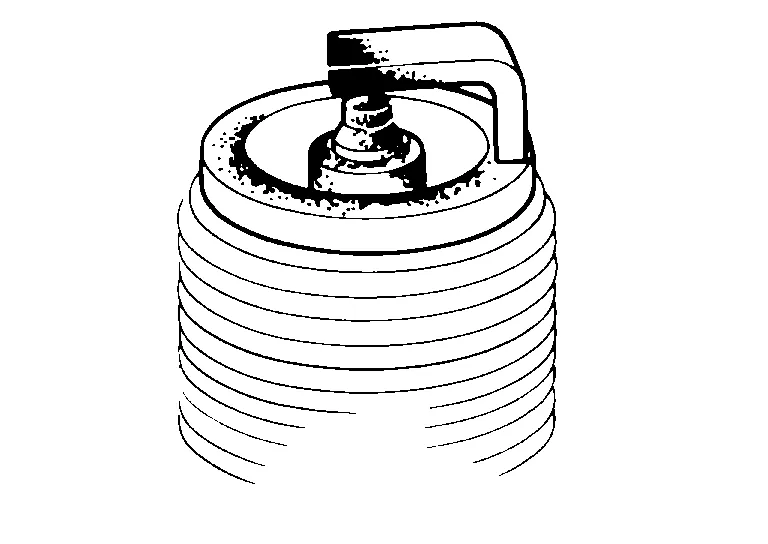
Is the inspection result normal?
YES>>Replace spark plug(s) with standard type one(s). For spark plug type, refer to Spark Plug.
NO>>Repair or clean spark plug. Then GO TO 9.
CHECK FUNCTION OF IGNITION COIL-III
-
Reconnect the initial spark plugs.
-
Crank engine for approximately 3 seconds, and recheck whether spark is generated between the spark plug and the grounded portion.
Spark should be generated.
Is the inspection result normal?
YES>>INSPECTION END
NO>>Replace spark plug(s) with standard type one(s). For spark plug type, refer to Spark Plug.
CHECK FUEL INJECTOR
-
Turn ignition switch OFF.
-
Remove fuel injector assembly. Refer to Removal and Installation.
Keep fuel hose and all fuel injectors connected to fuel tube.
-
Disconnect all ignition coil harness connectors.
-
Reconnect all fuel injector harness connectors disconnected.
-
Turn ignition switch ON.
-
Check that the fuel does not drip from fuel injector.
Does fuel drip from fuel injector?
YES>>Replace the fuel injector(s) from which fuel is dripping. Refer to Removal and Installation.
NO>>INSPECTION END
 P0340 Cmp Sensor (phase)
DTC Description
DTC DETECTION LOGIC
The cylinder No. signal is not sent to ECM for the first few seconds during engine cranking.
The cylinder No. signal is not sent to ECM during engine running...
 P0441 Evap Control System
DTC Description
DTC DETECTION LOGICIn this evaporative emission (EVAP) control system, purge flow occurs during non-closed throttle conditions. Purge volume is related to air intake volume...
Other information:
Nissan Murano (Z52) 2015-2024 Service Manual: C1a04 Abs/tcs/vdc System
DTC Description DTC DETECTION LOGIC DTC No. CONSULT screen terms DTC detection condition C1A04–97 ABS/TCS/VDC CIRC (ABS/TCS/VDC circuit) Diagnosis condition When Ignition switch is ON. Signal (terminal) — Threshold If a malfunction occurs in the VDC/TCS/ABS system Diagnosis delay time — POSSIBLE CAUSE ABS actuator and electric unit (control unit) FAIL-SAFEThe following systems are canceled: Intelligent Cruise Control Automatic Emergency Braking (AEB) Intelligent Forward Collision Warning (I-FCW) DTC Confirmation Procedure CHECK DTC PRIORITY If DTC “C1A04–97” is displayed with DTC “U1000–01”, first diagnose the DTC “U1000–01”...
Nissan Murano (Z52) 2015-2024 Service Manual: Engine Control System
System Description SYSTEM DIAGRAMSYSTEM DESCRIPTIONECM controls the engine by various functions. Function Reference Multiport fuel injection system System Description Electric ignition system System Description Air conditioning cut control System Description Automatic speed control device (ASCD) System DescriptionSystem Description Cooling fan control System Description Electronic controlled engine mount System Description Evaporative emission system System Description Throttle control System Description Intake valve timing control System Description Exhaust valve timing control System Description Engine protection control at low engine oil pressure System Description Fuel filler cap warning system System Description Variable induction air system System Description Integrated control of engine, CVT, and ABS System Description CAN communication System Description Fuel pump control module (FPCM) System Description Fail-safe DTC No...
Categories
- Manuals Home
- Nissan Murano Owners Manual
- Nissan Murano Service Manual
- Indicator lights
- Fuel recommendation
- Intelligent Forward Collision Warning (I-FCW)
- New on site
- Most important about car
Seatback pockets
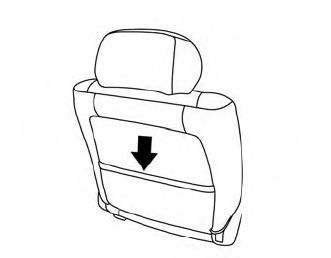
Theremaybe one or two seatback pockets located on the back of the driver and passenger seats. The pockets can be used to store maps.
WARNING
