
Nissan Murano: Starting and driving / Hill start assist system
WARNING
- Never rely solely on the hill start assist system to prevent the vehicle from moving backward on a hill. Always drive carefully and attentively. Depress the brake pedal when the vehicle is stopped on a steep hill. Be especially careful when stopped on a hill on frozen or muddy roads. Failure to prevent the vehicle from rolling backwardsmay result in a loss of control of the vehicle and possible serious injury or death.
- The hill start assist system is not designed to hold the vehicle at a standstill on a hill. Depress the brake pedal when the vehicle is stopped on a steep hill. Failure to do so may cause the vehicle to roll backwards and may result in a collision or serious personal injury.
- The hill start assist may not prevent the vehicle from rolling backwards on a hill under all load or road conditions. Always be prepared to depress the brake pedal to prevent the vehicle from rolling backwards. Failure to do so may result in a collision or serious personal injury.
When the vehicle is stopped on a hill, the hill start assist system automatically keeps the brakes applied. This helps prevent the vehicle from rolling backward in the time it takes the driver to release the brake pedal and apply the accelerator.
Hill start assist will operate automatically under the following conditions:
- The shift lever is moved to a forward or reverse gear.
- The vehicle is stopped completely on a hill by applying the brake.
- The hill grade is above 10%.
The maximum holding time is two seconds. After two seconds the vehicle will begin to roll back and hill start assist will stop operating completely.
Hill start assist will not operate when the shift lever is moved to N (Neutral) or P (Park) or on a flat and level road.
 Rise-up and build-up. Brake force distribution
Rise-up and build-up
The system gradually adjusts braking
power during normal braking to help provide
an enhanced brake feel.
Brake force distribution
During braking while driving through turns,
the system optimizes the distribution of
force to each of the four wheels depending
on the radius of the turn...
 Front and rear sonar system (if so equipped)
The sonar (parking sensor) system sounds
a tone to inform the driver of obstacles
near the bumper.
When the “DISPLAY” key is ON, the sonar
view will automatically appear in the meter...
Other information:
Nissan Murano (Z52) 2015-2024 Service Manual: Light Reminder Warning
Light Reminder Warning SYSTEM DIAGRAMWARNING CHIME OPERATION CONDITIONSIf all of the following conditions are fulfilled: Operation conditions Ignition switch OFF Combination switch (Lighting switch) 1st or 2nd position Driver side door Open [front door switch LH ON] WARNING CHIME CANCEL CONDITIONSWarning is canceled if any of the following conditions are fulfilled: Operation conditions Ignition switch ON Combination switch (Lighting switch) OFF or AUTO position Driver side door Close [front door switch LH OFF] SIGNAL PATH BCM requires warning chime output to combination meter when it judges light reminder warning chime is necessary from signals below...
Nissan Murano (Z52) 2015-2024 Service Manual: Power Supply and Ground Circuit
Diagnosis Procedure CHECK FUSE Check that the following fuses are not blown: Terminal No. Signal name Fuse No. Capacity 40 Ignition signal 29 10 A Are the fuses blown? YES>> Replace the blown fuse after repairing the affected circuit...
Categories
- Manuals Home
- Nissan Murano Owners Manual
- Nissan Murano Service Manual
- How to enable/disable the LDW system
- Warning lights
- Indicator lights
- New on site
- Most important about car
LATCH (Lower Anchors and Tethers for CHildren) system
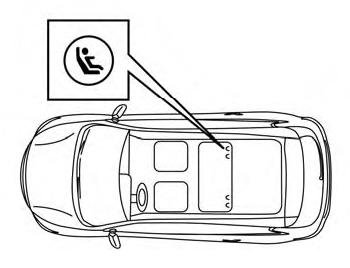
LATCH system lower anchor locations - bench seat
Your vehicle is equipped with special anchor points that are used with LATCH system compatible child restraints. This system may also be referred to as the ISOFIX or ISOFIX compatible system. With this system, you do not have to use a vehicle seat belt to secure the child restraint unless the combined weight of the child and child restraint exceeds 65 lbs. (29.5 kg). If the combined weight of the child and child restraint is greater than 65 lbs. (29.5 kg), use the vehicle’s seat belt (not the lower anchors) to install the child restraint. Be sure to follow the child restraint manufacturer’s instructions for installation.
