
Nissan Murano: System / Hill Start Assist Function
SYSTEM DIAGRAM
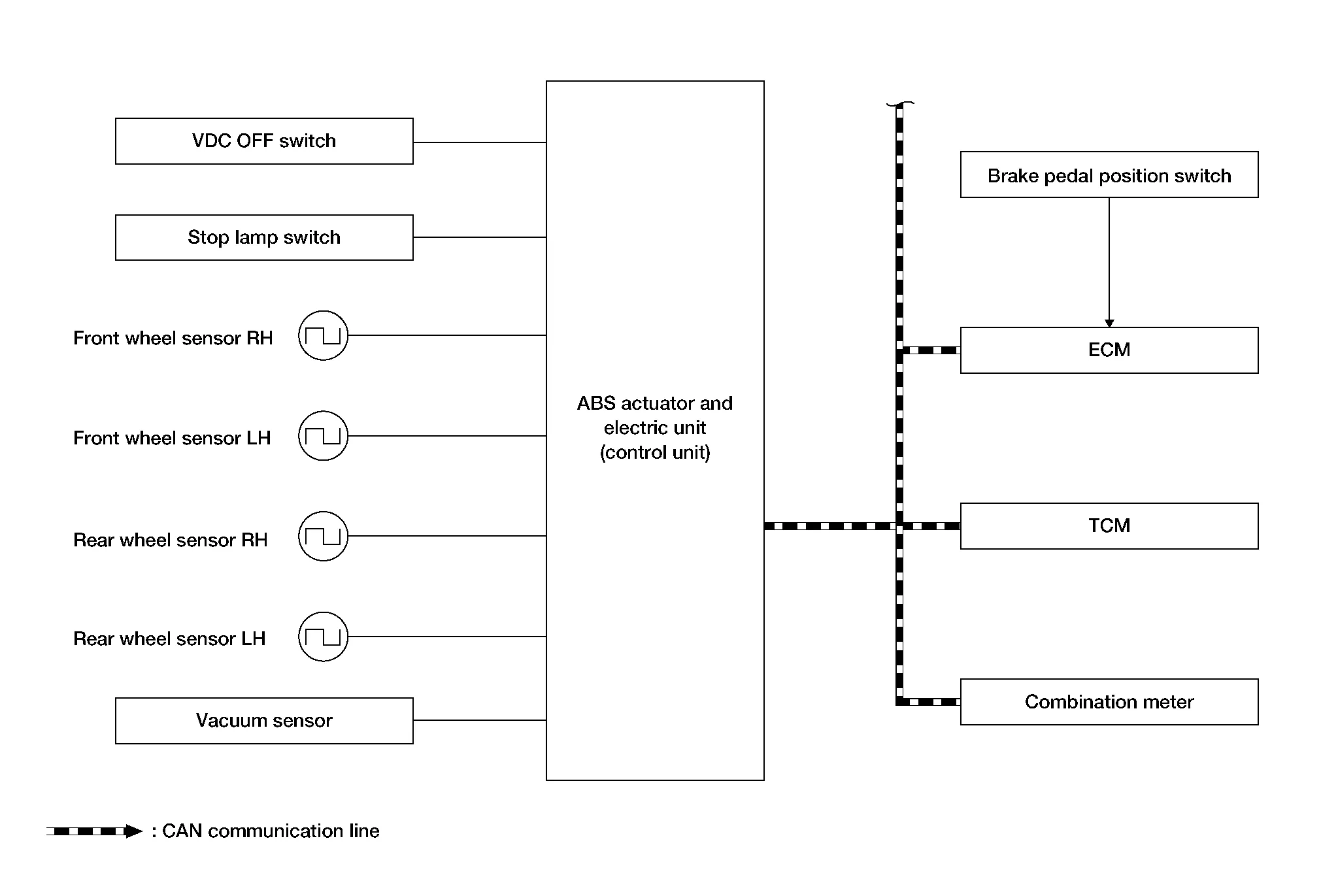
-
This function maintains brake fluid pressure so that the vehicle does not move backward even if brake pedal is released to depress accelerator pedal to start the Nissan Murano vehicle while it is stopped on an uphill slope by depressing brake pedal.
-
This function operates when the Nissan Murano vehicle is in stop status on a uphill slope of slope ratio 10% or more and selector lever is in a position other than P or N.
-
Hill start assist function is only for the start aid. It maintains the brake fluid pressure for approximately 2 seconds after releasing the brake pedal and then decreases the pressure gradually. If the Nissan Murano vehicle can start by the accelerator operation, the brake is released automatically and a smooth start can be performed.
-
Fail-safe function is adopted. When a malfunction occurs in hill start assist function, the control is suspended for VDC function, TCS function, brake assist function and hill start assist function. The Nissan Murano vehicle status becomes the same as models without VDC function, TCS function, brake assist function and hill start assist function. However, ABS function and EBD function are operated normally. Refer to Fail-Safe.
SIGNAL TRANSMISSION FUNCTION LIST
Major signal transmission between each unit via communication lines is shown in the following table:
| Component | Signal description |
|---|---|
| ECM |
Mainly transmits the following signals to ABS actuator and electric unit (control unit) via CAN communication:
Mainly receives the following signal from ABS actuator and electric unit (control unit) via CAN communication:
|
| TCM |
Mainly transmits the following signal to ABS actuator and electric unit (control unit) via CAN communication:
|
| Combination meter |
Mainly receives the following signals from ABS actuator and electric unit (control unit) via CAN communication:
Mainly receives the following signals from ABS actuator and electric unit (control unit) via CAN communication:
|
 Brake Assist Function
System Description
SYSTEM DIAGRAM
When the driver brakes hard in an emergency, the stopping distance is reduced by increasing brake fluid pressure.
Fail-safe function is adopted...
 Warning/indicator/chime List
Warning Lamp/Indicator Lamp
Name Design Layout/Function
ABS warning lamp
or
For function: Refer to Component Function Check.
For layout: Refer to Design...
Other information:
Nissan Murano (Z52) 2015-2024 Owners Manual: How to enable/disable the RCTA system
Perform the following steps to enable or disable the RCTA system. Using “Settings” in the vehicle information display: Press the button until “Settings” displays in the vehicle information display and then press the OK button. Use the button to select “Driver Assistance...
Nissan Murano (Z52) 2015-2024 Service Manual: B13cf Buttons
DTC Description DTC DETECTION LOGIC DTC No. CONSULT screen terms (Trouble diagnosis content) DTC detection condition B13CF-73 Buttons (Audio unit) Diagnosis condition When ignition switch is ON. Signal (terminal) — Threshold — Diagnosis delay time — POSSIBLE CAUSEAudio unitFAIL-SAFEAudio unit buttons error Confirmation Procedure PERFORM DTC CONFIRMATION PROCEDURE CONSULT Ignition switch ON...
Categories
- Manuals Home
- Nissan Murano Owners Manual
- Nissan Murano Service Manual
- Tire rotation
- Turning the AEB system on/off
- Checking engine oil level
- New on site
- Most important about car
LATCH (Lower Anchors and Tethers for CHildren) system
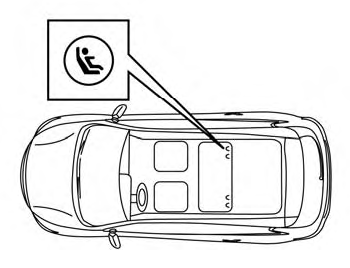
LATCH system lower anchor locations - bench seat
Your vehicle is equipped with special anchor points that are used with LATCH system compatible child restraints. This system may also be referred to as the ISOFIX or ISOFIX compatible system. With this system, you do not have to use a vehicle seat belt to secure the child restraint unless the combined weight of the child and child restraint exceeds 65 lbs. (29.5 kg). If the combined weight of the child and child restraint is greater than 65 lbs. (29.5 kg), use the vehicle’s seat belt (not the lower anchors) to install the child restraint. Be sure to follow the child restraint manufacturer’s instructions for installation.
