
Nissan Murano: System Description / Handling Precaution
PRECAUTIONS FOR AUTOMATIC EMERGENCY BRAKING (AEB)
-
The automatic emergency braking (AEB) system is a supplemental aid to the driver. It is not a replacement for the driver′s attention to traffic conditions or responsibility to drive safely. It cannot prevent accidents due to carelessness or dangerous driving techniques.
-
The automatic emergency braking (AEB) system does not function in all driving, traffic, weather and road conditions.
-
The automatic braking will cease under the following conditions:
-
When the steering wheel is turned as far as necessary to avoid a collision.
-
When the accelerator pedal is depressed.
-
When there is no longer a Nissan Murano vehicle detected ahead.
-
-
If the automatic emergency braking (AEB) system has stopped the Nissan Murano vehicle, the vehicle will remain at a standstill for approximately 2 seconds before the brakes are released.
-
The system will not detect the following objects:
-
Pedestrians, animals, or obstacles in the roadway
-
Oncoming Nissan Murano vehicles in the same lane
-
Crossing vehicles
-
-
The radar sensor has some performance limitations. For stationary Nissan Murano vehicles, the automatic emergency braking (AEB) system can function at speeds of up to approximately 80 km/h (50 MPH).
-
The radar sensor may not detect a Nissan Murano vehicle ahead in the following conditions:
-
Dirt, ice, snow or other material covering the radar sensor.
-
Interference by other radar sources.
-
Snow or road spray from traveling Nissan Murano vehicles.
-
If the vehicle ahead is narrow (e.g.motorcycle)
-
When driving on a steep downhill slope or roads with sharp curves.
-
-
In some road or traffic conditions, the automatic emergency braking (AEB) system may unexpectedly apply partial braking. When acceleration is necessary, continue to depress the accelerator pedal to override the system.
-
Braking distances increase on slippery surfaces.
-
Excessive noise will interfere with the warning chime sound, and the chime may not be heard.
 Operation
Switch Name and Function
No. Switch name Description
AEB system setting screen
(Integral switch settings screen)
The setting of AEB/I-FCW system can be switched between ON and OFF
Menu Displayed by Pressing Each Switch
SYSTEM DISPLAY No...

Other information:
Nissan Murano (Z52) 2015-2024 Service Manual: U1000 Can Comm Circuit
DTC Description DescriptionCAN (Controller Area Network) is a serial communication line for real time applications. It is an on-Nissan Murano vehicle multiplex communication line with high data communication speed and excellent error detection ability...
Nissan Murano (Z52) 2015-2024 Service Manual: Intake Valve Timing Control
System Description SYSTEM DIAGRAMSystem DescriptionINTAKE VALVE TIMING CONTROLSystem DescriptionThis mechanism hydraulically controls cam phases continuously with the fixed operating angle of the intake valve.The ECM receives signals such as crankshaft position, camshaft position, engine speed, and engine coolant temperature...
Categories
- Manuals Home
- Nissan Murano Owners Manual
- Nissan Murano Service Manual
- Warning lights
- High Beam Assist (if so equipped)
- All-Wheel Drive (AWD) (if so equipped)
- New on site
- Most important about car
Fuel gauge
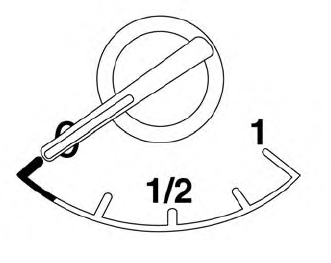
The gauge indicates the approximate fuel level in the tank.
The gauge may move slightly during braking, turning, acceleration, or going up or down hills.
The gauge needle returns to 0 (Empty) after the ignition switch is placed in the OFF position.
