
Nissan Murano: System / Evap Orative Emission System
SYSTEM DIAGRAM

SYSTEM DESCRIPTION

The evaporative emission system is used to reduce hydrocarbons emitted into the atmosphere from the fuel system. This reduction of hydrocarbons is accomplished by activated charcoals in the EVAP canister.
The fuel vapor in the sealed fuel tank is led into the EVAP canister which contains activated carbon and the vapor is stored there when the engine is not operating or when refueling to the fuel tank.
The vapor in the EVAP canister is purged by the air through the purge line to the intake manifold when the engine is operating. EVAP canister purge volume control solenoid valve is controlled by ECM. When the engine operates, the flow rate of vapor controlled by EVAP canister purge volume control solenoid valve is proportionally regulated as the air flow increases.
EVAP canister purge volume control solenoid valve also shuts off the vapor purge line during decelerating and idling.
 Electronic Controlled Engine Mount
System Description
SYSTEM DIAGRAMSYSTEM DESCRIPTIONThe ECM controls the engine mount operation corresponding to the engine speed. The control system has a 2-step control [Soft/Hard] Vehicle condition Engine mount control
Engine speed: Below 950 rpm
Soft
Engine speed: Above 950 rpm
Hard
ELECTRONIC CONTROLLED ENGINE MOUNT LINE DRAWING
Electronic controlled engine mount control solenoid valve
Intake manifold collector
: From next figure
Front electronic controlled engine mount
Rear electronic controlled engine mount
: To previous figure
NOTE:
Do not use soapy water or any type of solvent while installing vacuum hose...
 Throttle Control
System Description
SYSTEM DIAGRAM*: ECM determines the start signal status by the signals of engine speed and battery voltage.SYSTEM DESCRIPTIONECM calculates the value of signal transmitted from the accelerator pedal and activates the throttle valve by transmitting a control signal to the electric throttle control actuator...
Other information:
Nissan Murano (Z52) 2015-2024 Service Manual: Front Coil Spring and Strut
Exploded View 1. Piston rod lock nut 2. Strut mount insulator 3. Strut mount bearing 4. Front coil spring 5. Bound bumper 6. Lower rubber seat 7. Strut Front Removal and Installation REMOVALRemove strut bolt access panel from cowl top...
Nissan Murano (Z52) 2015-2024 Service Manual: Intelligent Key Button Operation Has Poor Range (one Key)
Diagnosis Procedure Intelligent Key button operation has poor range. (One Intelligent Key has the symptom, other keys operate normally.)SYMPTOM TABLE (ONE INTELLIGENT KEY HAS THE SYMPTOM, OTHER KEYS OPERATE NORMALLY) Door lock operation (remote keyless entry) Door lock operation (request switch) or back door open operation (opener switch of back door panel) Engine started with ignition switch operation (Intelligent Key is within the detection area of inside key antenna) Engine started with ignition switch operation (registered Intelligent Key placed next to ignition switch) Poor range OK OK OK DIAGNOSIS PROCEDURERefer to Diagnosis Procedure...
Categories
- Manuals Home
- Nissan Murano Owners Manual
- Nissan Murano Service Manual
- System malfunction
- Warning lights
- Passenger compartment
- New on site
- Most important about car
LATCH (Lower Anchors and Tethers for CHildren) system
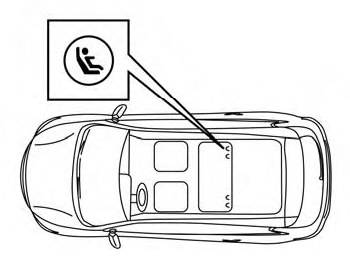
LATCH system lower anchor locations - bench seat
Your vehicle is equipped with special anchor points that are used with LATCH system compatible child restraints. This system may also be referred to as the ISOFIX or ISOFIX compatible system. With this system, you do not have to use a vehicle seat belt to secure the child restraint unless the combined weight of the child and child restraint exceeds 65 lbs. (29.5 kg). If the combined weight of the child and child restraint is greater than 65 lbs. (29.5 kg), use the vehicle’s seat belt (not the lower anchors) to install the child restraint. Be sure to follow the child restraint manufacturer’s instructions for installation.
