Nissan Murano: Front Door / Door Hinge
REMOVAL
Remove front door assembly. Refer to Removal and Installation.
Remove front door hinge bolts (body side) and front door hinge.
INSTALLATION
Installation is in the reverse order of removal.
CAUTION:
-
Tighten nuts/bolts to specified torque. Refer to Exploded View.
-
Apply anticorrosive agent to hinge mating surface.
-
After installation, check front door open/close and lock/unlock operation.
-
Check door hinge rotating point for poor lubrication. If necessary, apply a suitable multi-purpose grease.
-
After installation, perform front door adjustment procedure. Refer to Adjustment.
 Door Striker
Removal and Installation
REMOVALRemove bolts and front door striker.INSTALLATIONInstallation is in the reverse order of removal.CAUTION:
Do not reuse front door striker bolts...
 Door Check Link
Removal and Installation
REMOVALFully close front door window.
Remove front door speaker. Refer to Removal and Installation [NAVIGATION WITHOUT BOSE],Removal and Installation [NAVIGATION WITH BOSE]...
Other information:
Nissan Murano (Z52) 2015-2024 Owners Manual: Parking brake
WARNING Be sure the parking brake is fully released before driving. Failure to do so can cause brake failure and lead to an accident. Do not release the parking brake from outside the vehicle. Do not use the shift lever in place of the parking brake...
Nissan Murano (Z52) 2015-2024 Service Manual: C1113 Yaw Rate/side/decel G Sensor
DTC Description DTC DETECTION LOGIC DTC No. CONSULT screen item (Trouble diagnosis content) DTC detected condition C1113 G-SENSOR (G-sensor circuit) Diagnosis condition When ignition switch ON. When power supply voltage is normal. When the Nissan Murano vehicle speed is 6...
Categories
- Manuals Home
- Nissan Murano Owners Manual
- Nissan Murano Service Manual
- Vehicle Dynamic Control (VDC) OFF switch
- Fuel recommendation
- Checking engine oil level
- New on site
- Most important about car
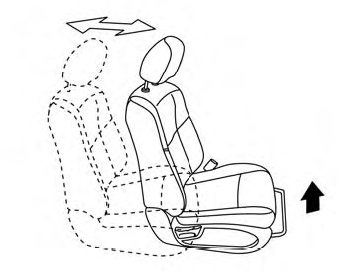
Front manual seat adjustment (if so equipped)
Your vehicle seats can be adjusted manually. For additional information about adjusting the seats, refer to the steps outlined in this section.
Forward and backward