
Nissan Murano: Dtc/circuit Diagnosis / Trouble Diagnosis - Specification Value
ECM input/output valve when the engine control system operates normally.
 NOTE:
NOTE:
The SP value is indicated when “DISPLAY TYPE” is “Line Graph”.
When the indicated value of “DATA MONITOR” mode is within the SP value, the engine control system is confirmed OK. When the indicated value of “DATA MONITOR” mode is not within the SP value, the engine control system may have one or more malfunctions.
The SP value will be displayed for the following three items:
-
B/FUEL SCHDL (The fuel injection pulse width programmed into ECM prior to any learned on board correction)
-
A/F ALPHA-B1/B2 (The mean value of air-fuel ratio feedback correction factor per cycle)
-
MAS AIR FLOW SENSOR (Hz) (The signal frequency of the mass air flow sensor)
START
Check that all of the following conditions are satisfied.
-
Nissan Murano Vehicle driven distance: More than 5,000 km (3,107 miles)
-
Barometric pressure: 98.3 - 104.3 kPa (1.003 - 1.064 kg/cm2, 14.25 - 15.12 psi)
-
Atmospheric temperature: 20 - 30°C (68 - 86°F)
-
Engine coolant temperature: 75 - 95°C (167 - 203°F)
-
Transmission: Warmed-up
-
After the engine is warmed up to normal operating temperature, drive Nissan Murano vehicle until “FLUID TEMP SE” (CVT fluid temperature sensor signal) indicates more than 60°C (140°F).
-
-
Electrical load: Not applied
-
Rear window defogger switch, air conditioner switch lighting switch are OFF. Steering wheel is straight ahead.
-
-
Engine speed: Idle
>>
GO TO 2.
CHECK REFERENCE OF DATA MONITOR MODE
 With CONSULT
NOTE:
Perform “Reference” in “DATA MONITOR” mode in maximum scale display.
-
Perform basic inspection. Refer to Work Procedure.
-
On CONSULT screen, select “ENGINE”>>“DATA MONITOR”.
-
Select “Reference” and change “DISPLAY TYPE” to “Line Graph”.
-
Select “B/FUEL SCHDL”, “A/F ALPHA-B1”, “A/F ALPHA-B2” and “MAS AIR FLOW SENSOR (Hz)” in “SPEC” of “DATA MONITOR” mode with CONSULT.
-
Check that monitor items are within the SP value.
Is the measurement value within the SP value?
YES>>INSPECTION END
NO>>Proceed to Diagnosis Procedure.
OVERALL SEQUENCE


DETAILED PROCEDURE
CHECK “A/F ALPHA-B1”, “A/F ALPHA-B2”
With CONSULT
-
Start engine.
-
Confirm that the testing conditions are met. Refer to Component Function Check.
-
Select “DATA MONITOR” mode of “ENGINE” using CONSULT.
-
Select “Reference” and change “DISPLAY TYPE” to “Line Graph”.
-
Select “A/F ALPHA-B1”, “A/F ALPHA-B2”.
NOTE:
Check “A/F ALPHA-B1”, “A/F ALPHA-B2” for approximately 1 minute because they may fluctuate. It is NG if the indication is out of the SP value even a little.
Is the measurement value within the SP value?
YES>>GO TO 17.
NO>>Less than the SP value: GO TO 2.
NO>>More than the SP value: GO TO 3.
CHECK “B/FUEL SCHDL”
Select “B/FUEL SCHDL” in “Reference” of “DATA MONITOR” mode, and check that the indication is within the SP value.
Is the measurement value within the SP value?
YES>>GO TO 4.
NO>>More than the SP value: GO TO 19.
CHECK “B/FUEL SCHDL”
Select “B/FUEL SCHDL” in “Reference” of “DATA MONITOR” mode, and check that the indication is within the SP value.
Is the measurement value within the SP value?
YES>>GO TO 6.
NO>>More than the SP value: GO TO 6.
NO>>Less than the SP value: GO TO 25.
CHECK “A/F ALPHA-B1”, “A/F ALPHA-B2”
-
Stop the engine.
-
Disconnect PCV hose, and then plug it.
-
Start engine.
-
Select “DATA MONITOR” mode of “ENGINE” using CONSULT.
-
Select “Reference” and change “DISPLAY TYPE” to “Line Graph”.
-
Select “A/F ALPHA-B1”, “A/F ALPHA-B2”.
Is the measurement value within the SP value?
YES>>GO TO 5.
NO>>GO TO 6.
CHANGE ENGINE OIL
-
Stop the engine.
-
Change engine oil.
NOTE:
This symptom may occur when a large amount of gasoline is mixed with engine oil because of driving conditions (such as when engine oil temperature does not rise enough since a journey distance is too short during winter). The symptom will not be detected after changing engine oil or changing driving conditions.
>>
INSPECTION END
CHECK FUEL PRESSURE
Check fuel pressure. (Refer to Work Procedure.)
Is the inspection result normal?
YES>>GO TO 9.
NO>>Fuel pressure is too high: Replace “fuel filter and fuel pump assembly”, refer to Removal and Installation, and then GO TO 8.
NO>>Fuel pressure is too low: GO TO 7.
DETECT MALFUNCTIONING PART
Check fuel hoses and fuel tubes for clogging.
Is the inspection result normal?
YES>>Replace “fuel filter and fuel pump assembly”, refer to Removal and Installation, and then GO TO 8.
NO>>Repair or replace malfunctioning part and then GO TO 8.
CHECK “A/F ALPHA-B1”, “A/F ALPHA-B2”
-
Start engine.
-
Select “DATA MONITOR” mode of “ENGINE” using CONSULT.
-
Select “Reference” and change “DISPLAY TYPE” to “Line Graph”.
-
Select “A/F ALPHA-B1”, “A/F ALPHA-B2”.
Is the measurement value within the SP value?
YES>>INSPECTION END
NO>>GO TO 9.
PERFORM POWER BALANCE TEST
-
Perform “POWER BALANCE” in “ACTIVE TEST” mode.
-
Check that the each cylinder produces a momentary engine speed drop.
Is the inspection result normal?
YES>>GO TO 12.
NO>>GO TO 10.
DETECT MALFUNCTIONING PART
Check the following below.
-
Ignition coil and its circuit (Refer to Component Function Check.)
-
Fuel injector and its circuit (Refer to Component Function Check.)
-
Intake air leakage
-
Low compression pressure (Refer to On-Nissan Murano Vehicle Service.)
Is the inspection result normal?
YES>>Replace fuel injector, refer to Removal and Installation, and then GO TO 11.
NO>>Repair or replace malfunctioning part and then GO TO 11.
CHECK “A/F ALPHA-B1”, “A/F ALPHA-B2”
-
Start engine.
-
Select “DATA MONITOR” mode of “ENGINE” using CONSULT.
-
Select “Reference” and change “DISPLAY TYPE” to “Line Graph”.
-
Select “A/F ALPHA-B1”, “A/F ALPHA-B2”.
Is the measurement value within the SP value?
YES>>INSPECTION END
NO>>GO TO 12.
CHECK A/F SENSOR 1 FUNCTION
Perform all DTC CONFIRMATION PROCEDURE related with A/F sensor 1.
-
For DTC P0130, P0150, P2237, P2238, P2239, P2240, P2241, P2242, P2251, P2252, P2253, P2254, P2255, P2256, refer to DTC Index.
-
For DTC P0131, P0151, refer to DTC Index.
-
For DTC P0132, P0152, refer to DTC Index.
-
For DTC P014C, P014D, P014E, P014F, P015A, P015B, P015C, P015D, refer to DTC Index.
-
For DTC P2096, P2097, P2098, P2099, refer to DTC Index.
Are any DTCs detected?
YES>>GO TO 15.
NO>>GO TO 13.
CHECK A/F SENSOR 1 CIRCUIT
Perform Diagnostic Procedure according to corresponding DTC.
>>
GO TO 14.
CHECK “A/F ALPHA-B1”, “A/F ALPHA-B2”
-
Start engine.
-
Select “DATA MONITOR” mode of “ENGINE” using CONSULT.
-
Select “Reference” and change “DISPLAY TYPE” to “Line Graph”.
-
Select “A/F ALPHA-B1”, “A/F ALPHA-B2”.
Is the measurement value within the SP value?
YES>>INSPECTION END
NO>>GO TO 15.
DISCONNECT AND RECONNECT ECM HARNESS CONNECTOR
-
Stop the engine.
-
Disconnect ECM harness connector. Check pin terminal and connector for damage, and then reconnect it.
>>
GO TO 16.
CHECK “A/F ALPHA-B1”, “A/F ALPHA-B2”
-
Start engine.
-
Select “DATA MONITOR” mode of “ENGINE” using CONSULT.
-
Select “Reference” and change “DISPLAY TYPE” to “Line Graph”.
-
Select “A/F ALPHA-B1”, “A/F ALPHA-B2”.
Is the measurement value within the SP value?
YES>>INSPECTION END
NO>>Detect malfunctioning part according to Symptom Table.
CHECK “B/FUEL SCHDL”
-
Select “DATA MONITOR” mode of “ENGINE” using CONSULT.
-
Select “Reference” and change “DISPLAY TYPE” to “Line Graph”.
-
Select “B/FUEL SCHDL”.
Is the measurement value within the SP value?
YES>>INSPECTION END
NO>>More than the SP value: GO TO 18.
NO>>Less than the SP value: GO TO 25.
DETECT MALFUNCTIONING PART
-
Check for the cause of large engine friction. Refer to the following.
-
Engine oil level is too high
-
Engine oil viscosity
-
Belt tension of power steering, generator, A/C compressor, etc. is excessive
-
Noise from engine
-
Noise from transmission, etc.
-
-
Check for the cause of insufficient combustion. Refer to the following.
-
Valve clearance malfunction
-
Intake valve timing control function malfunction
-
Camshaft sprocket installation malfunction, etc.
-
>>
Repair or replace malfunctioning part, and then GO TO 30.
CHECK INTAKE SYSTEM
Check for the cause of uneven air flow through mass air flow sensor. Refer to the following.
-
Crushed air ducts
-
Malfunctioning seal of air cleaner element
-
Uneven dirt of air cleaner element
-
Improper specification of intake air system
Is the inspection result normal?
YES>>GO TO 21.
NO>>Repair or replace malfunctioning part, and then GO TO 20.
CHECK “A/F ALPHA-B1”, “A/F ALPHA-B2”, AND “B/FUEL SCHDL”
-
Select “DATA MONITOR” mode of “ENGINE” using CONSULT.
-
Select “Reference” and change “DISPLAY TYPE” to “Line Graph”.
-
Select “A/F ALPHA-B1”, “A/F ALPHA-B2” and “B/FUEL SCHDL”.
Is the measurement value within the SP value?
YES>>INSPECTION END
NO>>“B/FUEL SCHDL” is more, “A/F ALPHA-B1”, “A/F ALPHA-B2” are less than the SP value: GO TO 21.
DISCONNECT AND RECONNECT MASS AIR FLOW SENSOR HARNESS CONNECTOR
-
Stop the engine.
-
Disconnect mass air flow sensor harness connector. Check pin terminal and connector for damage and then reconnect it again.
>>
GO TO 22.
CHECK “A/F ALPHA-B1”, “A/F ALPHA-B2”
-
Start engine.
-
Select “DATA MONITOR” mode of “ENGINE” using CONSULT.
-
Select “Reference” and change “DISPLAY TYPE” to “Line Graph”.
-
Select “A/F ALPHA-B1”, “A/F ALPHA-B2”.
Is the measurement value within the SP value?
YES>>Detect malfunctioning part of mass air flow sensor circuit and repair it. Refer to Diagnosis Procedure. Then GO TO 29.
NO>>GO TO 23.
CHECK “MAS AIR FLOW SENSOR (Hz)”
-
Select “DATA MONITOR” mode of “ENGINE” using CONSULT.
-
Select “Reference” and change “DISPLAY TYPE” to “Line Graph”.
-
Select “MAS AIR FLOW SENSOR (Hz)”.
Is the measurement value within the SP value?
YES>>GO TO 24.
NO>>More than the SP value: Replace mass air flow sensor, refer to Removal and Installation, and then GO TO 29.
REPLACE ECM
Replace ECM. Refer to Removal and Installation.
>>
GO TO 29.
CHECK INTAKE SYSTEM
Check for the cause of uneven air flow through mass air flow sensor. Refer to the following.
-
Crushed air ducts
-
Malfunctioning seal in air cleaner element
-
Uneven dirt in air cleaner element
-
Improper specification in intake air system
Is the inspection result normal?
YES>>GO TO 27.
NO>>Repair or replace malfunctioning part, and then GO TO 26.
CHECK “B/FUEL SCHDL”
-
Select “DATA MONITOR” mode of “ENGINE” using CONSULT.
-
Select “Reference” and change “DISPLAY TYPE” to “Line Graph”.
-
Select “B/FUEL SCHDL”.
Is the measurement value within the SP value?
YES>>INSPECTION END
NO>>Less than the SP value: GO TO 27.
CHECK “MAS AIR FLOW SENSOR (Hz)”
-
Select “DATA MONITOR” mode of “ENGINE” using CONSULT.
-
Select “Reference” and change “DISPLAY TYPE” to “Line Graph”.
-
Select “MAS AIR FLOW SENSOR (Hz)”.
Is the measurement value within the SP value?
YES>>GO TO 28.
NO>>Less than the SP value: Replace mass air flow sensor, refer to Removal and Installation, and then GO TO 30.
CHECK INTAKE SYSTEM
Check for the cause of air leakage after the mass air flow sensor. Refer to the following.
-
Disconnection, looseness, and cracks in air duct
-
Looseness of oil filler cap
-
Disconnection of oil level gauge
-
Open stuck, breakage, hose disconnection, or cracks in PCV valve
-
Disconnection or cracks in EVAP purge hose, stuck open EVAP canister purge volume control solenoid valve
-
Malfunctioning seal in rocker cover gasket
-
Disconnection, looseness, or cracks in hoses, such as a vacuum hose, connecting to intake air system parts
-
Malfunctioning seal in intake air system, etc.
>>
GO TO 30.
CHECK “A/F ALPHA-B1”, “A/F ALPHA-B2”, AND “B/FUEL SCHDL”
-
Select “DATA MONITOR” mode of “ENGINE” using CONSULT.
-
Select “Reference” and change “DISPLAY TYPE” to “Line Graph”.
-
Select “A/F ALPHA-B1”, “A/F ALPHA-B2” and “B/FUEL SCHDL”.
Is the measurement value within the SP value?
YES>>INSPECTION END
NO>>Detect malfunctioning part according to Symptom Table.
CHECK “B/FUEL SCHDL”
-
Select “DATA MONITOR” mode of “ENGINE” using CONSULT.
-
Select “Reference” and change “DISPLAY TYPE” to “Line Graph”.
-
Select “B/FUEL SCHDL”.
Is the measurement value within the SP value?
YES>>INSPECTION END
NO>>Detect malfunctioning part according to Symptom Table.

 Power Supply and Ground Circuit
Diagnosis Procedure
CHECK THE BATTERY CABLE
Turn ignition switch OFF.
Check the battery cable for tightening enough.
NOTE:
Check the continuity between the battery cable and the battery terminal...
Other information:
Nissan Murano (Z52) 2015-2024 Service Manual: Component Parts. Can Terminator
Component Parts Location Side radar RH AWD control unit AV control unit (With navigation system) Audio unit (Without navigation system) A/C auto amp. 3CH CAN gateway Sonar control unit ABS actuator and electric unit (control unit) Power steering control module Distance sensor Around view monitor control unit ADAS control unit TCU TCM ECM IPDM E/R Data link connector CAN terminator BCM Combination meter Steering angle sensor Lane camera unit Air bag diagnosis sensor unit Driver seat control unit Automatic back door control module Side radar LH Component Description FUNCTIONS WITHIN THE SYSTEMEach control unit is connected with CAN network...
Nissan Murano (Z52) 2015-2024 Service Manual: Cluster Lid a
Removal and Installation REMOVALRemove instrument lower panel LH. Refer to Removal and Installation. Using a suitable tool, release pawls and remove gap hider (1) from steering column upper cover (2). : Pawl Using a suitable tool, release clips and remove cluster lid A (1)...
Categories
- Manuals Home
- Nissan Murano Owners Manual
- Nissan Murano Service Manual
- Vehicle Dynamic Control (VDC) OFF switch
- Shift lock release
- Memory storage function (key-link)
- New on site
- Most important about car
Luggage hooks
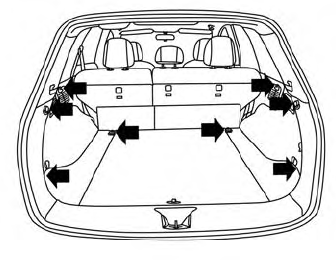
When securing items using luggage hooks located on the back of the seat or side finisher do not apply a load over more than 6.5 lbs. (29 N) to a single hook.
The luggage hooks that are located on the floor should have loads less than 110 lbs. (490 N) to a single hook.
