
Nissan Murano: Brake System :: Unit Disassembly and Assembly / Rear Disc Brake

| 1. | Torque member | 2. | Bushing | 3. | Piston boot |
| 4. | Slide pin boot | 5. | Slide pin | 6. | Piston |
| 7. | Piston seal | 8. | Brake caliper body | 9. | Bleeder cap |
| 10. | Brake hose | 11. | Copper sealing washers | 12. | Inner shim cover |
| 13. | Inner shim | 14. | Inner pad | 15. | Pad retainer |
| 16. | Outer pad | 17. | Outer shim | 18. | Outer shim cover |
| A. | Niglube Rx-2 | B. | Rubber grease | C. | Molykote® AS-880N |
 : Apply brake fluid. : Apply brake fluid. |
|||||
DISASSEMBLY
Remove the brake caliper from the vehicle. Refer to Removal and Installation.
Remove slide pin boots from torque member.
Remove slide pin bushing from slide pin.
Place a wooden block in the cylinder body and blow air from union bolt hole to remove piston and piston boot.

WARNING:
Do not get fingers caught between pistons and brake caliper body.
CAUTION:
Do not reuse piston boot.
Remove piston seal from brake caliper body using suitable tool.

CAUTION:
-
Do not damage cylinder inner wall.
-
Do not reuse piston seal.
Remove bleeder valve and cap.
INSPECTION AFTER DISASSEMBLY
Brake Caliper Body
Check the inner wall of the brake caliper body for rust, wear, cracks or damage. Replace the brake caliper body if any abnormal condition is detected.
CAUTION:
Always clean with new brake fluid. Do not clean with mineral oil such as gasoline and light oil.
Torque Member
Check the torque member for rust, wear, cracks or damage. Replace the torque member if any abnormal condition is detected.
Piston
Check the surface of the piston for rust, wear, cracks or damage. Replace the piston if any abnormal condition is detected.
CAUTION:
Piston sliding surface is plated. Do not polish with sandpaper.
Slide Pin and Slide Pin Boot
Check the slide pins and slide pin boots for rust, wear, cracks or damage. Replace the parts if any abnormal condition is detected.
ASSEMBLY
Install bleeder valve and cap.
Apply rubber grease to piston seal (1), and install it to the brake caliper body.

CAUTION:
Do not reuse piston seal.
Apply rubber grease to piston boot (1). Cover the piston (2) end with the piston boot, and then install cylinder side lip on the piston boot securely into the groove on brake caliper body.

CAUTION:
Do not reuse piston boot.
Apply brake fluid to piston (1). Push piston into brake caliper body by hand and push piston boot (2) piston side lip into the piston groove.

CAUTION:
Press the piston evenly and vary the pressing point to prevent cylinder inner wall from contact.
Apply Niglube Rx-2 grease to bushing; install bushing to slide pin.
Apply Niglube Rx-2 grease to slide pin boots and slide pins.
Install slide pin boots and slide pins to torque member.
Install the brake caliper to the Nissan Murano vehicle. Refer to Removal and Installation.
INSPECTION AFTER INSTALLATION
Check the drag of rear disc brake. If any drag is found, follow the procedure described below.
Remove brake pads.
Using a suitable tool, press the pistons into the brake caliper body.
CAUTION:
Do not damage the piston boots.
Install brake pads.
Depress the brake pedal several times.
Check the drag of rear disc brake again. If any drag is found, disassemble the brake caliper body.
Burnish contact surfaces after refinishing or replacing disc brake rotors or if a soft pedal occurs at very low mileage. Refer to Brake Pedal.
 Front Disc Brake
Exploded View
1.
Torque member
2.
Bushing
3.
Piston boot
4.
Slide pin boot
5.
Slide pin
6.
Piston
7.
Piston seal
8.
Brake caliper body
9...
 Brake System :: Service Data and Specifications (sds). Service Data and Specifications (sds)
General Specifications
Unit: mm (in) Master cylinder
Cylinder bore diameter
27 (1.063)
Control valve
Valve type
Electric brake force distribution
Recommended brake fluid
Refer to Fluids and Lubricants...
Other information:
Nissan Murano (Z52) 2015-2024 Service Manual: Low Tire Pressure Warning Lamp Stays on
Diagnosis Procedure CHECK BCM CONNECTORS Ignition switch OFF. Disconnect BCM connectors. Check terminals for damage or loose connections. Is the inspection result normal? YES>> GO TO 2. NO>> Repair or replace damaged connectors. BCM POWER SUPPLY AND GROUND CIRCUITS Check BCM power supply and ground circuits...
Nissan Murano (Z52) 2015-2024 Service Manual: Thermostat and Thermostat Housing
Exploded View 1. Gasket 2. Thermostat assembly (water inlet) Removal and Installation WARNING: Do not remove the radiator cap when the engine is hot. Serious burns could occur from high-pressure engine coolant escaping from the radiator. Wrap a thick cloth around the cap...
Categories
- Manuals Home
- Nissan Murano Owners Manual
- Nissan Murano Service Manual
- System malfunction
- Indicator lights
- GAS STATION INFORMATION
- New on site
- Most important about car
Vehicle security system
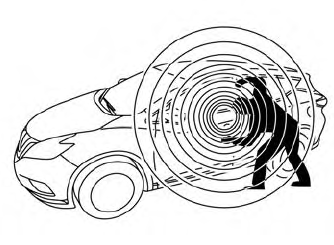
Your vehicle has two types of security systems:
Vehicle security system NISSAN Vehicle Immobilizer SystemThe vehicle security system provides visual and audible alarm signals if someone opens the doors, liftgate or the hood when the system is armed. It is not, however, a motion detection type system that activates when a vehicle is moved or when a vibration occurs.
