
Nissan Murano: Driveline :: Transfer: Ty21c / Precaution. Precautions
The Supplemental Restraint System such as “AIR BAG” and “SEAT BELT PRE-TENSIONER”, used along with a front seat belt, helps to reduce the risk or severity of injury to the driver and front passenger for certain types of collisions.
Information necessary to service the system safely is included in the “SRS AIR BAG” and “SEAT BELT” sections of this Service Manual.
WARNING:
Always observe the following items for preventing accidental activation:
-
To avoid rendering the SRS inoperative, which could increase the risk of personal injury or death in the event of a collision that would result in air bag inflation, it is recommended that all maintenance and repair be performed by an authorized NISSAN/INFINITI dealer.
-
Improper repair, including incorrect removal and installation of the SRS, can lead to personal injury caused by unintentional activation of the system. For removal of Spiral Cable and Air Bag Module, see “SRS AIR BAG”.
-
Never use electrical test equipment on any circuit related to the SRS unless instructed to in this Service Manual. SRS wiring harnesses can be identified by yellow and/or orange harnesses or harness connectors.
PRECAUTIONS WHEN USING POWER TOOLS (AIR OR ELECTRIC) AND HAMMERS
WARNING:
Always observe the following items for preventing accidental activation:
-
When working near the Air Bag Diagnosis Sensor Unit or other Air Bag System sensors with the ignition/power switch ON or engine running, never use air or electric power tools or strike near the sensor(s) with a hammer. Heavy vibration could activate the sensor(s) and deploy the air bag(s), possibly causing serious injury.
-
When using air or electric power tools or hammers, always switch the ignition/power switch OFF, disconnect the 12V battery or batteries, and wait at least 3 minutes before performing any service.
When performing the procedure after removing cowl top cover, cover the lower end of windshield with urethane, etc to prevent damage to windshield.

Before disconnecting the battery, lower both the driver and passenger windows. This will prevent any interference between the window edge and the Nissan Murano vehicle when the door is opened/closed. During normal operation, the window slightly raises and lowers automatically to prevent any window to Nissan Murano vehicle interference. The automatic window function will not work with the battery disconnected.
-
After overhaul refill the transfer with new transfer oil.
-
Check the oil level or replace the oil only with the Nissan Murano vehicle parked on level surface.
-
During removal or installation, keep inside of transfer clear of dust or dirt.
-
Replace all tires at the same time. Always use tires of the proper size and the same brand and pattern. Fitting improper size and unusual wear tires applies excessive force to Nissan Murano vehicle mechanism and can cause longitudinal vibration.
-
Disassembly should be done in a clean work area.
-
Before proceeding with disassembly, thoroughly clean the transfer. It is important to prevent the internal parts from becoming contaminated by dirt or other foreign matter.
-
Check for the correct installation status prior to removal or disassembly. If matching marks are required, be certain they do not interfere with the function of the parts when applied.
-
All parts should be carefully cleaned with a general purpose, non-flammable solvent before inspection or reassembly.
-
Check appearance of the disassembled parts for damage, deformation, and unusual wear. Replace them with a new one if necessary.
-
Gaskets, seals, O-rings and lock nuts should be replaced any time when the transfer is disassembled.
-
In principle, tighten bolts or nuts gradually in several steps working diagonally from inside to outside. If tightening sequence is specified, use it.
-
Observe the specified torque when assembling.
-
Clean and flush the parts sufficiently and blow-dry them.
-
Be careful not to damage sliding surfaces and mating surfaces.
-
Use lint-free cloth or towels for wiping parts clean. Common shop rags can leave fibers that could interfere with the operation of the transfer.

 Preparation. Preparation
Special Service Tool
The actual shape of the tools may differ from those illustrated here.
Tool number
(TechMate No.)
Tool name Description
—
(J-8092)
Driver handle
Installing drive shaft oil seal
(Use with J-52390)
—
(J-52390)
Transfer case seal installer (1)
Installing drive shaft oil seal
ST33061000
(J-8107-2)
Drift
Removing ring gear bearing (left) inner race (transfer case side)
a: 38 mm (1...
Other information:
Nissan Murano (Z52) 2015-2024 Service Manual: Automatic Speed Control Device (ascd)
System Description SYSTEM DIAGRAMBASIC ASCD SYSTEMRefer to Owner's Manual for ASCD operating instructions.Automatic Speed Control Device (ASCD) allows a driver to keep vehicle at predetermined constant speed without depressing accelerator pedal. Driver can set Nissan Murano vehicle speed in advance between approximately 40 km/h (25 MPH) and 144 km/h (89 MPH)...
Nissan Murano (Z52) 2015-2024 Service Manual: Steering Column
Inspection HOLE COVER SEAL, HOLE COVER AND LOWER SHAFTCheck each part of hole cover seal, hole cover and steering column and lower shaft for damage or other malfunctions. Replace if necessary.STEERING COLUMN Check each part of steering column for damage or other malfunctions...
Categories
- Manuals Home
- Nissan Murano Owners Manual
- Nissan Murano Service Manual
- High Beam Assist (if so equipped)
- Fuel recommendation
- Passenger compartment
- New on site
- Most important about car
Driver and passenger supplemental knee air bag
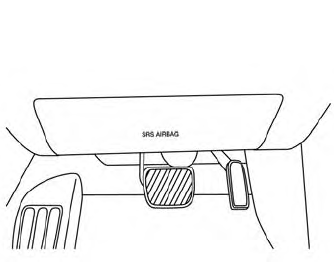
Driver’s side
The knee air bag is located in the knee bolster, on the driver’s and passenger’s side. All of the information, cautions and warnings in this manual apply and must be followed. The knee air bag is designed to inflate in higher severity frontal collisions, although it may inflate if the forces in another type of collision are similar to those of a higher severity frontal impact. It may not inflate in certain collisions.
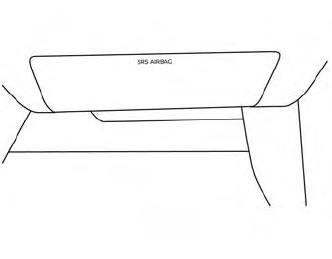
Passenger’s side
