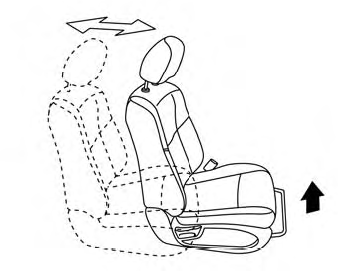
Nissan Murano: Safety—Seats, seat belts and supplemental restraint system / Head restraints/headrests
WARNING
Head restraints/headrests supplement the other vehicle safety systems. They may provide additional protection against injury in certain rear end collisions. Adjustable head restraints/headrests must be adjusted properly, as specified in this section. Check the adjustment after someone else uses the seat. Do not attach anything to the head restraint/headrest stalks or remove the head restraint/headrest. Do not use the seat if the head restraint/headrest has been removed. If the head restraint/headrest was removed, reinstall and properly adjust the head restraint/headrest before an occupant uses the seating position. Failure to follow these instructions can reduce the effectiveness of the head restraints/headrests. This may increase the risk of serious injury or death in a collision.
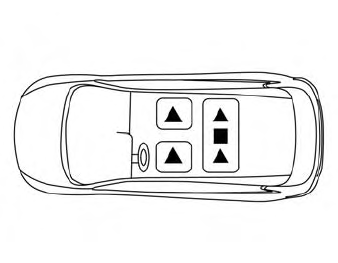
The illustration shows the seating positions equipped with head restraints/headrests.
 Indicates the seating position
is
equipped with a head restraint.
Indicates the seating position
is
equipped with a head restraint.
 Indicates the seating position
is equipped
with a headrest.
Indicates the seating position
is equipped
with a headrest.
+ Indicates the seating position is not equipped with a head restraint or headrest (if applicable).
- Your vehicle is equipped with a head restraint/headrest that may be integrated, adjustable or non-adjustable.
- Adjustable head restraints/headrests have multiple notches along the stalk(s) to lock them in a desired adjustment position.
- Proper Adjustment:
- For the adjustable type, align the head restraint/headrest so the center of your ear is approximately level with the center of the head restraint/headrest.
- If your ear position is still higher than the recommended alignment, place the head restraint/headrest at the highest position.
- If the head restraint/headrest has been removed, ensure that it is reinstalled and locked in place before riding in that designated seating position.
 Flexible seating
WARNING
Never allow anyone to ride in the
cargo area or on the rear seats when
they are in the fold-downposition. In a
collision, people riding in these areas
without proper restraints are more
likely to be seriously injured or killed...

Other information:
Nissan Murano (Z52) 2015-2024 Owners Manual: System temporarily unavailable
The following are conditions in which the ICC system may be temporarily unavailable. In these instances, the ICC system may not cancel and may not be able to maintain the selected following distance from the vehicle ahead. Condition A Under the following conditions, the ICC system is automatically canceled...
Nissan Murano (Z52) 2015-2024 Owners Manual: Turning the AEB system on/off
Perform the following steps to turn the AEB system on or off. Press the button until “Settings” displays in the vehicle information display and then press the OK button. Use the button to select “Driver Assistance.” Then press the OK button...
Categories
- Manuals Home
- Nissan Murano Owners Manual
- Nissan Murano Service Manual
- Passenger compartment
- Warning lights
- GAS STATION INFORMATION
- New on site
- Most important about car
Front manual seat adjustment (if so equipped)
Your vehicle seats can be adjusted manually. For additional information about adjusting the seats, refer to the steps outlined in this section.
Forward and backward