
Nissan Murano: Basic Inspection / Diagnosis and Repair Work Flow
OVERALL SEQUENCE
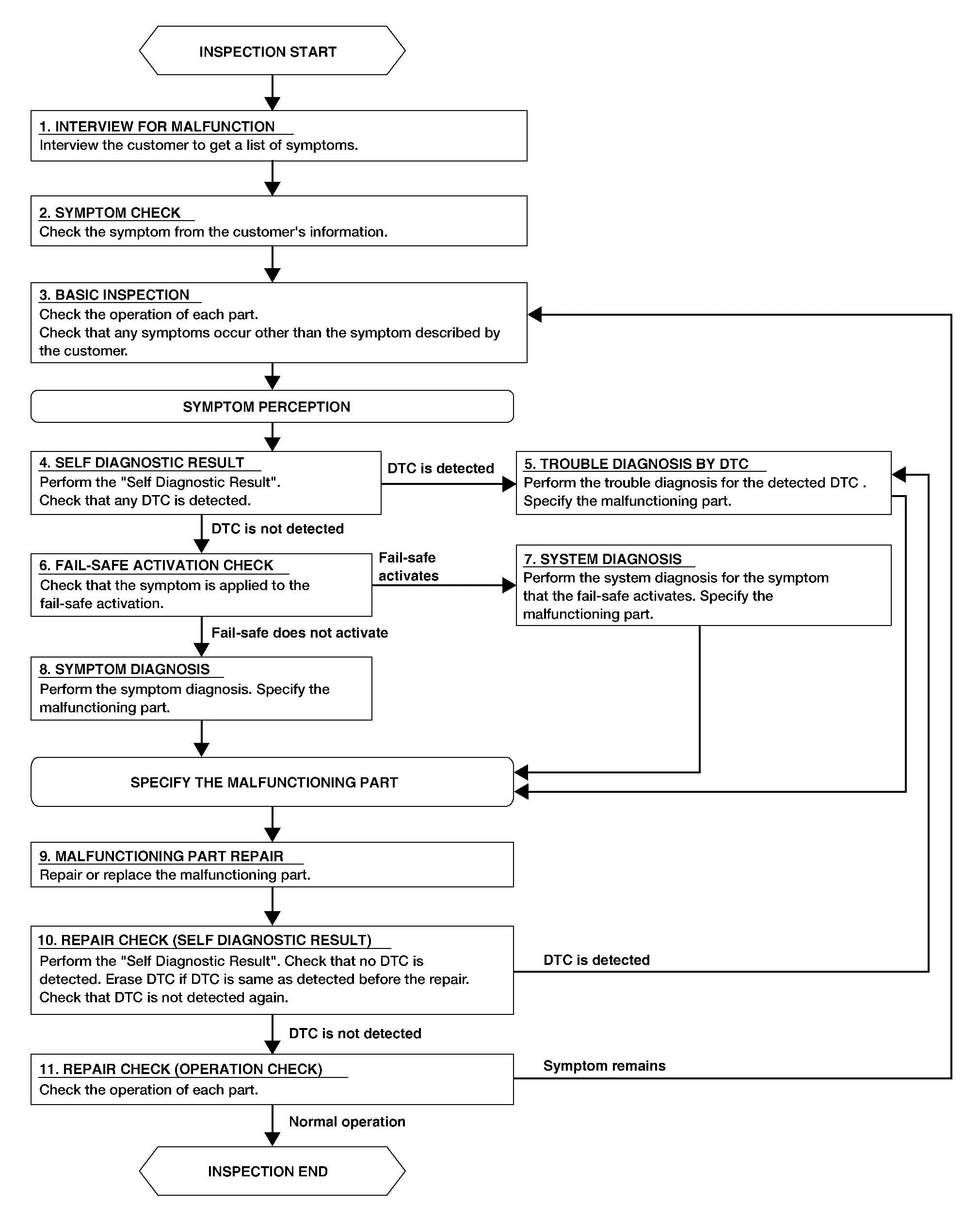
DETAILED FLOW
INTERVIEW FOR MALFUNCTION
Find out what the customer's concerns are.
>>
GO TO 2.
SYMPTOM CHECK
Verify the symptom from the customer's information.
>>
GO TO 3.
BASIC INSPECTION
Check the operation of each part. Check any concerns that occur other than those mentioned in the customer interview.
>>
GO TO 4.
SELF DIAGNOSTIC RESULT
 CONSULT
Select “Self Diagnostic Result” mode of “BCM”. Check that any DTC is detected.
Is any DTC detected?
YES>>GO TO 5.
NO>>GO TO 6.
TROUBLE DIAGNOSIS BY DTC
Perform the trouble diagnosis for the detected DTC. Specify the malfunctioning part.
>>
GO TO 9.
FAIL-SAFE ACTIVATION CHECK
Determine if the customer's concern is related to fail-safe activation.
Does the fail-safe activate?
YES>>GO TO 7.
NO>>GO TO 8.
SYSTEM DIAGNOSIS
Perform the system diagnosis for the system in which the fail-safe activates. Specify the malfunctioning part.
>>
GO TO 9.
SYMPTOM DIAGNOSIS
Perform the symptom diagnosis. Specify the malfunctioning part.
>>
GO TO 9.
MALFUNCTIONING PART REPAIR
Repair or replace the malfunctioning part.
>>
GO TO 10.
REPAIR CHECK (SELF DIAGNOSTIC RESULT)
CONSULT
Select “Self Diagnostic Result” mode of “BCM”. Verify that no DTCs are detected. Erase all DTCs detected prior to the repair. Verify that DTC is not detected again.
Is any DTC detected?
YES>>GO TO 5.
NO>>GO TO 11.
REPAIR CHECK (OPERATION CHECK)
Check the operation of each part.
Does it operate normally?
YES>>Inspection End.
NO>>GO TO 3.

 Led Headlamp Operation Inspection
Work Procedure
CHECK START
In the cool LED status (wait for more than 10 minutes after turning headlamp OFF), turn ON and turn OFF headlamp several times...
Other information:
Nissan Murano (Z52) 2015-2024 Service Manual: Water Pump
Exploded View 1. Timing chain tensioner (primary) 2. Valve timing control cover gasket (bank 1) 3. Valve timing control cover (bank 1) 4. Water pump cover 5. O-ring 6. O-ring (Identify with white mark) 7. Water pump A. Apply engine oil B...
Nissan Murano (Z52) 2015-2024 Service Manual: Use of Body Filler (putty) and Grinding
Use of Body Filler (Putty) and Grinding Panel irregularities may be corrected with a hammer and dolly. However, exact restoration of the original shape with these tools takes a long time. Body filler may be used to restore the original panel profile. For this purpose, the panel surface is finished slightly lower than the original surface...
Categories
- Manuals Home
- Nissan Murano Owners Manual
- Nissan Murano Service Manual
- Rear bench seat adjustment
- Passenger compartment
- Indicator lights
- New on site
- Most important about car
Driver and passenger supplemental knee air bag
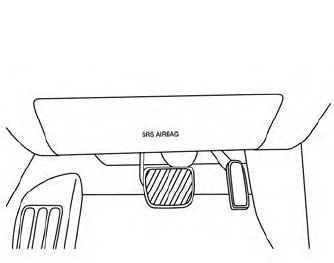
Driver’s side
The knee air bag is located in the knee bolster, on the driver’s and passenger’s side. All of the information, cautions and warnings in this manual apply and must be followed. The knee air bag is designed to inflate in higher severity frontal collisions, although it may inflate if the forces in another type of collision are similar to those of a higher severity frontal impact. It may not inflate in certain collisions.
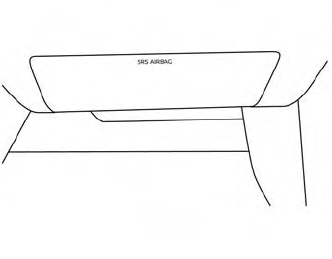
Passenger’s side
