Nissan Murano: Wheels and tires / Types of tires
WARNING
- When changing or replacing tires, be sure all four tires are of the same type (i.e., Summer, All Season or Snow) and construction. A NISSAN dealer may be able to help you with information about tire type, size, speed rating and availability.
- Replacement tires may have a lower speed rating than the factory equipped tires, and may not match the potential maximum vehicle speed. Never exceed the maximum speed rating of the tire.
- Replacing tires with those not originally specified by NISSAN could affect the proper operation of the low tire pressure warning system.
- Always use tires of the same type, size, brand, construction and tread pattern on all four wheels. Failure to do so may result in a circumference difference between tires on the front and rear axles which can cause the Vehicle Dynamic Control (VDC) system to malfunction resulting in personal injury or death, excessive tire wear and may damage the transmission, transfer case and differential gears.
- For additional information regarding tires, refer to “Important Tire Safety Information” (US) or “Tire Safety Information” (Canada) in the Warranty Information Booklet.
All-Wheel Drive (AWD) models
CAUTION
- ONLY use spare tires specified for the AWD model.
If excessive tire wear is found, it is recommended that all four tires be replaced with tires of the same size, brand, construction and tread pattern. The tire pressure and wheel alignment should also be checked and corrected as necessary. It is recommended that you visit a NISSAN dealer for this service.
All season tires
NISSAN specifies All Season tires on some models to provide good performance all year, including snowy and icy road conditions. All Season tires are identified by ALL SEASON and/or M&S on the tire sidewall. Snow tires have better snow traction than All Season tires andmaybe more appropriate in some areas.
Summer tires
NISSAN specifies summer tires on some models to provide superior performance on dry roads. Summer tire performance is substantially reduced in snow and ice.
Summer tires do not have the tire traction rating “M&S” on the tire sidewall.
If you plan to operate your vehicle in snowy or icy conditions, NISSAN recommends the use ofSNOWtires or ALL SEASON tires on all four wheels.
Snow tires
If snow tires are needed, it is necessary to select tires equivalent in size and load rating to the original equipment tires. If you do not, it can adversely affect the safety and handling of your vehicle.
Generally, snow tires have lower speed ratings than factory equipped tires and may not match the potential maximum vehicle speed. Never exceed the maximum speed rating of the tire.
If you install snow tires, they must be the same size, brand, construction and tread pattern on all four wheels.
For additional traction on icy roads, studded tires may be used. However, some U.S. states and Canadian provinces prohibit their use. Check local, state and provincial laws before installing studded tires. Skid and traction capabilities of studded snow tires on wet or dry surfaces may be poorer than that of non-studded snow tires.
 Tire labeling
Example
Federal law requires tire manufacturers
to place standardized information
on the sidewall of all tires.
This information identifies and describes
the fundamental characteristics
of the tire and also provides the
Tire Identification Number (TIN) for
safety standard certification...
 Tire chains
CAUTION
Tire chains/cables should not be installed
on 235/55R20 size tires. Installation
of the tire chains/cables on
235/55R20 size tires will cause damage
to the vehicle...
Other information:
Nissan Murano (Z52) 2015-2024 Service Manual: System. Power Distribution System
System Description SYSTEM DIAGRAMSignal transmission function list Signal name Input Output Description Push-button ignition switch signal Push-button ignition switch BCM Transmits the push-button ignition switch signal to the BCM. ACC/ON indicator lamp signal BCM Push-button ignition switch Activates/deactivates push-button ignition switch illumination using the ACC/ON indicator lamp signal...
Nissan Murano (Z52) 2015-2024 Service Manual: C1735 Ign Circuit Open
DTC Description NOTE: The Signal Tech II Tool [– (J-50190)] can be used to perform the following functions: Refer to the Signal Tech II User Guide for additional information. Activate and display TPMS sensor IDs Display tire pressure reported by the TPMS sensor Read TPMS DTCs Register TPMS sensor IDs DTC DETECTION LOGIC DTC No...
Categories
- Manuals Home
- Nissan Murano Owners Manual
- Nissan Murano Service Manual
- Checking engine oil level
- Memory storage function (key-link)
- Warning lights
- New on site
- Most important about car
Driver and passenger supplemental knee air bag
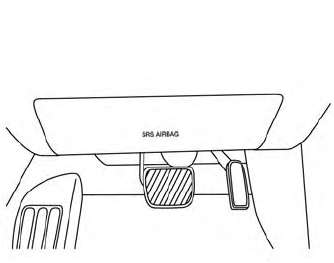
Driver’s side
The knee air bag is located in the knee bolster, on the driver’s and passenger’s side. All of the information, cautions and warnings in this manual apply and must be followed. The knee air bag is designed to inflate in higher severity frontal collisions, although it may inflate if the forces in another type of collision are similar to those of a higher severity frontal impact. It may not inflate in certain collisions.
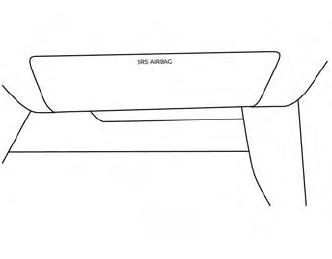
Passenger’s side
