
Nissan Murano: Dtc/circuit Diagnosis / P0125 Ect Sensor
DTC DETECTION LOGIC
-
Voltage sent to ECM from the sensor is not practical, even when some time has passed after starting the engine.
-
Engine coolant temperature is insufficient for closed loop fuel control.
| DTC |
CONSULT screen terms (Trouble diagnosis content) |
DTC detection condition | ||
| P0125 |
ECT SENSOR (Insufficient coolant temperature for closed loop fuel control) |
1 | Diagnosis condition | — |
| Signal (terminal) | Voltage signal transmitted from engine coolant temperature sensor to ECM | |||
| Threshold | Voltage sent to ECM from the sensor is not practical, even when some time has passed after starting the engine | |||
| Diagnosis delay time | — | |||
| 2 | Diagnosis condition | — | ||
| Signal (terminal) | Voltage signal transmitted from engine coolant temperature sensor to ECM | |||
| Threshold | Engine coolant temperature is insufficient for closed loop fuel control | |||
| Diagnosis delay time | — | |||
POSSIBLE CAUSE
-
Harness and connectors (High resistance in the circuit)
-
Engine coolant temperature sensor
-
Thermostat
FAIL-SAFE
Not applicable
CHECK DTC PRIORITY
If DTC P00125 is displayed with DTC P0116, P0117 or P0118, first perform the trouble diagnosis for DTC P0116, P0117 or P0118.
Is applicable DTC detected?
YES>>Perform diagnosis of applicable.
-
DTC P0116: Refer to DTC Description.
-
DTC P0117: Refer to DTC Description.
-
DTC P0118: Refer to DTC Description.
GO TO 2.
PRECONDITIONING
If DTC Confirmation Procedure has been previously conducted, always perform the following before conducting the next test.
-
Turn ignition switch OFF and wait at least 10 seconds.
-
Turn ignition switch ON.
-
Turn ignition switch OFF and wait at least 10 seconds.
>>
GO TO 3.
CHECK ENGINE COOLANT TEMPERATURE SENSOR FUNCTION
 With CONSULT
-
Turn ignition switch ON.
-
Select “DATA MONITOR” mode with CONSULT.
-
Check that “COOLANT TEMP/S” is above 10°C (50°F).
 With GST
Follow the procedure “With CONSULT” above.
Is the temperature above 10°C (50°F)?
YES>>INSPECTION END
NO>>GO TO 4.
PERFORM DTC CONFIRMATION PROCEDURE
With CONSULT
-
Start engine and run it for 65 minutes at idle speed.
If “COOLANT TEMP/S” increases to more than 10°C (50°F) within 65 minutes, stop engine because the test result will be OK.
CAUTION:
Never overheat engine.
-
Check 1st trip DTC.
With GST
Follow the procedure “With CONSULT” above.
Is 1st trip DTC detected?
YES>>Diagnosis Procedure
NO>>To check malfunction symptom before repair: Refer to Intermittent Incident.
NO>>Confirmation after repair: INSPECTION END
CHECK DTC PRIORITY
If DTC P00125 is displayed with DTC P0116, P0117 or P0118, first perform the trouble diagnosis for DTC P0116, P0117 or P0118.
Is applicable DTC detected?
YES>>Perform diagnosis of applicable.
-
DTC P0116: Refer to DTC Description.
-
DTC P0117: Refer to DTC Description.
-
DTC P0118: Refer to DTC Description.
GO TO 2.
CHECK ENGINE COOLANT TEMPERATURE SENSOR
Check engine coolant temperature sensor. Refer to Component Inspection.
Is the inspection result normal?
YES>>GO TO 3.
NO>>Replace engine coolant temperature sensor.
CHECK THERMOSTAT OPERATION
When the engine is cold [lower than 70°C (158°F)] condition, grasp lower radiator hose and confirm that the engine coolant does not flow.
Is the inspection result normal?
YES>>INSPECTION END
NO>>Repair or replace thermostat. Refer to Removal and Installation.
CHECK ENGINE COOLANT TEMPERATURE SENSOR
-
Turn ignition switch OFF.
-
Disconnect engine coolant temperature sensor harness connector.
-
Remove engine coolant temperature sensor. Refer to Exploded View.
-
Check resistance between engine coolant temperature sensor terminals as per the following.

| ECT sensor | Condition | Resistance (kΩ) | ||
|---|---|---|---|---|
| + | − | |||
| Terminal | ||||
| 1 | 2 | Temperature [°C (°F)] | 20 (68) | 2.37 - 2.63 |
| 50 (122) | 0.68 - 1.00 | |||
| 90 (194) | 0.236 - 0.260 | |||
Is the inspection result normal?
YES>>INSPECTION END
NO>>Replace engine coolant temperature sensor. Refer to Exploded View.
 P0122 Tp Sensor
DTC Description
DTC DETECTION LOGIC
An excessively low voltage from the TP sensor 2 is sent to ECM.
An excessively high voltage from the TP sensor 2 is sent to ECM...
 P0127 Iat Sensor
DTC Description
DTC DETECTION LOGICRationally incorrect voltage from the sensor is sent to ECM, compared with the voltage signal from engine coolant temperature sensor...
Other information:
Nissan Murano (Z52) 2015-2024 Service Manual: Door Hinge
Removal and Installation REMOVALRemove front door assembly. Refer to Removal and Installation. Remove front door hinge bolts (body side) and front door hinge.INSTALLATIONInstallation is in the reverse order of removal.CAUTION: Tighten nuts/bolts to specified torque...
Nissan Murano (Z52) 2015-2024 Service Manual: B2422 Back Door State
DTC Description DTC DETECTION LOGIC DTC No. CONSULT screen items (Trouble diagnosis content) DTC detecting condition B2422–78 BACK DOOR STATE (Back door state) Diagnosis condition All times Signal (terminal) Encoder LH A signal, encoder LH B signal, encoder RH A signal, encoder RH B signal (automatic back door control module connector terminal: 19, 20, 21) Threshold When the automatic back door control module detect the encoder pulse signal LH does not according with the encoder pulse signal RH Diagnosis delay time – B2422–79 BACK DOOR STATE (Back door state) Diagnosis condition All times Signal (terminal) – Threshold When automatic back door position information is deleted from automatic back door control module memory Diagnosis delay time – POSSIBLE CAUSE Improper installation of back door assembly Calibration of automatic back door position information Back door mechanism Encoder Harness or connectors (encoder circuit is open or shorted) Automatic back door control module Battery terminal is disconnected and reconnected FAIL-SAFEInhibit automatic back door system auto open/close function DTC Confirmation Procedure PERFORM DTC CONFIRMATION PROCEDURE CONSULT Ignition switch ON...
Categories
- Manuals Home
- Nissan Murano Owners Manual
- Nissan Murano Service Manual
- Intelligent Forward Collision Warning (I-FCW)
- Indicator lights
- Turning the AEB system on/off
- New on site
- Most important about car
Driver and passenger supplemental knee air bag
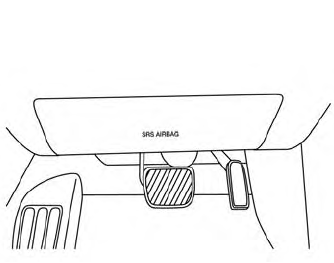
Driver’s side
The knee air bag is located in the knee bolster, on the driver’s and passenger’s side. All of the information, cautions and warnings in this manual apply and must be followed. The knee air bag is designed to inflate in higher severity frontal collisions, although it may inflate if the forces in another type of collision are similar to those of a higher severity frontal impact. It may not inflate in certain collisions.
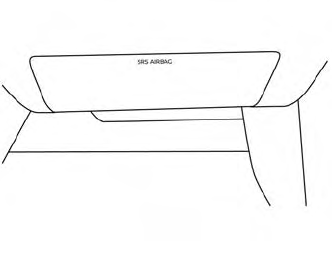
Passenger’s side
