
Nissan Murano: Engine / Fuel System :: Periodic Maintenance. Fuel System
Inspect fuel lines, fuel filler cap, and fuel tank for improper attachment, leaks, cracks, damage, loose connections, chafing or deterioration.
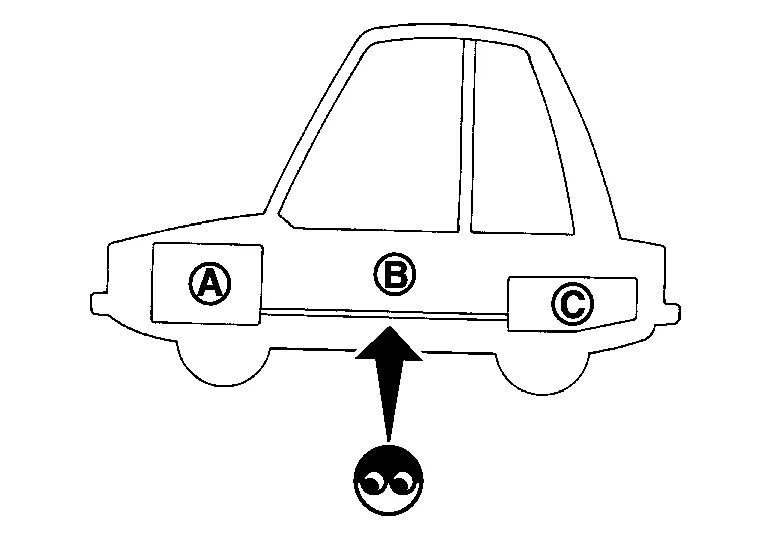
| (A) | : Engine |
| (B) | : Fuel line |
| (C) | : Fuel tank |
If necessary, repair or replace damaged parts.
CAUTION:
-
After connecting fuel tube quick connectors, check that quick connectors are secure.
-
Ensure that connector and resin tube never contact any adjacent parts.
-
Quick connector (1) can be disconnected when the tabs (F) are depressed completely. Do not twist it more than necessary.

(B) : Connection (cross-section) (D) : To under floor fuel line (E) : To fuel tank (G) : Disconnection -
Do not use any tools to disconnect quick connector.
-
Keep resin tube (C) away from heat. Be especially careful when welding near the resin tube.
-
Prevent acid liquid such as battery electrolyte, etc., from getting on resin tube.
-
Do not bend or twist resin tube during installation and disconnection.
-
Do not remove the remaining retainer (2) from hard tube (or the equivalent) (A) except when resin tube or retainer is replaced.
-
When resin tube or hard tube (or the equivalent) is replaced, also replace retainer with new one.
-
To keep the connecting portions clean and to avoid damage and foreign materials, cover them completely with plastic bags (A) or something similar.


Other information:
Nissan Murano (Z52) 2015-2024 Service Manual: B2416 Touch Sen R Open
DTC Description DTC DETECTION LOGIC DTC No. CONSULT screen items (Trouble diagnosis content) DTC detecting condition B2416–1B TOUCH SEN R OPEN (Touch sensor right open) Diagnosis condition All times Signal (terminal) Touch sensor RH signal (automatic back door control module connector terminal: 4) Threshold When one of the following conditions is satisfied Touch sensor RH circuit is open Disconnect touch sensor RH connector Diagnosis delay time – B2416–1E TOUCH SEN R OPEN (Touch sensor right open) Diagnosis condition All times Signal (terminal) Touch sensor RH signal (automatic back door control module connector terminal: 4) Threshold When one of the following conditions is satisfied Touch sensor RH circuit is open Disconnect touch sensor RH connector Diagnosis delay time – POSSIBLE CAUSE Improper installation of touch sensor Touch sensor RH Harness or connectors (touch sensor circuit is open) Automatic back door control module FAIL-SAFEInhibit automatic back door system auto open/close function DTC Confirmation Procedure PERFORM DTC CONFIRMATION PROCEDURE CONSULT Ignition switch ON...
Nissan Murano (Z52) 2015-2024 Owners Manual: Cleaning exterior
In order to maintain the appearance of your vehicle, it is important to take proper care of it. To protect the paint surfaces, wash your vehicle as soon as you can: After a rainfall to prevent possible damage from acid rain. After driving on coastal roads...
Categories
- Manuals Home
- Nissan Murano Owners Manual
- Nissan Murano Service Manual
- Jacking up vehicle and removing the damaged tire
- Power Steering Fluid (PSF)
- System malfunction
- New on site
- Most important about car
Vehicle security system
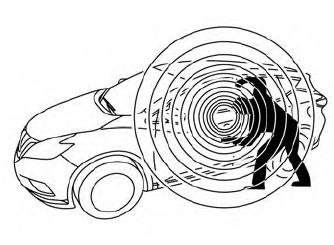
Your vehicle has two types of security systems:
Vehicle security system NISSAN Vehicle Immobilizer SystemThe vehicle security system provides visual and audible alarm signals if someone opens the doors, liftgate or the hood when the system is armed. It is not, however, a motion detection type system that activates when a vehicle is moved or when a vibration occurs.
