
Nissan Murano: Basic Inspection / Diagnosis and Repair Workflow
OVERALL SEQUENCE

| *1: Include 1st trip DTC. | |||||
| *2: Include 1st trip freeze frame data. |
DETAILED FLOW
GET INFORMATION FOR SYMPTOM
-
Get the detailed information from the customer about the symptom (the condition and the environment when the incident/malfunction occurred) using the “Diagnostic Work Sheet”. (Refer to Diagnostic Work Sheet.)
-
Ask if the customer requests I/M examination.
Malfunction information, obtained>>
GO TO 2.
NO>>GO TO 13.
CHECK DTC
 With CONSULT
-
Check DTC of “All DTC Reading”.
-
Perform the following procedure if DTC is displayed.
-
Record DTC and freeze frame data. (Print them out with CONSULT or GST.)
-
Erase only DTC of “ENGINE”. Refer to “How to Erase DTC and 1st Trip DTC” in CONSULT Function.
-
Turn ignition switch OFF.
-
Study the relationship between the cause detected by DTC and the symptom described by the customer. (Symptom Table is useful. Refer to Symptom Table.)
-
Are any symptoms described and any DTCs detected?
Symptom is described, DTC is detected>>GO TO 3.
Symptom is described, DTC is not detected>>GO TO 4.
Symptom is not described, DTC is detected>>GO TO 5.
CONFIRM THE SYMPTOM
Try to confirm the symptom described by the customer (except MIL ON).
Also study the normal operation and fail-safe related to the symptom. Refer to Description and Fail-safe.
Diagnosis Work Sheet is useful to verify the incident.
Verify relation between the symptom and the condition when the symptom is detected.
>>
GO TO 5.
CONFIRM THE SYMPTOM
Try to confirm the symptom described by the customer.
Also study the normal operation and fail-safe related to the symptom. Refer to Description and Fail-safe.
Diagnosis Work Sheet is useful to verify the incident.
Verify relation between the symptom and the condition when the symptom is detected.
>>
GO TO 6.
PERFORM DTC CONFIRMATION PROCEDURE
Perform DTC CONFIRMATION PROCEDURE for the displayed DTC, and then make sure that DTC is detected again.
If two or more DTCs are detected, refer to DTC Inspection Priority Chart and determine trouble diagnosis order.
 NOTE:
NOTE:
-
Freeze frame data is useful if the DTC is not detected.
-
Perform Component Function Check if DTC CONFIRMATION PROCEDURE is not included on Service Manual. This simplified check procedure is an effective alternative though DTC cannot be detected during this check.
If the result of Component Function Check is NG, it is the same as the detection of DTC by DTC CONFIRMATION PROCEDURE.
Is DTC detected?
YES>>GO TO 10.
NO>>Check according to Intermittent Incident.
PERFORM BASIC INSPECTION
Perform Work Procedure.
Do you have CONSULT?
YES>>GO TO 7.
NO>>GO TO 9.
PERFORM SPEC IN DATA MONITOR MODE
With CONSULT
Make sure that “MAS AIR FLOW SENSOR (Hz), “B/FUEL SCHDL”, “A/F ALPHA-B1” and “A/F ALPHA-B2” are within the SP value using CONSULT “SPEC” in “DATA MONITOR” mode of “ENGINE”. Refer to Component Function Check.
Is the measurement value within the SP value?
YES>>GO TO 9.
NO>>GO TO 8.
DETECT MALFUNCTIONING PART BY TROUBLE DIAGNOSIS - SPECIFICATION VALUE
Detect malfunctioning part according to Diagnosis Procedure.
Is a malfunctioning part detected?
YES>>GO TO 11.
NO>>GO TO 9.
DETECT MALFUNCTIONING SYSTEM BY SYMPTOM TABLE
Detect malfunctioning system according to Symptom Table based on the confirmed symptom in step 4, and determine the trouble diagnosis order based on possible causes and symptoms.
>>
GO TO 10.
DETECT MALFUNCTIONING PART BY DIAGNOSIS PROCEDURE
Inspect according to Diagnosis Procedure of the system.
NOTE:
The Diagnosis Procedure in EC section described based on open circuit inspection. A short circuit inspection is also required for the circuit check in the Diagnosis Procedure. For details, refer to Circuit Inspection.
Is a malfunctioning part detected?
YES>>GO TO 11.
NO>>Monitor input data from related sensors or check voltage of related ECM terminals using CONSULT. Refer to Reference Value.
REPAIR OR REPLACE THE MALFUNCTIONING PART
With CONSULT
-
Repair or replace the malfunctioning part.
-
Reconnect parts or connectors disconnected during Diagnosis Procedure again after repair and replacement.
-
Check DTC. If DTC is displayed, erase it. Refer to “How to Erase DTC and 1st Trip DTC” in CONSULT Function.
>>
GO TO 12.
FINAL CHECK
With CONSULT
When DTC was detected in step 2, perform DTC CONFIRMATION PROCEDURE or Component Function Check again, and then make sure that the malfunction have been completely repaired.
When symptom was described from the customer, refer to confirmed symptom in step 3 or 4, and make sure that the symptom is not detected.
Is DTC detected and does symptom remain?
YES>>DTC is detected: GO TO 10.
YES>>Symptom remains: GO TO 6.
NO>>No request for I/M examination from the customer: Before returning the Nissan Murano vehicle to the customer, always erase unnecessary DTC in ECM and TCM ( Refer to “How to Read DTC and 1st Trip DTC” in CONSULT Function.)
NO>>I/M examination, requested from the customer: GO TO 13.
PREPARE FOR I/M EXAMINATION
-
Set SRT codes. Refer to Description.
-
Erase permanent DTCs. Refer to Description.
>>
INSPECTION END.
DESCRIPTION
There are many operating conditions that lead to the malfunction of engine components. A good grasp of such conditions can make troubleshooting faster and more accurate.
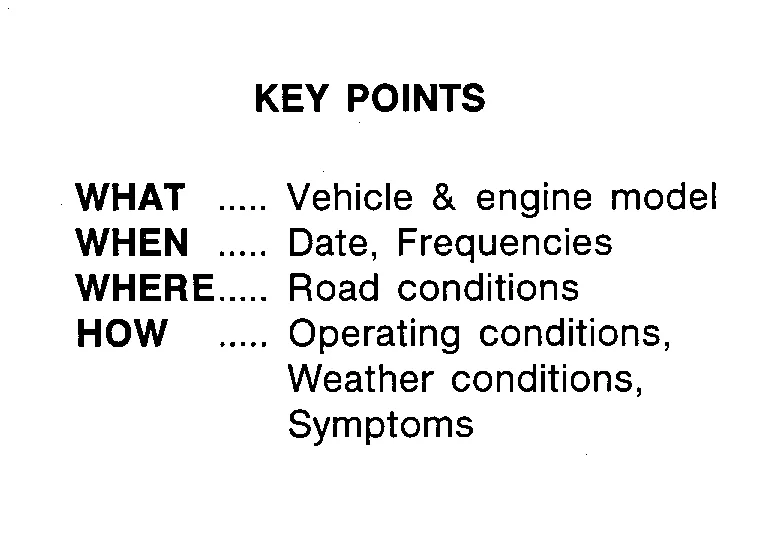
In general, each customer feels differently about symptoms. It is important to fully understand the symptoms or conditions for a customer complaint.
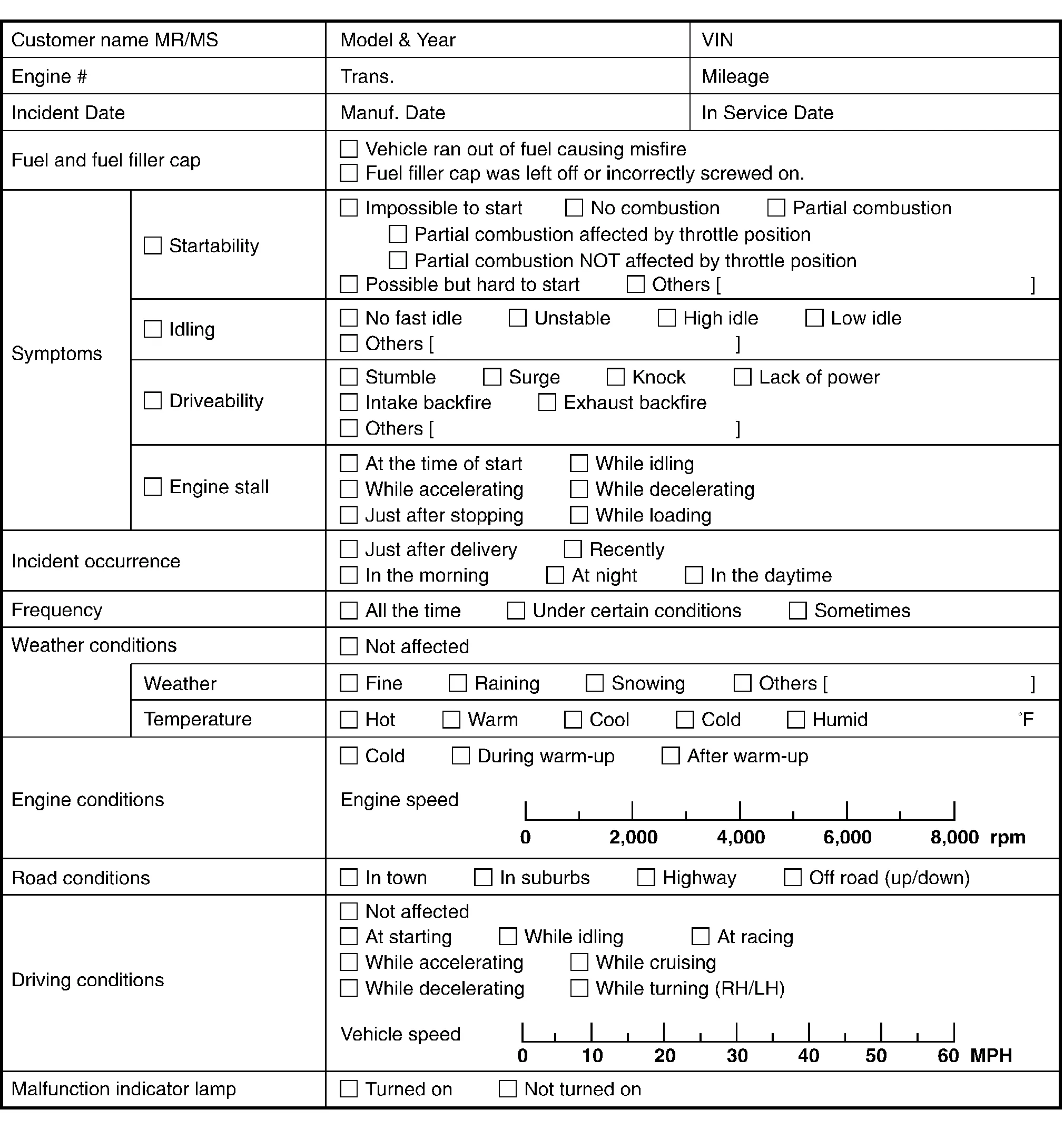
Utilize a diagnostic worksheet like the WORKSHEET SAMPLE below in order to organize all the information for troubleshooting.
Some conditions may cause the MIL to illuminate or blink, and DTC to be detected. Examples:
-
Vehicle ran out of fuel, which caused the engine to misfire.
-
Fuel filler cap was left off or incorrectly screwed on, allowing fuel to evaporate into the atmosphere.
WORKSHEET SAMPLE

 Service After Replacing or Removing Engine Parts
Description
SPECIAL REPAIR REQUIREMENT×: Applicable Part name Service performed Required service Reference
Replacement Removal*1
ECM
×
Additional service when replacing ECM
Description
×
Accelerator pedal released position learning
Description
Throttle valve closed position learning
Description
Idle air volume learning
Description
VIN registration
Description
Accelerator Pedal
×
×
Accelerator pedal released position learning
Work Procedure
Electric throttle
×
×
Throttle valve closed position learning
Work Procedure
×
Idle air volume learning
Work Procedure
Engine assembly
×
Throttle valve closed position learning*2
Work Procedure
Idle air volume learning*2
Work Procedure
×
Accelerator pedal released position learning
Work Procedure
Throttle valve closed position learning*2
Work Procedure
*1: Harness connector disconnection included...
Other information:
Nissan Murano (Z52) 2015-2024 Service Manual: Optical Sensor
Exploded View 1. Optical sensor 2. Defroster grille A. Harness connector Pawl Removal and Installation REMOVALUsing a suitable tool, release pawls and remove optical sensor (2) from defroster grille (1). : Pawl Disconnect harness connector (A) from optical sensor...
Nissan Murano (Z52) 2015-2024 Service Manual: Normal Operating Condition
Description RELATED TO NOISEThe majority of the audio concerns are the result of outside causes (bad CD, electromagnetic interference, etc.).The following noise results from variations in field strength, such as fading noise and multi-path noise, or external noise from trains and other sources...
Categories
- Manuals Home
- Nissan Murano Owners Manual
- Nissan Murano Service Manual
- System malfunction
- GAS STATION INFORMATION
- Shift lock release
- New on site
- Most important about car
Autolight system
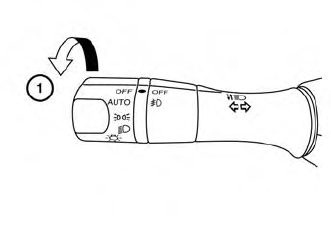
The autolight system allows the headlights to turn on and off automatically. The autolight system can:
Turn on the headlights, front parking, tail, license plate and instrument panel lights automatically when it is dark. Turn off all the lights (except daylight running lights) when it is light. Keep all the lights on for a period of time after you place the ignition switch in the OFF position and all doors are closed.