
Nissan Murano: Dtc/circuit Diagnosis / P0451 Pressure Sensor
DTC DETECTION LOGIC
An excessively low voltage from the sensor is sent to ECM.
| DTC |
CONSULT screen terms (Trouble diagnosis content) |
DTC detection condition | |
| P0451 |
EVAP SYS PRES SEN (EVAP control system pressure sensor performance) |
Diagnosis condition | Ignition switch ON |
| Signal (terminal) |
|
||
| Threshold | ECM detects a state that the pressure difference remains the threshold value or more for continuously for 5 seconds or more under the condition that the pressure of the EVAP control system pressure sensor and that of the barometric pressure sensor are equal. | ||
| Diagnosis delay time | 3 seconds or more | ||
POSSIBLE CAUSE
-
EVAP control system pressure sensor
-
ECM
(Built in barometric pressure sensor)
-
Clogging, cruching, or damage in hose or piping
FAIL-SAFE
Not applicable
DTC CONFIRMATION PROCEDURE
 NOTE:
NOTE:
Never refuel before and during the following procedure.
CHECK DTC PRIORITY
If DTC P0451 is displayed with P0452 or P0453, first perform the trouble diagnosis for DTC P0452 or P0453.
Is DTC P0452 or P0453 detected?
YES>>Perform diagnosis of applicable.
-
DTC P0452:Refer to DTC Description.
-
DTC P0453:Refer to DTC Description.
GO TO 2.
PRECONDITIONING
If DTC Confirmation Procedure has been previously conducted, always perform the following procedure before conducting the next test.
-
Turn ignition switch OFF and wait at least 10 seconds.
-
Turn ignition switch ON.
-
Turn ignition switch OFF and wait at least 10 seconds.
>>
GO TO 3.
PERFORM DTC CONFIRMATION PROCEDURE
-
Turn ignition switch ON.
-
Check 1st trip DTC.
Is 1st trip DTC detected?
YES>>Proceed to Diagnosis Procedure.
NO>>To check malfunction symptom before repair: Refer to Intermittent Incident.
NO>>Confirmation after repair: INSPECTION END
CHECK HOSE AND PIPING
-
Turn ignition switch OFF.
-
Check the following.
-
Blockage, crush, or damage in the hose and piping of EVAP purge line between fuel tank and intake manifold.
-
Blockage, crush, or damage in the hose and the piping of intake air passage between inlet air duct and intake manifold.
Is the inspection result normal?
YES>>GO TO 2.
NO>>Repair or replace error-detected parts.
CHECK EVAP CONTROL SYSTEM PRESSURE SENSOR
Check EVAP control system pressure sensor. Refer to Component Inspection.
Is the inspection result normal?
YES>>Check intermittent incident. Refer to Intermittent Incident.
NO>>Replace EVAP control system pressure sensor. Refer to Removal and Installation.
CHECK EVAP CONTROL SYSTEM PRESSURE SENSOR
-
Turn ignition switch OFF.
-
Remove EVAP control system pressure sensor with its harness connector. Refer to Removal and Installation.
Always replace O-ring with a new one.
-
Install a vacuum pump to EVAP control system pressure sensor.
-
Turn ignition switch ON and check output voltage between ECM terminals under the following conditions.
ECM Applied vacuum kPa
(bar, kg/cm2, psi)Voltage Connector + – Terminal Terminal E32 121 148 Not applied 1.8 - 4.8 V -26.7 (-0.267, -0.272, -3.87) 2.1 to 2.5 V lower than above value CAUTION:
-
Always calibrate the vacuum pump gauge when using it.
-
Never apply below −93.3 kPa (−0.933 bar, −0.952 kg/cm2, −13.53 psi) or pressure over 101.3 kPa (1.013 bar, 1.033 kg/cm2, 14.69 psi).
-
Is the inspection result normal?
YES>>INSPECTION END
NO>>Replace EVAP control system pressure sensor. Refer to Removal and Installation.
 P0448 Evap Canister Vent Control Valve
DTC Description
DTC DETECTION LOGICEVAP canister vent control valve remains closed under specified driving conditions. DTC
CONSULT screen terms
(Trouble diagnosis content)
DTC detection condition
P0448
VENT CONTROL VALVE
(Evaporative emission system vent control circuit shorted)
Diagnosis condition
—
Signal (terminal)
—
Threshold
EVAP canister vent control valve remains closed under specified driving conditions
Diagnosis delay time
—
POSSIBLE CAUSE
EVAP canister vent control valve
EVAP control system pressure sensor and the circuit
Blocked rubber tube to EVAP canister vent control valve
EVAP canister is saturated with water
FAIL-SAFENot applicable
DTC Confirmation Procedure
PRECONDITIONING
If DTC Confirmation Procedure has been previously conducted, always perform the following before conducting the next test...
 P0452 Evap Control System Pressure Sensor
DTC Description
DTC DETECTION LOGICAn excessively low voltage from the sensor is sent to ECM. DTC
CONSULT screen terms
(Trouble diagnosis content)
DTC detection condition
P0452
EVAP SYS PRES SEN
(Evaporative emission system pressure sensor/switch low)
Diagnosis condition
—
Signal (terminal)
Voltage signal transmitted from EVAP control system pressure sensor to ECM
Threshold
An excessively low voltage from the sensor is sent to ECM
Diagnosis delay time
—
POSSIBLE CAUSE
Harness or connectors
(EVAP control system pressure sensor circuit is open or shorted...
Other information:
Nissan Murano (Z52) 2015-2024 Service Manual: B2630 Sunload Sensor
DTC Description DTC DETECTION LOGIC DTC No. CONSULT screen terms (Trouble diagnosis content) DTC detection condition B2630 SUNLOAD SENSOR (SHORT) (Sunload sensor) Diagnosis condition When ignition switch is ON. Signal (terminal) - Threshold Detected calorie at sunload sensor 1395 w/m2 (1200 kcal/m2·h) or more Diagnosis delay time - POSSIBLE CAUSE Sunload sensor A/C auto amp...
Nissan Murano (Z52) 2015-2024 Service Manual: Precautions
Description Observe the following precautions to ensure safe and proper servicing. These precautions are not described in each individual section. Precaution for Supplemental Restraint System (SRS) "AIR BAG" and "SEAT BELT PRE-TENSIONER" The Supplemental Restraint System such as “AIR BAG” and “SEAT BELT PRE-TENSIONER”, used along with a front seat belt, helps to reduce the risk or severity of injury to the driver and front passenger for certain types of collisions...
Categories
- Manuals Home
- Nissan Murano Owners Manual
- Nissan Murano Service Manual
- Jacking up vehicle and removing the damaged tire
- Rear bench seat adjustment
- Shift lock release
- New on site
- Most important about car
LATCH (Lower Anchors and Tethers for CHildren) system
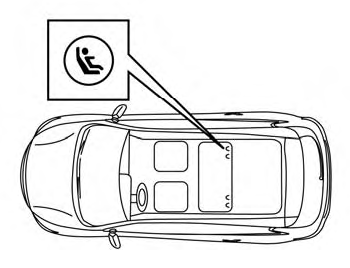
LATCH system lower anchor locations - bench seat
Your vehicle is equipped with special anchor points that are used with LATCH system compatible child restraints. This system may also be referred to as the ISOFIX or ISOFIX compatible system. With this system, you do not have to use a vehicle seat belt to secure the child restraint unless the combined weight of the child and child restraint exceeds 65 lbs. (29.5 kg). If the combined weight of the child and child restraint is greater than 65 lbs. (29.5 kg), use the vehicle’s seat belt (not the lower anchors) to install the child restraint. Be sure to follow the child restraint manufacturer’s instructions for installation.
