
Nissan Murano: Basic Inspection / Fuel Pressure
FUEL PRESSURE RELEASE
 With CONSULT
-
Turn ignition switch ON.
-
Perform “FUEL PRESSURE RELEASE” in “WORK SUPPORT” mode with CONSULT.
-
Start engine.
-
After engine stalls, crank it 2 or 3 times to release all fuel pressure.
-
Turn ignition switch OFF.
 Without CONSULT
-
Remove fuel pump fuse located in IPDM E/R.
-
Start engine.
-
After engine stalls, crank it 2 or 3 times to release all fuel pressure.
-
Turn ignition switch OFF.
-
Reinstall fuel pump fuse after servicing fuel system.
FUEL PRESSURE CHECK
CAUTION:
Before disconnecting fuel line, release fuel pressure from fuel line to eliminate danger.
 NOTE:
NOTE:
-
Prepare pans or saucers under the disconnected fuel line because the fuel may spill out. The fuel pressure cannot be completely released because this models do not have fuel return system.
-
Be careful not to scratch or get the fuel hose connection area dirty when servicing, so that the quick connector o-ring maintains seal ability.
-
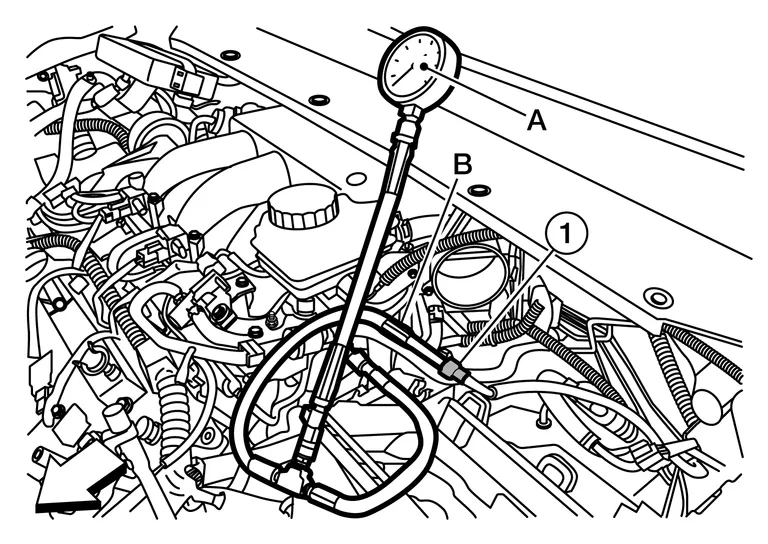
Use Fuel Pressure Gauge Kit [SST: — (J-44321)] and Fuel Pressure Adapter [SST: — (J-44321-6)] to check fuel pressure.
-
Release fuel pressure to zero.
-
Remove fuel hose using Quick Connector Release [SST: — (J-45488)].
-
Do not twist or kink fuel hose because it is plastic hose.
-
Do not remove fuel hose from quick connector.
-
Keep fuel hose connections clean.
-
-
Install Fuel Pressure Adapter [SST: — (J-44321-6)] (B) and Fuel Pressure Gauge kit [SST: — (J44321)] (A) as shown in figure.
-
Do not distort or bend fuel rail tube when installing fuel pressure gauge adapter.
-
When reconnecting fuel hose, check the original fuel hose for damage and abnormality.

: Quick connector -
-
Turn ignition switch ON (reactivate fuel pump) and check for fuel leakage.
-
Start engine and check for fuel leakage.
-
Read the indication of fuel pressure gauge kit [SST: — (J-44321)].
-
During fuel pressure check, check for fuel leakage from fuel connection every 3 minutes.
At idling : Approximately 350 kPa (3.57 kg/cm2, 51 psi)
-
-
If result is unsatisfactory, go to next step.
-
Check the following.
-
Fuel hoses and fuel tubes for clogging
-
Fuel filter for clogging
-
Fuel pump
-
Fuel pressure regulator for clogging
-
-
If OK, replace fuel pressure regulator.
If NG, repair or replace malfunctioning part.
-
Before disconnecting Fuel Pressure Gauge kit [SST: — (J-44321)] and Fuel Pressure Adapter [SST: — (J-44321-6)], release fuel pressure to zero.
 Basic Inspection
Work Procedure
INSPECTION START
Check service records for any recent repairs that may indicate a related malfunction, or a current need for scheduled maintenance...
 How to Set Srt Code
Description
OUTLINEIn order to set all SRTs, the self-diagnoses as in the “SRT ITEM” table must have been performed at least once. Each diagnosis may require actual driving for a long period of time under various conditions...
Other information:
Nissan Murano (Z52) 2015-2024 Service Manual: Transmission Assembly
Exploded View FWD Models 1. Gusset 2. Transaxle assembly 3. O-ring 4. CVT fluid charging pipe 5. Water outlet 6. CVT fluid charging pipe cap A. For the tightening torque, refer to Removal and Installation . : Apply petroleum jelly AWD Models 1...
Nissan Murano (Z52) 2015-2024 Owners Manual: Loading tips
The GVW must not exceed GVWR or GAWR as specified on the F.M.V.S.S./C.M.V.S.S. certification label. Do not load the front and rear axle to the GAWR. Doing so will exceed the GVWR. WARNING Properly secure all cargo with ropes or straps to help prevent it fromsliding or shifting...
Categories
- Manuals Home
- Nissan Murano Owners Manual
- Nissan Murano Service Manual
- Memory storage function (key-link)
- Turning the AEB system on/off
- Jacking up vehicle and removing the damaged tire
- New on site
- Most important about car
LATCH (Lower Anchors and Tethers for CHildren) system
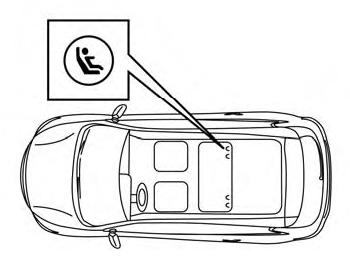
LATCH system lower anchor locations - bench seat
Your vehicle is equipped with special anchor points that are used with LATCH system compatible child restraints. This system may also be referred to as the ISOFIX or ISOFIX compatible system. With this system, you do not have to use a vehicle seat belt to secure the child restraint unless the combined weight of the child and child restraint exceeds 65 lbs. (29.5 kg). If the combined weight of the child and child restraint is greater than 65 lbs. (29.5 kg), use the vehicle’s seat belt (not the lower anchors) to install the child restraint. Be sure to follow the child restraint manufacturer’s instructions for installation.
